

Subscribe
to receive news by email

Poll
Will the Trump Administration Shift U.S. Policy in Favor of Palestine?
- No (86%)
- Yes (14%)
 Loading ...
Copyright © 2026 Arab America
Go topIraq Qualify For First World Cup Since 1986
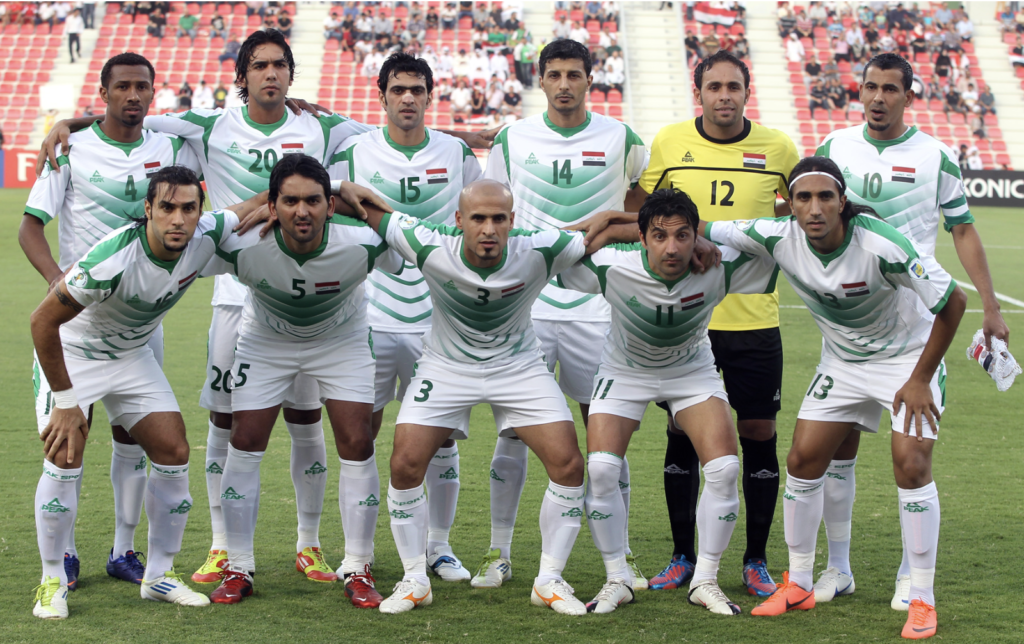

The Iraqi national football team pose ahead of their 2014 FIFA World Cup qualifying match against Oman in Doha
Photo By Doha Stadium Plus Qatar, CC BY 2.0, via Wikimedia Commons
By Jake Harris / Arab America Contributing Writer
Iraq have qualified for their first World Cup since 1986. The Iraqi National Team are Nicknamed the “Lions of Mesopotamia”. This is an ode to the nation’s history as the cradle of human civilization. Despite the long drought away from the tournament, Iraq has a history of success in Asia’s continental competitions, miraculously winning the Asian Cup in 2007 during the backdrop of the immense national strife due to the Iraq War. They have been on the precipice of World Cup qualification in recent tournaments, building towards this moment. In the 1986 World Cup, Iraq failed to win a match in the group stage. This summer, they will have the opportunity to make history as the first Iraqi National Team to win a game at a World Cup.
Iraq’s Qualifying Campaign
They were the 48th and final team to secure a spot in the 2026 World Cup. The opening rounds of Asian qualification were a breeze for them. The majority of the less talented national teams were eliminated early in the process. The third round of qualifying is where the most of the traditional powers of Asia end up competing in groups. Iraq finished third in their group behind Jordan and South Korea. This did not eliminate them but instead pushed them to a fourth round with other 3rd place finishers.
In the fourth round of qualification, Iraq finished 2nd in their group, once again pushing them to one final opportunity to qualify: the Intercontinental Playoff. While each continent is guaranteed a certain number of places at the World Cup, these continents have last gasp opportunities to add a further spot if their representative beats the representative from the other continent. Iraq would play Bolivia for the final spot in the FIFA World Cup. They won the match 2-1 in Guadalupe, Mexico, securing a historic first qualification in the most dramatic circumstances.
Match Schedule
Iraq will open the tournament with a match against Norway on June 16th, at Gillette Stadium in Foxborough, Massachusetts. This is the home of the NFL’s New England Patriots. On June 22nd, Iraq will travel to Philadelphia to play 2018 World Cup winners France. On June 26th, Iraq will play their final Group Stage game against Senegal in Toronto. Depending on how they do in these three matches, they may qualify for the knockout phase of the tournament. The knockout stage is single elimination.
Iraq will look to emulate other underdog countries. Ones who, against all odds, advanced past difficult groups and punched above their weight in the knockout stage. The best example of this is Costa Rica in 2014, they were grouped with England, Uruguay, and Italy. As a result they were predicted by the soccer media to easily finish bottom of the group. They won the group, and made it all the way to the Quarter-Finals before losing on penalty kicks to the Netherlands. Iraq are in similar circumstances, France are a top-5 team on the planet, Norway have one of the world’s best goal-scorers, and Senegal are a powerhouse on the African continent.
Fort Worth Airport Incident
Iraqi fans looking to travel to the tournament face significant travel restrictions due to the Trump Administration’s policies. An incident occurred at Dallas Fort Worth Airport involving Iraqi fans awaiting a connecting flight to Mexico prior to the Bolivia match. A man walked up to fans waving the flag, and threatened to “call ICE” on the fans. The incident raises concerns related to how the tournament will operate during a national immigration crackdown in the US.
Despite the political backdrop that permeates the World Cup, the tournament will be a historic occasion for Arab Sports. Eight qualifiers is an all-time high of Arab countries competing. Iraq and Jordan are seen as the “wild card” qualifiers, with Jordan reaching the World Cup for the first time. While West Asia, particularly the Levant and the Arab peninsula have endured significant regional instability, the tournament has the potential to bring people together and strengthen Arab unity.
Want more articles like this? Sign up for our e-newsletter!
Check out our blog here!