Subscribe
to receive news by email

Poll
Will the Trump Administration Shift U.S. Policy in Favor of Palestine?
- No (86%)
- Yes (14%)
 Loading ...
Copyright © 2026 Arab America
Go topThe Day I Finally Accepted My Father's Death
Understanding the Man Behind the Coffin
By: Adel Korkor / Arab America Contributing Writer
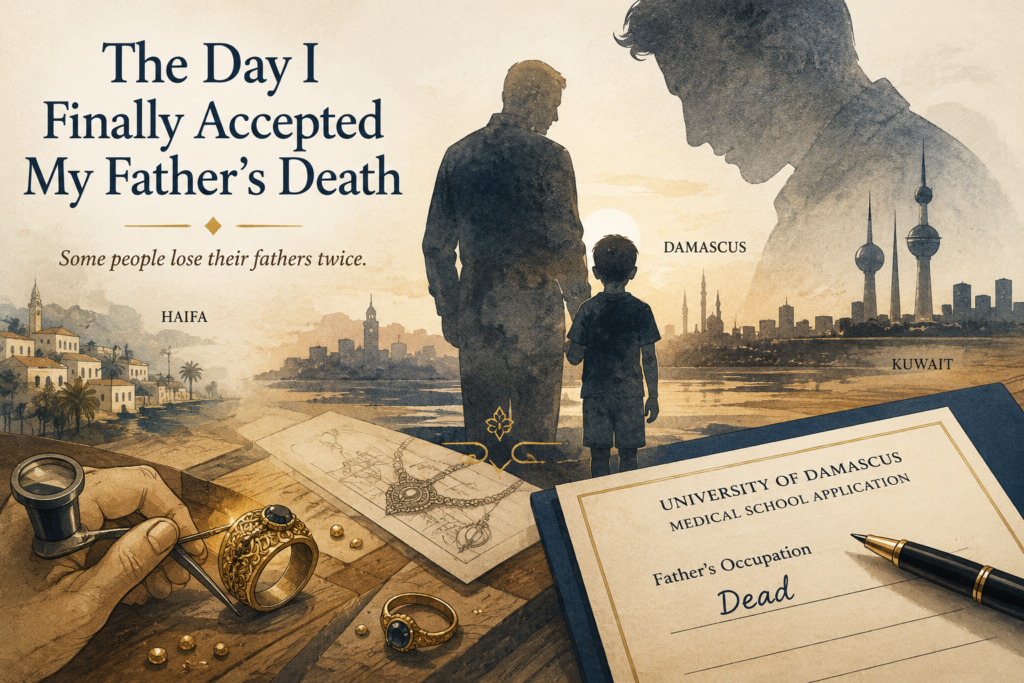
Some people lose their fathers twice. The first time is when death takes them. The second is when they finally realize they will never come back.
For me, the second loss came five years after the first.
I was filling out the application for admission to the University of Damascus Medical School. Like thousands of students before me, I carefully completed each line until I reached a simple question:
Father’s Occupation. I stopped writing. For a moment, I considered writing what had always defined him. Jeweler. Master craftsman. Designer. Artist.
But that was no longer true.
Instead, I wrote a single word that changed everything. Dead.
I stared at the page, and for the first time since I had walked behind his coffin five years earlier, I cried.
Until that moment, some part of the little boy inside me still believed he would come home.
My father was born in Damascus, Syria, but spent much of his youth in Haifa, Palestine. It was there that he learned the art that would define his life. He was a jeweler. He learned it from his father.
Not simply someone who sold jewelry, but someone who imagined, designed, and brought it to life with his own hands. Gold and precious stones were his language. Beauty was his profession.
He possessed remarkable artistic talent, and later in life he traveled to Italy to visit some of the country’s finest jewelry designers, eager to learn from the masters while refining his own extraordinary abilities.
Long before I understood entrepreneurship, my father lived it. He believed in dreams. Sometimes too much.
Israel’s creation in 1948 changed everything. Like countless Arab families, ours became part of a generation forced to leave behind homes, livelihoods, memories, and security. My father lost much of his wealth. He lost the life he had built. He lost the future he had imagined.
Starting over is never easy.
Starting over after losing almost everything is something only those who have experienced it can truly understand.
He eventually settled with my mother in Damascus, Syria.
About a year before I was born in 1950, he took my mother and their three children on an adventure in Latakia, Syria. It is where He attempted to build a carbonated beverage company.
Looking back, I suspect that business represented more than an investment. It represented hope. A new beginning. A chance to prove to himself that he could rebuild everything taken away. But it failed.
My mother understood something that my father could not yet see. She knew where his true gift lay.
She encouraged him to return to jewelry, not because it was familiar, but because it was who he was.
Sometimes the people who love us see our calling more clearly than we do. She was right.
Once he returned to jewelry, he flourished. His talent found an audience. His artistry found its purpose.
Eventually, he established a successful jewelry business in Kuwait with an Armenian partner and began rebuilding the life he had lost.
Every summer, he came home. Those visits became the highlight of my childhood. I measured my years not by school terms but by my father’s arrival.
He would return with stories, gifts, chocolate, candies, and the unmistakable presence that only a father can bring to a home.
Then, at summer’s end, he would leave again to continue building our future. As a child, I accepted that rhythm. I always knew he would come back.
Until the summer of 1963…
…he didn’t.
Instead of my father stepping off the airplane, my mother and my brother-in-law returned carrying him in a metal coffin packed in ice. He died suddenly in Kuwait. He was only in his mid-forties.
As a physician today, I recognize the many possibilities that existed. But as a little boy, I did not care about medical explanations. I simply waited.
Children have an extraordinary capacity to deny permanent loss. Every knock on the door. Every unexpected visitor. Every passing season.
Part of me believed he would somehow return. That belief lasted for years.
Looking back now, I understand my father differently than I did as a child. He was a remarkably strong man. But he was also vulnerable.
He possessed enormous talent, yet often seemed unaware of just how gifted he truly was. He was charming, creative, and ambitious.
Yet underneath that confidence lived insecurity, anger, and frustration. I think many entrepreneurs understand that contradiction.
The world sees confidence. Only they know the uncertainty that lies beneath it.
He dreamed big. Sometimes he chased the wrong dream. Sometimes he doubted himself. Sometimes he ignored the gifts that had always been there. In that way, he was wonderfully human.
My father also fought another battle. He had insulin-dependent diabetes. Unfortunately, he belonged to a generation that often viewed illness differently. Rather than accepting it, he seemed determined to deny it. Perhaps denial made him feel stronger. Perhaps acknowledging it made him feel vulnerable. Whatever the reason, he did not manage his disease as we would today.
As a physician, I cannot help but wonder whether better treatment or better acceptance might have changed the outcome.
Perhaps it would have. Perhaps not. Medicine teaches us probabilities. Life reminds us of uncertainty.
For many years after becoming a physician myself, I often thought about him. I wondered what advice he would have given me. Whether he would have been proud. Whether he would have enjoyed watching his grandchildren grow. Whether we would have become friends as well as father and son. Those are conversations death never allows.
Time has softened many memories. What remains is not the image of the coffin. It is the image of the man.
A craftsman holding delicate gold between his fingers.
A refugee rebuilding a life from almost nothing.
A husband who trusted his wife’s wisdom.
A father who sacrificed months away from his children so they might have opportunities he never had.
A dreamer.
An artist.
A flawed man.
A courageous man.
My father taught me that talent alone is never enough. Dreams must be matched by perseverance. Failure is not the opposite of success.
Sometimes the road leads us back to where we were always meant to be. My mother helped him find that road.
He, in turn, helped create the life that eventually made mine possible.
Today, when I think about my father, I no longer think first about the tragedy of losing him.
I think about the extraordinary resilience that defined his life.
He lost a homeland.
He lost a fortune.
He started over.
He failed.
He started over again.
And through talent, determination, and courage, he rebuilt.
That may be his greatest legacy.
The little boy who waited for his father to come home eventually became a physician, an entrepreneur, a husband, a father, and now a grandfather.
Only with the passing of time have I realized that so much of who I became began with the man whose occupation I once had to replace with a single heartbreaking word. The form asked for my father’s occupation.
Today, if it asked me again, I would answer differently.
I would write:
Artist. Dreamer. Survivor. Father.
Adel B. Korkor, M.D., is a Syrian (Latakia)-born American physician, entrepreneur, inventor, and philanthropist. A U.S. citizen since 1983, he founded the Adel B. Korkor Foundation in 2017 to support individuals living with mental illness. Dr. Korkor is a former chairman of the board of the Arab America Foundation and remains actively engaged in the Arab American community.
Want more articles like this? Sign up for our e-newsletter!
Check out our blog here!