
Subscribe
to receive news by email

Poll
Will the Trump Administration Shift U.S. Policy in Favor of Palestine?
- No (87%)
- Yes (13%)
 Loading ...
Copyright © 2026 Arab America
Go topThe Hidden Pioneers of the Medieval Arab World
By: Fayzeh Abou Ardat / Arab America Contributing Writer
The Middle Ages have frequently been depicted throughout history as a period when women were restricted to household duties. However, women actively participated in intellectual, cultural, and political life in the medieval Arab world between the eighth and fifteenth centuries. Many women overcame social barriers to become philosophers, poets, doctors, patrons, and leaders. All who contributing to the development of Islamic civilization. Their narratives dispel prejudices and demonstrate the long history of female accomplishment in Arab and Islamic culture.
Women of Knowledge: Scholars, Poets, and Teachers
Islamic civilization placed a high importance on education, and women were encouraged to pursue knowledge, particularly in the fields of literature, theology, and law. Fatima al-Fihri (d. 880 CE), who established the University of al-Qarawiyyin in Fez, Morocco. In 859 CE, she was one of the most notable individuals. Her school is still the oldest continuously running university in the world. It is also a model for higher education in both the Islamic and Western cultures.
Lubna of Córdoba (10th century), a secretary and librarian in the court of Caliph al-Hakam II in al-Andalus (Islamic Spain), is another example. She managed the enormous royal library of Córdoba, one of the biggest in the medieval world, and was a talented mathematician and calligrapher. Lubna’s administrative power and intellectual prowess demonstrate the respect that educated women may earn in high society.
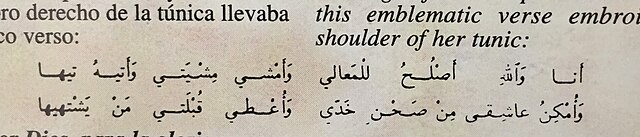
Poet and Córdoba princess Wallada bint al-Mustakfi (1001–1091) exploited her riches and position to organize literary salons that drew the brightest minds of her day. Her poems conveyed wit and independence; one of her well-known phrases is as follows:
“I am, by God, fit for high positions,
and go my way with pride.”
Sutayta al-Mahmali (10th century) was a master of mathematics and law in Baghdad. Male intellectuals praised her proficiency in inheritance law and arithmetic. Sufi mystic of Basra, Rabi‘a al-Adawiyya (717–801), had a significant impact on Islamic spirituality through her belief in divine love and devotion. She is still regarded as one of Islam’s first and most renowned female mystics.
These ladies demonstrated that female education was not an anomaly but rather a cherished aspect of medieval Arab civilization by being a member of a wide intellectual network that extended throughout the Islamic world.
Power and Patronage: Women in Politics and Public Life
A number of Arab women throughout the Middle Ages exercised civic and political influence in addition to their scholarly interests. Shajarat al-Durr (d. 1257), who ruled Egypt following the death of her husband, Sultan as-Salih Ayyub, was one of the most well-known. After capturing King Louis IX of France, she negotiated with the Crusaders and effectively led the realm during the Seventh Crusade. Despite her brief rule, she demonstrated her diplomatic and strategic acumen by leading amid a crisis.
Arwa al-Sulayhi (1048–1138) was queen of Yemen for more than forty years. She oversaw intricate political alliances, and spoke directly with the Fatimid caliphs in Cairo. Arwa also made investments in public facilities, including schools, roads, and mosques. She was dubbed “al-Sayyida al-Hurra” (the noble free lady) for her administration, which was marked by justice, religious commitment, and efficient management.
Through philanthropy and patronage, women also influenced society. To finance schools, hospitals, and mosques, wealthy women created waqf, or charitable endowments. For example, Caliph Harun al-Rashid’s wife, Zubayda bint Ja’far (d. 831 CE), funded the Zubayda Trail, a significant technical achievement that brought fresh water to Mecca. Her services demonstrated female leadership in public welfare and made the Hajj easier for many pilgrims.
Even in situations where formal authority was restricted, these women’s efforts demonstrate how Arab women could have an impact on economics, architecture, and governance. The places, organizations, and customs they contributed to the development of still bear witness to their legacy.
Legacy and Influence: Remembering Forgotten Voices
Although the names of many Arab women from the Middle Ages have disappeared from popular culture, their influence may still be seen in literature, education, and spirituality. Zaynab al-Mariyya and Hafsa bint al-Hajj al-Rukuniyya were well-known poets in Andalusia whose works addressed themes of independence, love, and knowledge. Their writings offer a unique perspective on the inner lives and intellectual agency of women in medieval Spain.
Women like Maryam al-Ijliya al-Astrulabi (10th century, Aleppo) made significant contributions to scientific and medical advancements. Maryam worked for the Hamdanid court and was a skilled manufacturer of astrolabes. Which are complex astronomical devices used for navigation and calculating prayer times. Her artistry served as a symbol of the proactive contribution women made to the advancement of science.
These women had a significant impact even after they passed away. The Islamic world’s educational and political systems were shaped in part by their intellectual and cultural contributions. Additionally, they cleared the path for following generations of women who resurrected their spirit of scholarship and leadership, from the Ottoman Empire’s professors to the 19th-century reformers and writers.
These women’s accomplishments are being rediscovered by historians and scholars today. Serving as a reminder that civilizational advancement has always been a collaborative effort. Arab women in the Middle Ages were active contributors, scholars, poets, benefactors, and monarchs. Their voices still motivate aspirations for equality and acknowledgment today.
Want more articles like this? Sign up for our e-newsletter!
Check our blog here!