
Subscribe
to receive news by email

Poll
Will the Trump Administration Shift U.S. Policy in Favor of Palestine?
- No (87%)
- Yes (13%)
 Loading ...
Copyright © 2026 Arab America
Go topTrump’s Board of Peace Unveils Gaza Plan at Davos
By Jake Harris / Arab America Contributing Writer
The Trump administration’s blueprint for reconstructing Gaza has been dubbed “The Board of Peace”. The plan was unveiled by Trump’s son in law Jared Kushner at the World Economic Forum in Davos, Switzerland. It included a concept image depicting a rebuilt Gaza as a futuristic city. An image that almost resembles some of the largest cities in the gulf states.
The ‘Board of Peace’
Trump has designated himself as chairman of the board for life, with devolved powers in lesser roles. The board is not only dubbed as a representative for the future governance of Gaza, but as a rival supranational organization to the United Nations itself. The UN Security Council endorsed the creation of the board in the context of Gaza, but the organization has expanded their plans to be a vessel for resolving conflict worldwide. A culmination of President Trump’s actions showing skepticism to long standing international organizations. Organizations that the President has dubbed as “globalist”
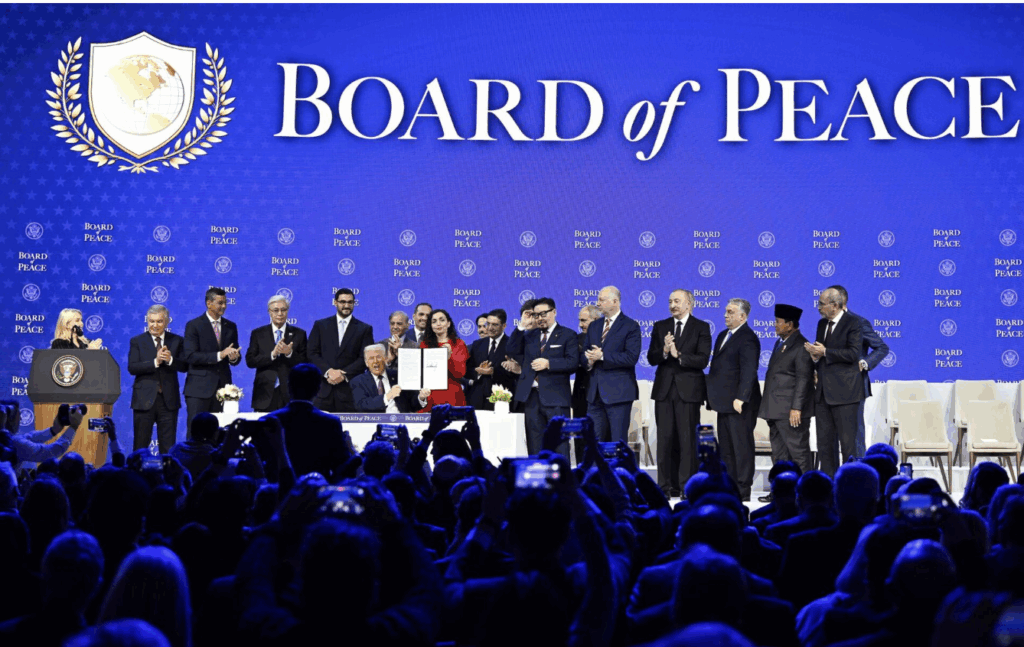
Subsequently, world leaders have been invited to join this board. Notable US Allies such as Mark Carney of Canada, Keir Starmer of the UK, and Emmanuel Macron of France have declined the invitation for membership. This illustrates the background of tension between the President and NATO allies. Russian President Vladimir Putin was invited to join the plan, but nothing is finalized. Benjamin Netanyahu is reported to be joining the board despite not being at the signing ceremony at Davos.
Organizational Structure
The executive board for Gaza’s administration includes a wide range of political and apolitical figures. Secretary of State Marco Rubio, joined with Steve Witkoff and Jared Kushner as members of Trump’s inner circle. Former British Prime Minister Tony Blair will also be on the executive board. Blair remains a controversial figure in Britain going back to his involvement in the unpopular Iraq War.
The structure of the Board of Peace is very concentrated in nature. President Trump has the power to issue unilateral resolutions. He can appoint and dismiss any board members at his will. The highest level of hierarchy in which Palestinians themselves will be able to participate is in the “national committee for the administration of Gaza”. This is a level of authority below the Gaza Executive Board, and the General Executive Board. The committee lacks significant political authority and is mostly confined to relief efforts and civil issues.
Gaza Government Plan
Furthermore, there is a notable lack of detail regarding the fate of the Palestinian people themselves. Historical landmarks in Gaza’s “old city” are set to be under the industrial zone of the city, with the city being split into blocs designated for industry, tourism, and residential areas. Future dreams of true Palestinian self-governance will likely need to gain the approval of the Israelis, who are likely to hold significant influence within the board of peace when Netanyahu signs on.
Photo by President.az, CC BY 4.0, via Wikimedia Commons
Considering the levels of destruction in Gaza, it’s hard to imagine the full vision of this plan coming to fruition in the near future. While all the Israeli hostages have now been recovered, questions remain over the future of Hamas. The timetable of the Board of Peace’s plan relies heavily on Hamas disarmament happening peacefully. The lack of a peaceful disarmament could theoretically lead to Israel sending the military back in. Following the recovery of the remains of the final hostage, the Rafah crossing is due to be reopened by Israel, a move that indicates a positive development towards reopening the flow of goods into Gaza. The extent to which this border will be free-flowing is yet to be seen.
Nations Involved
The fate of the West Bank remains a separate dilemma. It is not out of the realm of possibility that the representatives in the Board of Peace from other Arab nations will use their influence on the Board to advocate for less Israeli incursion into the area. The Arab Nations that have signed the charter are: Bahrain, Jordan, Morocco, Saudi Arabia, and the UAE. Non-Arab Nations in the Islamic World include: Azerbaijan, Indonesia, Kazakhstan, Pakistan, Turkey, and Uzbekistan. Egypt is likely to sign on but is yet to officially sign the charter.
Want more articles like this? Sign up for our e-newsletter!
Check our blog here!