

Subscribe
to receive news by email

Poll
Will the Trump Administration Shift U.S. Policy in Favor of Palestine?
- No (87%)
- Yes (13%)
 Loading ...
Copyright © 2026 Arab America
Go topUnderstanding U.S. Military Presence in the Arab World
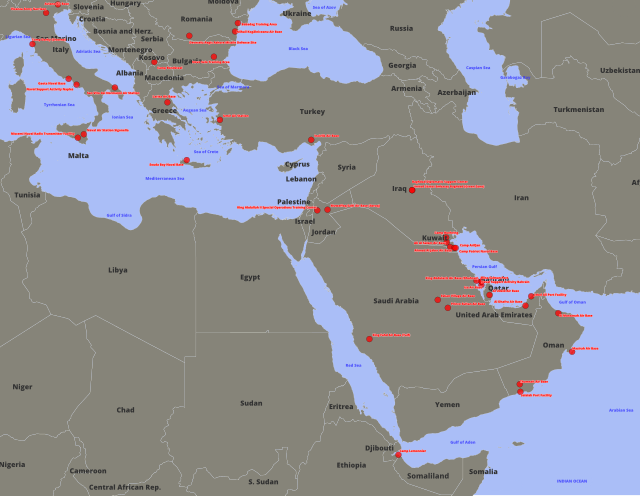
By Ben Samuels/Arab America Contributing Writer
It’s no secret that the United States has maintained a strong physical presence in the Arab world through numerous military bases in nations such as Qatar, Bahrain, Kuwait, Saudi Arabia, and more. This is not an entirely new development as the U.S has had bases in Saudi Arabia since 1945, which started with the Dhahran airfield. Since then, the Cold War saw significant development due to the U.S attempting to stop soviet influence in the Gulf states, as well as post 9/11 reforms, which sparked more bases all over the Arab world in the name of “The War on Terror”. According to the Council on Foreign Relations, the U.S. currently maintains around 19 bases in the region. The reasons for these bases are heavily debated; a few of the main concepts, however, are related to protecting energy and trade routes, deterrence, and providing military support to allies.
Protection of Trade Routes
Nations in the Arab world are home to some of the world’s largest oil reserves, creating a strong export market for oil and key transport hubs for its shipment. For example, the Strait of Hormuz is one of the most important passageways, as around 20% of the world’s oil supply passes through it, and U.S. bases, such as those in Bahrain, help monitor activity and respond quickly in the area if needed. If there is a disruption in the Strait of Hormuz, there could be significant threats to the oil market, including oil prices and global trade in oil products. U.S. Navy forces, in coordination with Bahrain, help ensure regular shipping patterns and overall movement through one of the world’s most important passageways. In addition, the Suez Canal has major implications, as it connects the Mediterranean Sea to the Red Sea and is significant for Europe-Asia trade. Reportedly, around 12% of global trade goods pass through the Suez Canal, underscoring the canal’s importance to its operations. The U.S. was also granted priority passage by the Egyptian government to create a smoother path for the U.S. in the event of a regional crisis. Overall, one of the key functions of U.S. bases in the region is to help monitor and respond to threats that could disrupt the maritime routes essential to global trade.
Deterrence and Regional Allies
Another key reason for U.S. bases in the Arab world is deterrence against enemies and the protection of regional allies. Some Gulf states, such as Saudi Arabia, host U.S. bases under tight security pacts and agreements between the nations. Both the U.S and Saudi Arabia have had conflicts with Iran, and the bases allow for quick retaliation against any type of Iranian aggression, as well as acting as a deterrent for attacks on the Gulf states. In addition, the bases in Kuwait and Qatar are key to acting quickly against Iran, as many of the current military operations are using these bases as a center point. Overall, these bases were created in part to prevent conflict before it occurs. Whether this has worked in practice is debated; however, the core concept revolves around deterrence. In addition, the bases are used to help protect regional allies such as Israel, which is often in regional conflict with Iran and others. These bases help the U.S. provide military support quickly and coordinate intelligence. The U.S also participates in training exercises for military allies in Kuwait, Saudi Arabia, and Qatar. Overall, the bases help deter enemies like Iran while also protecting and equipping allies in the region.
Conclusion
Overall, the U.S is a major player in almost all international affairs, which has helped solidify the U.S.-led international order. The physical presence allows the U.S. to maintain its global dominance and influence, as bases enable a rapid and effective response to international conflict. Through these bases, they are able to help oversee and maintain critical trade routes such as the Suez Canal and Strait of Hormuz as well as protecting allies like Israel and Saudi Arabia while deterring enemies. Bases have been apparent in the region for almost 100 years; however, conflict has further developed the bases and led to the expansion that now sees over a dozen heavily equipped bases in many different nations.
Want more articles like this? Sign up for our e-newsletter!
Check out our blog here!