

Subscribe
to receive news by email

Poll
Will the Trump Administration Shift U.S. Policy in Favor of Palestine?
- No (86%)
- Yes (14%)
 Loading ...
Copyright © 2026 Arab America
Go topWashington Wants a Deal Lebanon Cannot Make
By: Ghassan Rubeiz / Arab America Contributing Writer
Lebanon is being asked to negotiate peace with Israel under Trump administration sponsorship while the region remains on edge over the US-Israel-Iran war. Despite active diplomatic exchanges, the core issues — Iran’s nuclear program, the Strait of Hormuz, and Israel’s fundamental distrust of Tehran — remain unresolved.
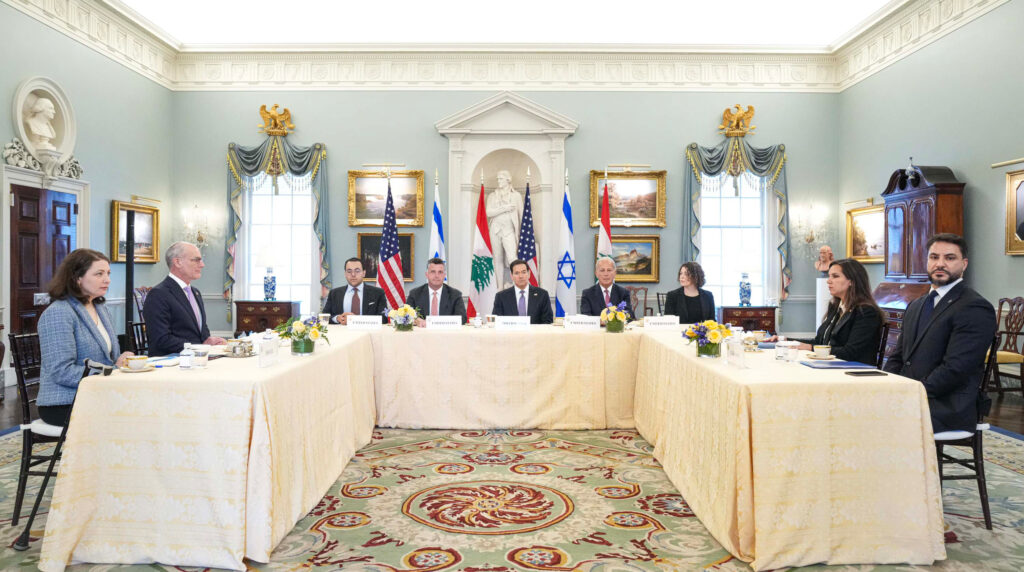
That is the uncomfortable truth behind the third round of Lebanon-Israel talks expected this week in Washington on May 14-15. The previous two rounds produced no substantive progress. This one, most likely, will not either — and Lebanon should be clear-eyed about why.
Washington is eager to show diplomatic movement in the Middle East. With tensions rising over Iran, Gaza, and the West Bank grinding on without a political horizon, Trump wants a working “peace track” he can take credit for. Lebanon — weakened, exhausted, and desperate for international support — becomes a convenient stage for that narrative.
What Lebanon actually wants is straightforward: full Israeli withdrawal from occupied Lebanese territory, credible security guarantees, and international support for reconstruction. These are not unreasonable demands. But they require a negotiating environment that does not currently exist.
Lebanon is not entirely without options. Its renewed dialogue with Syria over the past twelve months — covering border control, security coordination, refugee management, and limiting Hezbollah’s armed presence along their shared frontier — is a development Washington should not dismiss. Given Syria’s historic, demographic, and cultural connection with Lebanon, a strengthened Beirut-Damascus relationship could give Lebanon real leverage in demanding full Israeli withdrawal, open new diplomatic approaches to Hezbollah, and advance state-building in both capitals. This is a long-term track, not a substitute for the Washington process — but it may ultimately be more durable and significant than anything negotiated under present conditions.
Escalation with Iran appears increasingly likely. Trump has called the latest Iranian diplomatic proposal “totally unacceptable,” and Netanyahu says the war with Iran “is not over.” Israel continues its military campaign in Gaza. Along the Lebanese border, Israel and Hezbollah exchange fire almost daily. This is not a post-war environment in which negotiations can take root. It is an environment of active conflict — the very conditions in which diplomacy becomes theater rather than substance.
On the ground, Israel is consolidating a buffer zone behind its declared “yellow line” in south Lebanon. Villages like Kfar Kila and Khiam remain under Israeli control, their residents displaced, their homes and farmland destroyed. What is described as a temporary security measure increasingly resembles territorial entrenchment. Only Washington can pressure Israel to withdraw, and President Trump does not have the political will — or the capital — to force Netanyahu’s hand.
Even if Israel were ready for serious talks, Lebanon is not positioned to negotiate with national unity and strength. Hezbollah’s supporters remain a demographic and ideological force that cannot be ignored, and their resistance is not weakening while Israel continues to strike civilians and Lebanese infrastructure. Any government that proceeds without full national consent risks political rupture and a crisis of legitimacy. Lebanon cannot negotiate peace while one of its most powerful actors remains at war.
What can Lebanon realistically do in Washington? Use the meeting not to pretend peace is within reach, but to expose the gap between rhetoric and reality. Lebanon should ask Israel directly: Will you fully withdraw from occupied Lebanese territory in exchange for normalized relations? Is the yellow line in South Lebanon a temporary security boundary or a permanent border? And Lebanon should ask Washington: Are you prepared to guarantee Lebanese security and recognize Palestinian rights with the same seriousness you extend to Israel? If the United States wants Lebanon to take great political risks, it must offer matching political guarantees. Anything less is a photo opportunity.
For Arab Americans, these questions carry personal weight. Many of us have family in Lebanon and the Palestinian territories — we carry the memory of war, displacement, and paralysis. We understand the frustration with Hezbollah’s armed presence in a country exhausted by conflict. But Iran remains a central actor in Lebanese politics, and Tehran’s influence runs directly through Hezbollah’s weapons and Lebanon’s political veto. Any peace that ignores that reality is doomed from the start.
Lebanon must resist being rushed into a process that neither Lebanon nor the region can sustain. The Washington meeting may satisfy diplomatic optics. It will not bring peace. What Lebanon and its neighbors need is not a negotiation staged for an American audience — but a genuine path to stability, built on honest terms, real guarantees, and a region no longer at war.
Ghassan Rubeiz is the former Middle East Secretary of the World Council of Churches. Earlier, he taught psychology and social work in his country of birth, Lebanon, and later in the United States, where he currently lives. He has contributed to political commentary for the past twenty years and has delivered occasional public talks on peace, justice, and interfaith topics. You can reach him at rubeizg@gmail.com
The views and opinions expressed in this article are those of the author and do not necessarily reflect the position of Arab America. The reproduction of this article is permissible with proper credit to Arab America and the author.
Want more articles like this? Sign up for our e-newsletter!
Check our blog here!