Subscribe
to receive news by email

Poll
Will the Trump Administration Shift U.S. Policy in Favor of Palestine?
- No (86%)
- Yes (14%)
 Loading ...
Copyright © 2026 Arab America
Go topPathbreakers of Arab America—MC Abdul
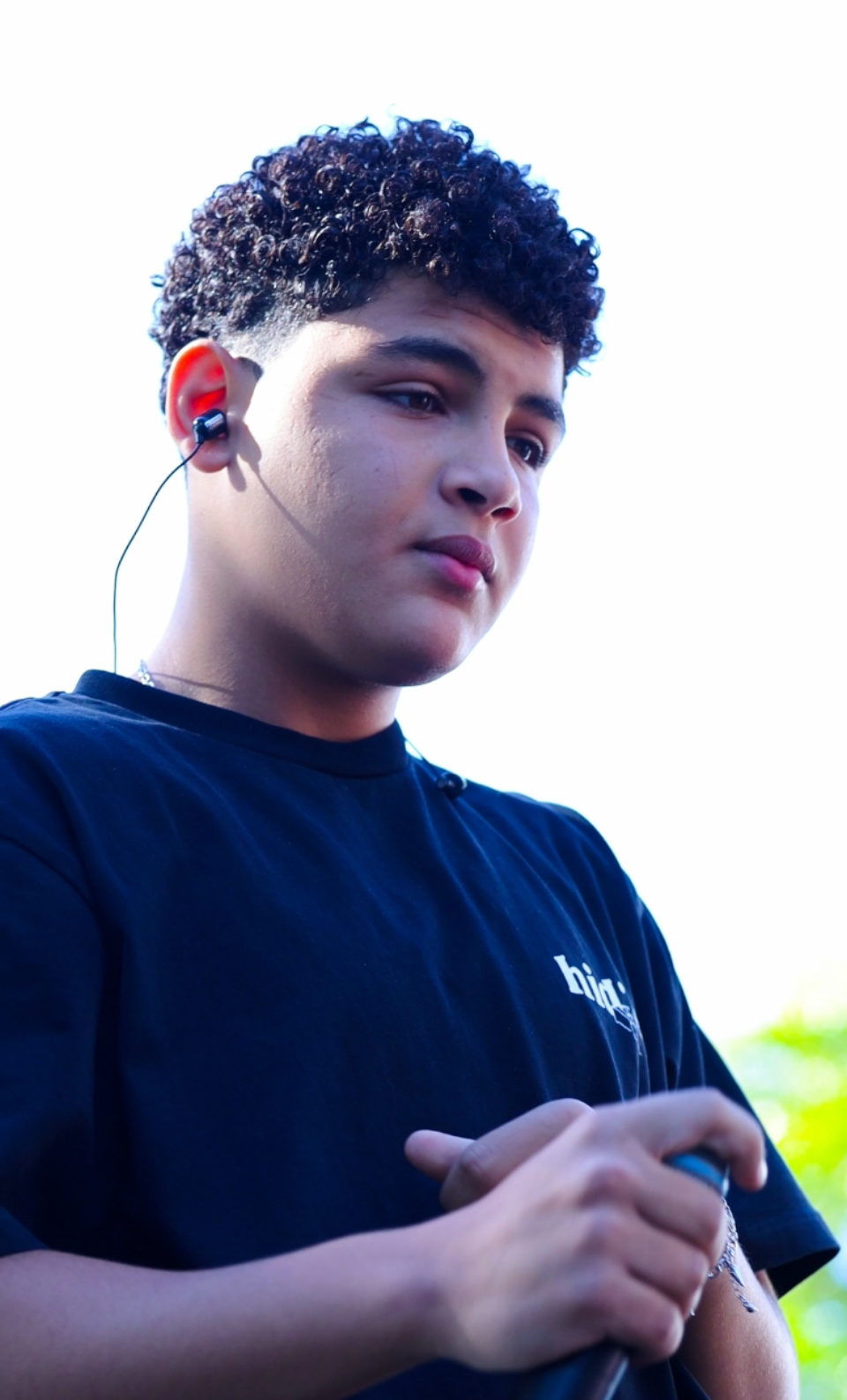
Photo Wikipedia
By: John Mason / Arab America Contributing Writer
This is our 122nd in Arab America’s series on American pathbreakers of Arab descent. The series features personalities from various fields, including entertainment, business, sports, science, the arts, academia, journalism, and politics. Our 122nd pathbreaker, MC Abdul (birth name Abdel Rahman Al-Shantti), is a young Palestinian rapper from Gaza. He grabbed the attention of the global record label Empire following the 2021 release of his song “Palestine,” amid the conflict in Sheik Jarrah. Symbolically important, this neighborhood in East Jerusalem was captured by Israel during the 1967 6-Day war and clashed over in May 2021 by Palestinians and Israeli police over threatened evictions.
Palestinian prodigy, rapper MC Abdul, pours his soul into his craft, raising awareness about the Palestinian cause and the need for peace
MC Abdul, whose birth name is Abdel Rahman Al-Shantti, was born in Gaza on September 14, 2008. (The ‘MC’ before Abdul is a takeoff of the Gaelic, son of…) The record of his mother’s surgery for emergency bleeding in Egypt around 2007 and the subsequent inability to monitor that surgery because of Israel’s blockade of Gaza seems to have fed the emotion behind many of her son’s songs. It was Abdul’s family who exposed him to artists such as Palestinian DJ Khaled, American Eminem, and others, including NF, Tupac, and Jay-Z.
Abdul initially gained popularity when he sang a rap song about freedom in front of his school in Gaza, which drew hundreds of thousands of views on social media. His song “Palestine,” released in 2021 amid the conflict in Sheik Jarrah in Gaza in May of that year, went viral, garnering over 5 million social media views in 4 days. Abdul performed the first show of his career in Doha, as part of the 2022 FIFA World Cup. He moved to live with his uncle in Los Angeles following three years of visa battle. Some years later, he was finally able to bring his family out of Gaza in mid-March of 2024.
One of Abdul’s more poignant recent songs is a collaboration with Palestinian-Algerian artist Saint Levant. It celebrates Palestinian culture in their song and video, ‘Deira,’ performed in early 20th-century traditional Algerian musical style, ‘Shaabi Arab.’ The title “Deira” translates to ‘the Kasbah’ or ‘the old city’ and references a hotel built by Levant’s father in Gaza in 2,000. The hotel, constructed from mud brick, was a local architectural marvel but was destroyed in recent attacks by Israel. Abdul sings verses reflecting the ongoing conflict and personal experiences, including lines like: “Big dreams, heavy nights/praying that my family can stay alive/imagine trying to fly with no wings/but I promise you the caged bird sings.” He had already gained global recognition with his earlier, 2021 viral hit ‘Palestine.’
“‘Deira,’” according to ‘Billboard Magazine,’ “is both a musical and cultural statement, blending traditional Arab sounds with personal and historical narratives…and amplifying Palestinian voices internationally.”
Confronting the unfathomable challenges of living in Palestine under Israeli occupation since 1948, rapper Abdul nails it through the Western musical mode of rap
An underlying theme of Abdul’s lyrics is his conviction that he, according to ‘Rolling Stone Magazine,’ is “blessed to be together with his mother and siblings again.” This is despite the staggering loss of as many as 81 family members in Gaza. In the same ‘Rolling Stone’ interview, Abdul noted, “His focus is now firmly set on his music…a dream he’s literally been praying for. This is what I was born to do,” he says. “I’m on a mission.” He has also averred that his “message is about peace. Not the political side of it.”
In yet another interview, Abdul insists, “I don’t understand what politics is – the thing I’m trying to say is that I want the children of the world to live in peace and harmony and I want to be the voice of the children in Palestine.” From an early age, according to the ‘Scene Noise’ website, he has been “Delivering ice-cold statements with loaded lyrics over an Eminem beat.” The then-12-year-old Abdul’s latest music video “sees him drop personal reflections and articulate with a remarkable, casual fluency the feelings experienced by his generation in the face of the wider violence his city has endured.”
Having taught himself rap by listening extensively to American rap, Abdul hopes to make a difference with his lyrics. We recall that rap music originated in the early 1970s within African American and Latino communities in New York City. Through Abdul’s use of rap in English, we in the West and other English speakers across the globe can hear Abdul drop the hard truths about Palestinians in his videos.
One published description, in ‘YUNG,’ a cultural magazine focused on the Middle East and Africa, depicts Abdul, then at age 15, as “unplugged…not just killing the game, he’s reinventing it. In the heart of Gaza, a young voice rises above the rubble. This voice doesn’t just rap, it roars, it rebels, and it reverberates–a stark contrast to the cacophony of violent sounds that filled the air outside his window, from the ear-splitting booms to the unsettling silence that follows.” Furthermore, this source juxtaposes the possibility of succumbing to the despair enveloping Abdul’s surroundings with the discovery of a lifeline in music. “I became obsessed with developing this talent and passion that God blessed me with,” he confided, “reflecting a wisdom that belies his years.”
One might question the commitment to such a large cause as Palestine of someone as young as Abdul. Recall, he started making an impact on his fellow Palestinians as early as age 9, singing in front of his school; then, at age 13, he released his lyrical song, “Palestine”; and now, at age 18, he lives in the U.S. and is becoming a superstar. But Abdul, despite his youth, developed a path deeply rooted in the collective struggle of his people. He thus sees himself as a part of a larger narrative. “I am like any other Palestinian. We all go through hard times. Struggles are big parts of our lives as Palestinians,” Abdul averred. “But despite the harsh realities, we still love life, and we still have hopes for us to live in peace with freedom like the rest of the world.”
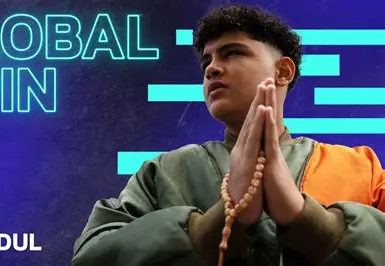
Abdul now looks ahead at how his notoriety can enhance our understanding of “the silent anguish of generations of Palestinians…and not just looking to conquer stages.” He sees his move to the U.S. as a “really important move and step in my career. It’s all about learning. I’m going to improve my writing and keep talking about the social issues, the struggles, and the pain me and my people go through. But I also want to make music people can vibe to and have fun listening to.”
To quote YUNG magazine once more, Abdul’s “youth belies the profundity of his words, making him not just a rapper but something of a raconteur of his time, his verses echoing the collective heartbeat of a people yearning for liberation. A young sage with a microphone, and a revolutionary in the making, his lyrics are his arsenal, his voice a clarion call, and his story a study of resilience, talent, and an indomitable will to rise above circumstances.”
In conclusion, Abdul may be one voice, but he speaks for many. He sees himself as a voice for his Palestinian people, a conduit for their collective pain and aspirations. May peace-loving people around the world be listening and will themselves to share this young man’s critical message.
Sources:
“MC Abdul—Abdel Rahman Al-Shanti,” Wikipedia Series on Arab Americans, 2026
“Saint Levant & Gazan Rapper MC Abdul Celebrate the Culture of Palestine in ‘Deira’ Video,” Billboard, 2/23/2024
“MC Abdul: The Palestinian Rapper on a Mission,” Rolling Stone, by Boutayna Chokrane, 3/21/2024
“The new release by the Palestinian artists follows Saint Levant’s recent signing to Universal Arabic Music,” By Katie Bain
“MC Abdul Unplugged-15-year-old MC Abdul from Gaza is not just killing the game, he’s reinventing it,” YUNG, Art & Culture, Music,” Menna Shanab, 9/28/2023
“Amidst Gaza’s Rubble, 12-Year-Old Rapper MC Abdul Speaks Out,” Scene Noise, 5/21/2021
John Mason, Ph.D., focuses on Arab culture, society, and history and is the author of LEFT-HANDED IN AN ISLAMIC WORLD: An Anthropologist’s Journey into the Middle East, New Academia Publishing, 2017 and of his new novel, WHISPERS FROM THE DESERT: Zaki, a Little Genie’s Tales of Good and Evil (2025), under his pen name, Yahia Al-Banna. He has taught at the University of Libya in Benghazi, Rensselaer Polytechnic Institute in New York, and the American University in Cairo. John served with the United Nations in Tripoli, Libya, and consulted extensively on socioeconomic and political development for USAID and the World Bank in 65 countries.
The views and opinions expressed in this article are those of the author and do not necessarily reflect the position of Arab America. The reproduction of this article is permissible with proper credit to Arab America and the author.
Want more articles like this? Sign up for our e-newsletter!
Check out our blog here!