
Subscribe
to receive news by email

Poll
Will the Trump Administration Shift U.S. Policy in Favor of Palestine?
- No (87%)
- Yes (13%)
 Loading ...
Copyright © 2026 Arab America
Go topWhy Jordan's Nuclear Power Program Has Stalled
By: Robert Jackson / Arab America Contributing Writer
Jordan is facing serious issues with energy security, high energy prices, and water shortages. To combat these problems, Jordan has been planning to build nuclear power plants. Jordan imports over 70% of its energy from other countries, costing the country billions every year. This imported energy is mostly bought from Saudi Arabia and Egypt in the form of oil and natural gas. Given the high level of volatility in the region, Jordan has long sought to enhance its energy security and become an energy exporter rather than an importer. Luckily for those ambitions, Jordan possesses large uranium deposits that could help it to fuel nuclear reactors.
The Jordanian government also sees potential in a process called nuclear desalination. In the process, the heat generated by a nuclear reactor and the energy it produces can be used to fuel reverse osmosis desalination. That means that Jordan could not only produce electricity and lower energy prices, but also use the reactors’ excess heat to make more fresh drinking water out of plentiful salt water. The small modular reactors (SMR) that they plan to purchase are ideal for these tasks. Moreover, the government would then be able to pump hundreds of millions of cubic meters of drinking water to the Jordanian capital, Amman, with energy produced from nuclear reactors. Amman’s rapid population growth means the need for water and energy is growing fast, so nuclear power plants seem like a great solution.
The Progress
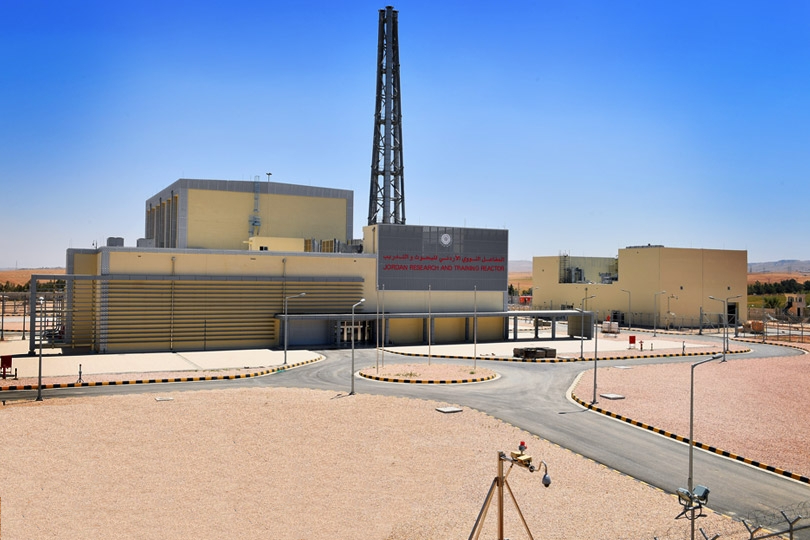
There has been some genuine progress in regards to nuclear power in Jordan because it recognizes the need for swift action to reduce its reliance on fossil fuels. For instance, the Jordan Research and Training Reactor (JRTR) was completed in 2016. This reactor, built on the campus of Jordan University of Science and Technology, is used to train nuclear engineers, reactor technicians, and forensic analysts. In addition, it has been used to produce radioisotopes for medical and industrial use. Outside of the JRTR, the government created the Jordanian Atomic Energy Commission in 2008. Jordan has also made many agreements with governments worldwide to assist with its nuclear energy program.
The Problems
Unfortunately, there have been major roadblocks to building nuclear power plants, including international collaboration and financing disagreements. One of the problems with international agreements has involved the uranium refinement process. For the raw uranium mined in Jordan to be useful, it first must be refined so that it can be used as fuel for reactors. It has been a time-consuming process to reach agreements with other countries like the U.S., because it didn’t want Jordan to refine the fuel itself. Instead, the U.S. pushed Jordan to follow the example of the U.A.E. and have its nuclear fuel refined in a different country like France. Although a refinement agreement was eventually reached with Russia, it took years, and ultimately, the planned $10 billion deal was canceled in 2018.
After the Russia deal collapsed, Jordan shifted its strategy and made plans to buy two SMRs from South Korea by 2025. Yet, there seems to be no indication that this deal will come to fruition either. This agreement likely fell through due to the same financing disagreements. Though Jordan has pursued constructing nuclear reactors for decades, financing disagreements have ended multiple reactor sale negotiations, including the aforementioned deal with Russia’s Rosatom in 2018 and an earlier deal with South Korea in 2010. Even the benefits of nuclear desalination are questionable, as desalination is an energy-intensive process that generates a lot of waste brine, harmful to the environment.
Conclusions
Jordanian efforts to shift away from fossil fuels to nuclear energy are admirable, but inefficient for the urgency of the situation. Nuclear power can be a practical solution in the long run, but the high upfront costs and strict international regulations make it ill-suited for Jordan at the moment. The high rate of population growth necessitates action, and limited water resources are being drained every day. Jordan’s government has recognized these problems and pivoted to cheaper and more accessible renewable energy sources like solar and wind power.
Want more articles like this? Sign up for our e-newsletter!
Check out our blog here!