Subscribe
to receive news by email

Poll
Will the Trump Administration Shift U.S. Policy in Favor of Palestine?
- No (87%)
- Yes (13%)
 Loading ...
Copyright © 2026 Arab America
Go topA Pastoral Moment Lost in a Time of War
By: Ghassan Rubeiz / Arab America Contributing Writer
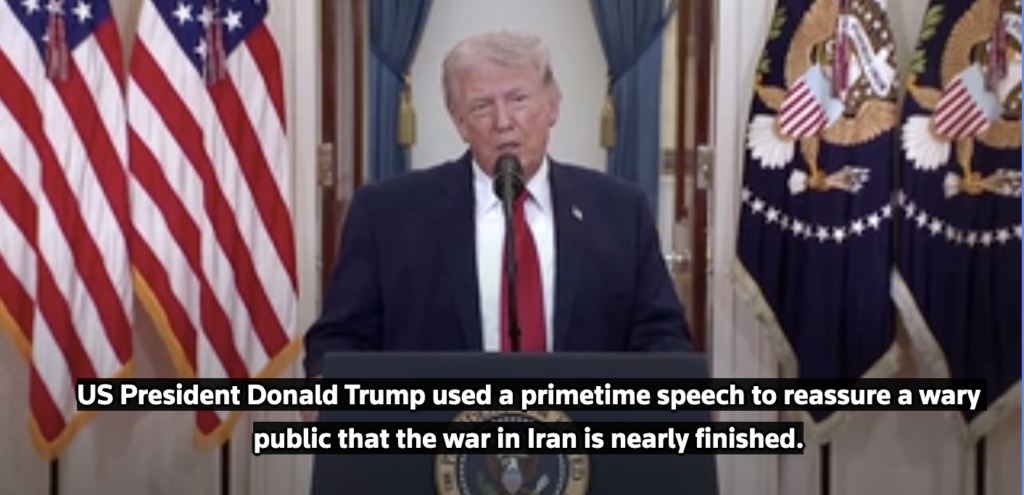
A president carries many responsibilities, but in moments of national anxiety, the country looks for a pastor in chief — someone who can steady the spirit, not inflame the fear. Last night, that moment slipped away. President Trump appeared unusually strained as he delivered what could have been a historic address, one meant to bind the nation together. Instead, he tried to recast a war of choice as a just war — a conflict increasingly slipping from his grasp.
The disappointment lay not only in what he said, but in what he refused to say. This week, Easter, Passover, and Ramadan converge in a rare alignment of all three Abrahamic faiths. This convergence happens once in many years. Leaders of faith across the world marked it. The president did not. He offered no reflection on shared humanity, no gesture toward the moral weight of that coincidence. He also passed over NASA’s extraordinary lunar mission in near silence — a mission that could have served as a symbol of what America achieves when it dreams boldly, trusts science, and draws on the full breadth of its people. Greatness, he might have said, is found not in destruction but in imagination. He chose not to say it.
Instead, he narrowed the frame. “We have devastated the enemy,” he declared. “America’s power is unmatched and unquestioned.” He described Iran as “a demonic force that understands only strength” — language that may rouse applause in certain quarters but does little to calm a weary nation or chart a way forward. “We will not back down,” he insisted, even as the strategic landscape grows more volatile and the costs of this war compound in ways his address refused to acknowledge. A just war requires a just end. He offered none.
What he omitted was as consequential as what he said. He denied any failure on the nuclear question, even as Iran retains the capacity to shape events across the region — to control the Strait of Hormuz, to raise oil prices, to disrupt global commerce. He said nothing about Hezbollah’s renewed confrontation with Israel’s attempt to occupy Lebanon’s south, nothing about resistance groups mobilizing against the U.S. presence in Iraq, nothing about the Houthis’ return to Yemen’s waterways. And he was silent on the war’s wider wreckage: the opening it gave Israel to invade Lebanon, the further abandonment of Gaza’s devastated population, the emboldened settler campaign accelerating annexation of the West Bank — erasing whatever remains of a just peace. Tens of thousands have died. Millions are displaced. The region’s children are inheriting ruins.
He offered no new ideas. No incentives for Iran to step back from the brink. No path forward for Lebanon or Palestine. No vision for ending a crisis that threatens to engulf the entire region.
The Middle East is desperate for common ground — on security for all peoples, on territorial rights, on Iran’s legitimate place in the regional order. Israel cannot secure its future by disciplining its neighbors with ever more advanced weapons. No nation can be safe while surrounded by enemies it has helped to create. Stability will come only when the region’s mosaic of peoples finds harmony through recognition and coexistence — not through domination.
America is at its best when it builds, not when it destroys. When it seeks facts, not when it manufactures threats. When it dreams of the moon, not when it wages wars that deepen insecurity. Last night was a moment to steady a shaken region, to honor a shared sacred season, and to speak to the better angels of a country longing for reassurance. Fear replaced inspiration. What the nation needed was a shepherd’s voice. What it received was something far smaller. The country — and the region — deserved better.
Ghassan Rubeiz is the former Middle East Secretary of the World Council of Churches. Earlier, he taught psychology and social work in his country of birth, Lebanon, and later in the United States, where he currently lives. He has contributed to political commentary for the past twenty years and has delivered occasional public talks on peace, justice, and interfaith topics. You can reach him at rubeizg@gmail.com
The views and opinions expressed in this article are those of the author and do not necessarily reflect the position of Arab America. The reproduction of this article is permissible with proper credit to Arab America and the author.
Want more articles like this? Sign up for our e-newsletter!
Check our blog here!