

Subscribe
to receive news by email

Poll
Will the Trump Administration Shift U.S. Policy in Favor of Palestine?
- No (86%)
- Yes (14%)
 Loading ...
Copyright © 2026 Arab America
Go topDiscovery in Southwestern Qatar Reveals New Sea Cow Species
Arab America Contributing Writer / Londyn Sewell
Size and Environmental Adaptation
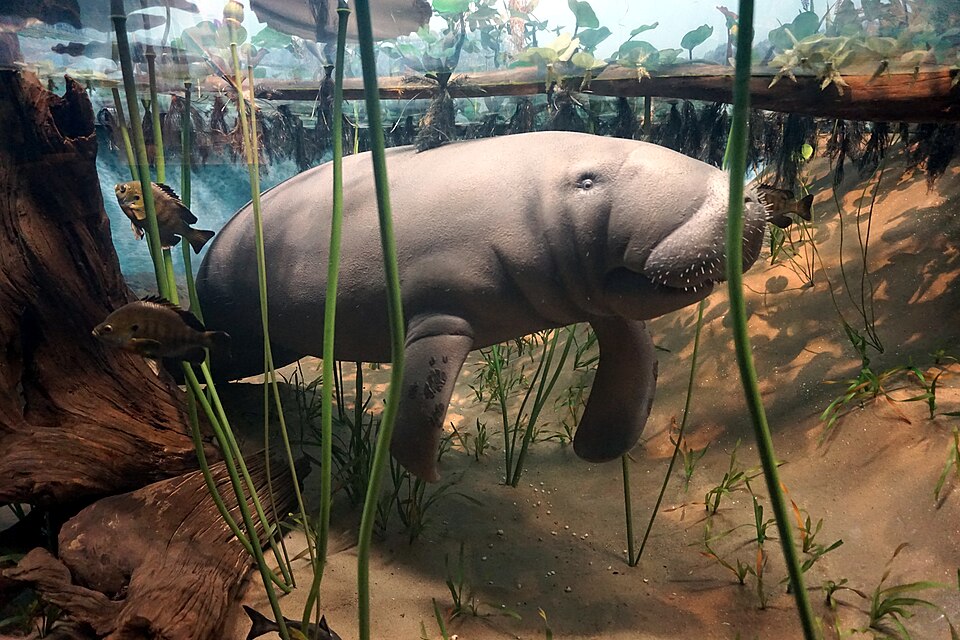
Researchers have identified a new extinct species of sea cow otherwise known as a Manatee, as Salwasiren Qatarensis, from fossil remains discovered in the Al Maszhabiya region of Southwest Qatar. The fossils date back roughly 21 million years to the Early Miocene period, offering a detailed look at a time when the region was covered by shallow coastal waters rather than the desert landscape seen today. This discovery adds important evidence to the evolutionary history of marine mammals in the Arabian Gulf.
Salwasiren Qatarensis was much smaller than sea cows, weighing about 250 pounds. In comparison, living species such as the dugong can weigh several times more. This size difference suggests that early sea cows occupied a different ecological role or lived in environments that required less body mass. A smaller size may also have affected how the animal moves through the water and how much food it needed to survive.
Physical Features & Feeding Behavior Differences
The fossil remains reveal several physical traits that distinguish this species from modern relatives. One of the most noticeable features is its straighter snout. Modern dugongs have a downward-facing snout that helps them graze the seagrass along the seafloor.
The straighter snout of Salwasiren qatarensis suggests it may have fed in a slightly different way. Potentially targeting vegetation in shallower water or feeding at different angles. Its tusks were also smaller, which may reflect differences in feeding behavior or social interaction.
Evidence of Evolutionary Transition
Another key feature is the presence of small, reduced hind limbs. Modern sea cows, including dugongs and manatees, lack visible hind limbs, having fully adapted to life in the water. The remnants found in Salwasiren qatarensis show that earlier species still retained some of these structures.
This provides strong evidence of the transition from land-dwelling ancestors to fully aquatic mammals. It marks an intermediate stage in evolution, where the body was still adjusting to a complete marine lifestyle.
The fossils were found in a well-preserved marine fossil bed that includes a range of other remains, such as shells and fish bones. These findings confirm that the Al Maszhabiya region was once part of a thriving coastal ecosystem.
Warm, shallow water likely supported seagrass beds and a variety of marine life, creating suitable conditions for sea cows. Over millions of years, changes in sea level and climate transformed this environment into the dry land seen today, while preserving the remains beneath layers of sediment.
Connection to Modern Populations
This discovery also connects with broader research led by Texas A&M University, which highlights the long-term presence of sea cows in the Arabian Gulf. The same region that once supported ancient species like Salwasiren qatarensis is now home to one of the largest populations of dugongs in the world. This continuity shows that the gulf has been a stable and important habitat for these animals across millions of years, even as environmental conditions have changed.
From the evolutionary perspective, Salwasiren qatarensis helps fill a gap in the fossil record. By comparing its features with both older and more recent species, scientists can better understand how sea cows have developed traits for aquatic life. Changes in body size, feeding structures, and limb reduction all point to gradual adaptation over time. Insights like these are not only valuable for studying sea cows but also for understanding how mammals in general adapt to major environmental shifts.
Importance of Fossil Preservation
The quality of the fossils is another important aspect of the discovery. Many of the bones were well preserved, allowing researchers to find details of their structure. This level of preservation makes it easier to confirm that the remains represent a distinct species rather than a variation of an existing one. It also allows for more accurate reconstruction of the animal’s appearance and behavior.
Beyond its scientific importance, the discovery highlights the growing role of the Middle East in paleontological research. Regions like Qatar have not traditionally been central to fossil studies, but findings like this show that they hold valuable records of ancient life. Continued exploration in these areas may lead to more discoveries that reshape understanding of the marine ecosystems in Earth’s history.
Educational and Cultural Impact
The identification of Salwasiren Qatarensis also has educational and cultural value. It adds to the natural history of Qatar and provides an opportunity to engage the public with science. Fossils from the site could be displayed in museums or used in academic programs, helping people learn about the region’s past in a direct and tangible way.
Overall, the discovery of Salwasiren Qatarensis provides clear evidence that Southwest Qatar was once part of a rich marine environment. The species’ unique features, including its smaller size, straighter snout, and partial hind limbs, offer important clues about how seacows evolved.
At the same time, this finding reinforces the idea that the Arabian Gulf has long been a key habitat for these animals. By linking ancient fossils with modern populations, researchers are building a clearer picture of how marine life in this region has changed and endured over millions of years.
Want more articles like this? Sign up for our e-newsletter!
Check our blog here!