
Subscribe
to receive news by email

Poll
Will the Trump Administration Shift U.S. Policy in Favor of Palestine?
- No (86%)
- Yes (14%)
 Loading ...
Copyright © 2026 Arab America
Go topPicturing Genocide: How Images of Gaza Translate Palestinian Experience
By: Rami Balin / Arab America Contributing Writer
For the past three years, we have been witnessing the most livestreamed genocide, pictures of Gaza flooding our newsfeeds, keeping us glued to the screens. These images, along with testimonies, soundscapes and other mediums, have been an important medium in raising awareness about the plight of Palestinians. They are undoubtedly our way of accessing and understanding Gaza, from a distance, from the safety of our own homes and streets, the comfort marked by our complicity in the ongoing genocide. Most of us have never been to Gaza – unsurprising, considering all the barriers Israel put in place to entrench the blockade of the enclave, and many other factors. Since Palestinian and pro-Palestinian voices are largely silenced in the mainstream media in an attempt to erase their anti-Zionist narratives, authentic images taken by Gazans, including journalists, have played a crucial role in awakening many to the realities experienced by Palestinians, to the racialized settler-colonial violence imposed on them by the Israeli state.
The Concentration Camp
Since Zionist terrorist militias ethnically cleansed Palestinians to establish the Jewish state in 1948, many thousands of Palestinian from the coast and from the Naqab (Negev in Hebrew) were driven to the area that now constitutes the Gaza Strip. To keep newly displaced people inside the area and to prevent them from returning to their homes and villages, having mostly destroyed during the Nakba, Zionists dug a line in the earth, sometimes literally in the sand, called it a border and fenced it in. The area became a concentration camp, which it remains almost eighty years later. Since then, generations of people have been surveilled, starved, bombed, cut off from the outside world, and denied basic human rights, their voices silenced on the global stage. Many Palestinians have been born, have lived and died in the Strip without ever leaving, not seeing anything beyond the concentration camp itself, not knowing a life otherwise. Since October 7, 2023, Gaza Strip became a death camp, its boundaries constantly shrinking, with Palestinians increasingly siloed into small areas, pushed further inward by the constant attacks of the Israeli army that haven’t stopped since the so-called “ceasefire” was announced in October 2025. As Eyal Weizman put it, “Israel wanted Palestinians trapped in these islands either to leave of die, and the exit points were closed.” They still are.
What Photographs Can’t Tell Us
There are dimensions of the genocide that images can’t convey. Palestinian experience in Gaza, their daily struggles amid the bombardment, starvation and other atrocities, their memories of Gaza before October 2023, their visions of the future, both their own and for Gaza itself, can’t be described solely through videos and photographs. For instance, the feeling of uncertainty in the face of the future seemingly filled with bombs alone.
The smell of burning buildings, of corpses.
The hungry cats roaming the streets where no buildings have survived.
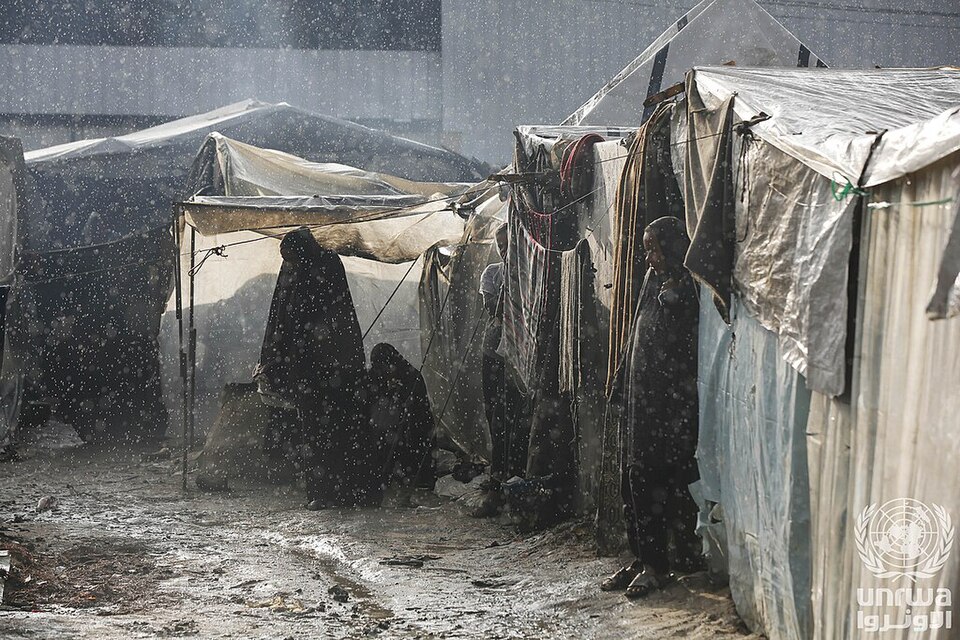
The sound overload of the tent camps where displaced Gazans are forced to stay after losing their homes.
The feeling of waking up in the small hours of the morning because your tent is flooding and you have nothing, once again.
Your own hunger and fear for everyone you love, their lives and well-being.
The asbestos-soaked dust that covers the ground. The poisoned wells. Water contaminated by sewage. The poison slowly seeping through your body.
The invisible borders, barriers arbitrarily drawn by Israel. People getting shot because they crossed those ghostly lines.
The feeling that your own life is disposable, because the settler-colonial state has decided you are not worthy of it.
Smells, sounds, any other sensory conditions of the genocide – all of those are known to us because Palestinians from Gaza have told us what they are, in theory, about their own experiences. Photographs and videos are successful in conveying some aspects of extreme violence but not others, but they do not lead to embodied understanding of Palestinian experiences of genocide. While nobody should be subjected to such conditions, understanding their nature, how they function and how they impact Palestinians in terms of overall health and mental health, their identities and cultural expressions, is essential to sustained advocacy for the end to genocide and for Palestinian cause as a whole.
Normalization of Endless Victimhood
For the western audiences, photographs of Gaza, as well as any country in the Global South, are a key to comprehending of the area, imagining of its landscapes and its people. But what if they never see anything but the war-torn earth, people in refugee camps and other inherently violent imagery? The way Gaza is presented, however true to the current state of things, spotlights people who live in horrible conditions, amid devastating destruction and starvation, in abject poverty, constantly struggling to survive. In the mainstream western media, these people are most often nameless, their predicament unexplained, as if self-evident, the perpetrator of violence against them unnamed as well, which plays a huge role in absolving Israel of responsibility for the carnage. Moreover, such photographs are humiliating for their subjects who at times present their bodies and living conditions to be recorded like evidence of a crime, to be judged and debated by people far away like their very existence is just one of the talking points. Habitually, mainstream western media only deems them responsible for their own suffering to placate Zionist talking points.
The prevalence of such imagery also plays a role in forming a notion, especially among the western audiences, that the people of Gaza are not capable of living otherwise, that their lives are abstracted in such existence on the margins. To contradict that, Gazans like Bisan Owda (@wizard_bisan1) have been adamant to show the world the other side of life in Gaza, emphasizing joy found even amidst the abominable hardships. Bisan’s videos question what joy is, what it means to feel joy in the middle of the ongoing genocide and how joy is an essential part of her understanding of Palestinian sumud, everyday steadfastness.
Depictions of daily life in Gaza not only catalog Palestinians’ existence and plight but also insist on their remaining in the public eye instead of disappearing from the global consciousness. For Gazans abroad, pictures and videos received through messages or viewed on social media are dispatches from home, a way to stay connected to loved ones in the enclave, to be close despite the distance. The importance of these is hard to overestimate.
The Threat of AI Imagery
Beyond directly being an essential weapon used by the Israeli military and intelligence to orchestrate and commit the genocide in Gaza, artificial intelligence has been deployed as a tool of propaganda, hasbara, by the Israeli government and the pro-Israel voices on the global stage. In his election campaign, Israeli far-right politician Itamar Ben-Gvir has used AI to create videos depicting Palestinians in Gaza, promoting full depopulation of the entire Gaza Strip. The onset of AI capable of producing increasingly realistic imagery also threatens credibility of Palestinian claims, amplifying the potential for full disinformation campaigns employing AI-generated fake representations of Gaza while simultaneously discarding real evidence of Israeli crimes, a tactic capable of derailing Palestinian solidarity movements and narratives of Indigenous liberation.
Beyond Depictions
The images of Gaza, be it photographs, videos or even art pieces, are invaluable to understanding not only the predicament of Palestinians inside the concentration camp but to connecting with their struggle and advocating for them. Many people speak of their empathy for the Palestinian people that turned into a driving force for action as a result of viewing Gaza through someone else’s camera lens. Such expression of relation and even kinship is hard to overestimate as we witness the genocide entering its fourth year. The toll that it has had on the people in Gaza and on their loved ones outside of Gaza is a toll no photograph can convey. Still, it is important to look, as the worst atrocities happen when no one is watching. We must also sustain Palestinian archives, whatever forms they take, as the genocidal settler-colonial state is notorious for destroying them too.
When Gazan journalist Salah Aljafarawi got killed, Meta wasted no time deleting his Instagram account and all of his work with it, acting as an extension of the Israeli state machine. By doing that, they killed him twice. However, all of Salah’s materials were saved by the people who followed his work, and now there are many fan accounts who celebrate him and his efforts to tell the truth in the face of grave danger and constant threats to his life. Because of his determination to capture the images of Gaza he also became a familiar face to people who never knew him personally but mourned him like he was their brother. His legacy lives on.
Want more articles like this? Sign up for our e-newsletter!
Check our blog here!