Subscribe
to receive news by email

Poll
Will the Trump Administration Shift U.S. Policy in Favor of Palestine?
- No (86%)
- Yes (14%)
 Loading ...
Copyright © 2026 Arab America
Go topSoundscapes of Gaza
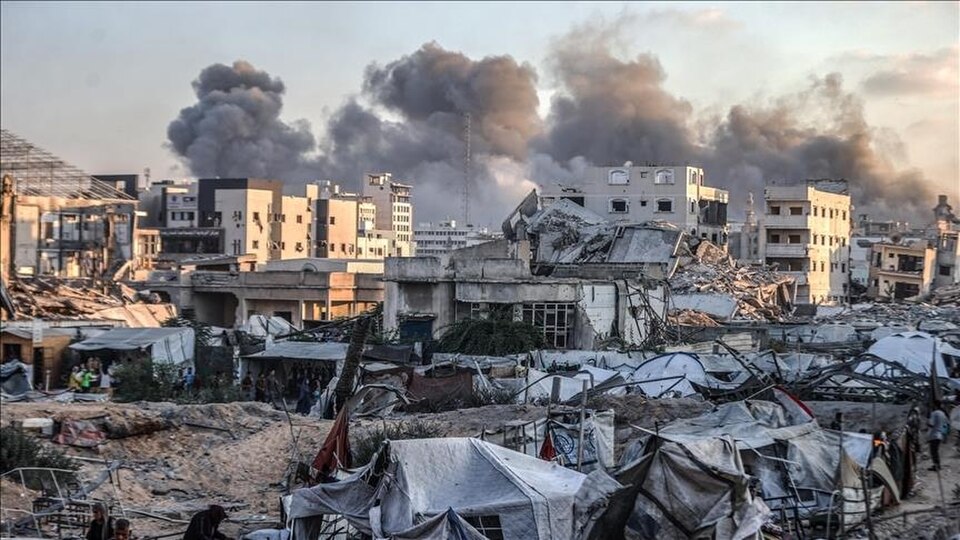
Photo by Wikimedia Commons
By: Rami Balin / Arab America Contributing Writer
Sounds of Palestine
We are in Gaza. A street of broken bombed houses, disjointed walls clinging to each other, the gaps in them more obvious in the torn concrete. The street itself is dust. A few people walk in the distance, a boy on a bicycle drives by. In the middle of it all, a man in a blue shirt puts on his headphones, lifts the boom mic on a pole and starts walking. His name is Mohamed Yaghi, and he is a sound engineer whose story we follow in “Gaza Sound Man” (Hussam Abu Dan, 2025) as he tells the story of Gaza through the sounds of life during the genocide and before it.
Gaza and Palestine in general have been largely represented through images. For those of us who have never been to Palestine or don’t live there, learning about what’s happening on the ground has been a predominantly visual experience. Images permeate the media spaces; they are both the headline and the proof – mostly of something horrific or unjust. As striking as they are, they are all too often silent, and this silence erases a whole layer of the reality lived by people on a daily basis. In this context, “Gaza Sound Man” is an important intervention that brings forward the sonic qualities of Palestinian everyday experiences of violence, giving them a new dimension. Moreover, it emphasizes Gaza as a place not only of pain and trauma but also of hope, dreams and memories, even though some of them are now rubble.
Mohamed Yaghi records sounds all over Gaza, having started before the beginning of the genocide on October 7, 2023. By doing that, he populates Gaza with stories of people, their voices and their surroundings: children playing in the sand between tents, ubiquitous hum of drones, footsteps. Audibly, Gaza before the genocide and during it are two different worlds. The stark contrast between them is evidence of how everything can change in a moment, one life replaced by the other, the non-life, the aftermath of missiles hitting.
Between Life and Death
Drawing attention to the mundane, Yaghi emphasizes the parts of life that we usually take for granted, like the sound of coffee being poured in the morning. He is making their absence more glaring as they disappear into silence – except even this silence is not empty. This particular emptiness is absence of familiar comforts drowned out by explosions, wailing of ambulances, and sounds where life stops altogether. Every sound carries a moment with it, and among them are sounds of death, the silences where sounds of life stop existing. The subtitle of the film in Arabic is “غزة.. صوت الحياة والموت”, which literally means “Gaza.. sound of life and death.” The film fluctuates between the two – in Gaza they are not extremes or polar opposites, they are almost inseparable, always side by side, accompanying one another.
Yaghi is physically present in all of these sounds, not only as a person recording them but as a person living them along with everybody else. Every sound is not an abstract recording but a personal experience, embodied by him, inescapably emotional.
People in the refugee camp, in tents, with only cloth instead of walls between them. People under the rubble, with walls crushed around them, trapping them where they are.
To Mohamed Yaghi, people’s voices and their stories are sounds too. As he sits with the little girl named Ghazal, she tells him about continuous displacement and the struggle to survive and fulfill daily needs. She says that a missile could hit them at any moment. It is true. The sound could stop, its existence precarious, despite the fact that the film has already been made. The fragility of these moments is palpable.
Memory Through Sound
It hasn’t always been this way. Yaghi listens to the recordings he made pre-October 7 – with all the difficulties that Gaza has been facing under occupation and the land and sea blockade, the life back then seems nigh idyllic from the vantage point in the midst of genocide. Recorded, these sounds exist, as does the memory of them. Yaghi himself admits that he has almost forgotten what they are in their absence.
Beyond the sonic story of Gaza, this film is a truly immersive experience. When we hear Gaza in such a way, it stops being a faraway place whose realities are incompatible with our own. Instead, due to the immersive qualities of the film and the soundscape itself, we are exposed to some aspects of the felt realities without being there physically, which gives us access to a drastically different mode of understanding. The work that Mohamed Yaghi has done to document these soundscapes is immense in scope, perilous and incredibly taxing. While his aim wasn’t to replicate the Palestinian experience of the genocide – an impossibility in itself – “Gaza Sound Man” offers us a rare glimpse into what Palestine under settler-colonial occupation sounds like.
Want more articles like this? Sign up for our e-newsletter!
Check our blog here!