
Subscribe
to receive news by email

Poll
Will the Trump Administration Shift U.S. Policy in Favor of Palestine?
- No (86%)
- Yes (14%)
 Loading ...
Copyright © 2026 Arab America
Go topThe Elections Palestinians Deserve
By: Ghassan Rubeiz / Arab America Contributing Writer
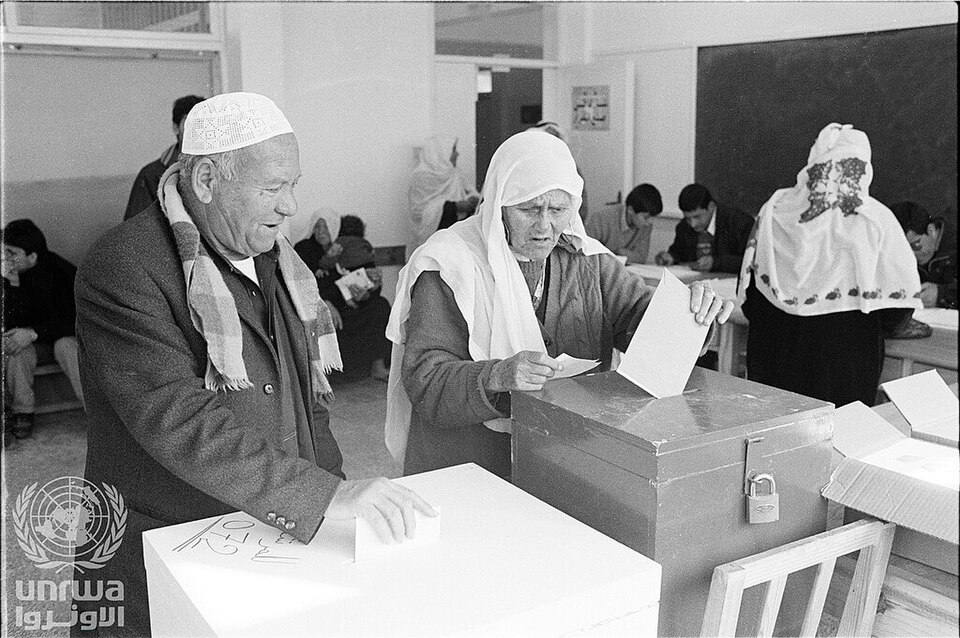
It is not entirely clear whether Palestinians are ready for the national legislative elections scheduled for November 28. These elections are slated for all three Palestinian territories comprising the West Bank, East Jerusalem, and Gaza.
I have an opinion: Voting in the midst of war, displacement, and occupation — under a governance system that has little interest in seeing Palestinians develop political vision or promising leadership — is an exercise constrained by military force.
Yet, if the elections were to occur, they should be used to test ideas essential to any search for a just and lasting peace.
Several political parties are preparing for the vote, but there is little indication that the competition will revolve around necessary, critical ideas. Their campaigns are not based on clear platforms or promised policies. Palestinians, for instance, are not being asked to choose between statehood and citizenship in a democratic secular state, or between armed resistance and civil resistance. Totally absent is any debate over secular versus religious governance or any exploration of whether Palestinians would accept a future state without a standing army.
Equally absent is a campaign centered on freeing Marwan Barghouti, the Palestinian imprisoned leader whose legitimacy and moral authority evoke Mandela’s approach to conflict resolution. A Barghouti-focused platform could test whether Palestinians are ready for leadership rooted in reconciliation.
Instead, a recent electoral plan has emerged pairing Hamas with a figure “who has been at odds with every party to the Palestinian division — sponsored by an Arab country leading normalization efforts with Israel, and aligned with Trump’s agenda,” as Qassam Muaddi reports in Mondoweiss (Sept. 4). That figure is Mohammad Dahlan, a former Fatah leader now backed by the United Arab Emirates. His externally engineered candidacy suggests that little has been learned from the region’s recent turmoil and political failures.
The Palestinian election cannot be separated from the regional dynamics that is currently reordering the Middle East around it. A “Mecca Alliance” among Saudi Arabia, Turkey and Pakistan is taking shape against an “Achilles’ Shield” among Israel, Greece and Greek-speaking Cyprus. If this polarization deepens, the region could be pushed toward a sectarian conflict pitting an Islamic cluster of countries against a Jewish-Christian one. Palestinians would do well to refuse that framing rather than accept it as their own fight — the same secular logic missing from their domestic campaign applies here too. In such a climate, why not test the idea of an inclusive regional peace, built on shared security guarantees rather than which side of the religious line a country sits on — a new political arrangement that seeks to save both Israel and Palestine rather than forcing the region to choose one or the other?
Elections naturally draw attention to the existing Palestinian leadership. Hamas is losing popularity. A poll last month by the Palestinian Center for Policy and Survey Research put support for Hamas at 24 percent, down from 35 percent ten months earlier. Does that decline not raise questions about the wisdom of launching a war that was strategically suicidal — initiated without regional backing and against an enemy capable of inflicting disproportionate human suffering, territorial expansion, and ethnic cleansing?
To run for office, Hamas is now partnering with parties proclaiming contradictory ideologies that offer no clear vision for the future. If it seeks to extend its political lifeline and secure a place in the legislature, why is it accepting conditional disarmament and cooperation with the “Board of Peace” associated with President Trump? That willingness to disarm may be part of why its popularity keeps falling.
The vast majority of Palestinian voters today are under 30. They have lived through fragmentation, occupation, and repeated cycles of war. They deserve an election that speaks to their future — not one that recycles the political failures of the past. A meaningful election would test whether this rising generation still wants a state of its own, or citizenship in a shared, secular order — and what leadership and resistance either path would demand.
If the vote does occur, Palestinians must use it not merely to select leaders but to test ideas — ideas capable of reshaping their future, redefining their national movement, and pushing the peace process forward. Valid elections should not be merely rituals for survival. Palestinians deserve more than survival. They deserve a true political horizon.
Ghassan Rubeiz is the former Middle East Secretary of the World Council of Churches. Earlier, he taught psychology and social work in his country of birth, Lebanon, and later in the United States, where he currently lives. He has contributed to political commentary for the past twenty years and has delivered occasional public talks on peace, justice, and interfaith topics. You can reach him at rubeizg@gmail.com
The views and opinions expressed in this article are those of the author and do not necessarily reflect the position of Arab America. The reproduction of this article is permissible with proper credit to Arab America and the author.
Want more articles like this? Sign up for our e-newsletter!
Check our blog here!