Subscribe
to receive news by email

Poll
Will the Trump Administration Shift U.S. Policy in Favor of Palestine?
- No (86%)
- Yes (14%)
 Loading ...
Copyright © 2026 Arab America
Go topAmazigh or Arab: North Africa’s Blended History
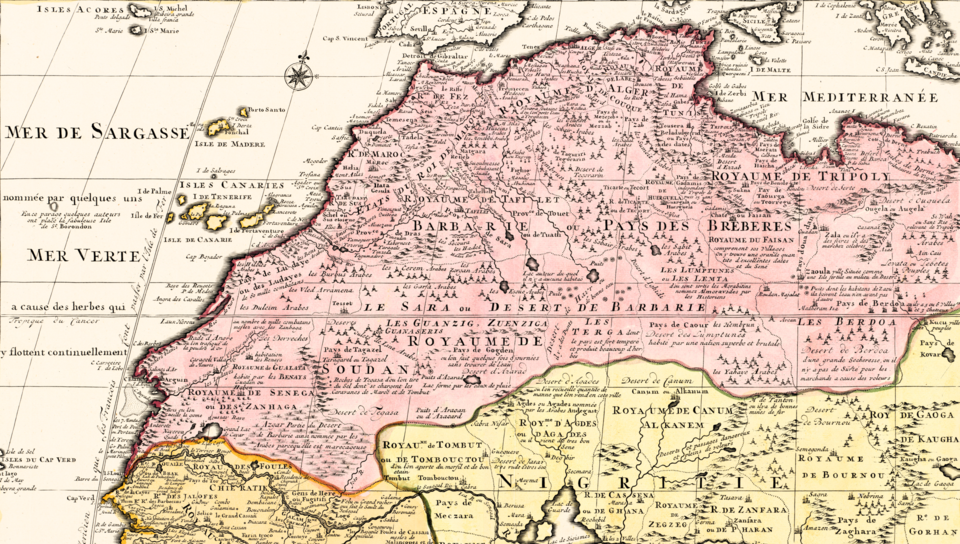
Photo Credit: Wikicommons
By: Nadia Boughanmi / Arab America Contributing Writer
North Africa, a unique region where the desert meets the sea. Lying on the northern coast of the African continent, it is home to various ethnic groups and cultural traditions. It was first home to the Nubians, Amazigh and other indigenous populations. Then came the rise of the Carthaginian empire and the Ottomans who introduced Arabic and Islam to the region. Lastly, in the 20th century, France gained colonial rule.
Due to the blended history, there are split views on if North Africa belongs to the Arab world, or to the ingenious African populations. While multiple dialects of Arabic are spoken across the region, so are tribal variations of Tamazight. These disagreements have led to an “identity crisis” for North Africans in the diaspora. Do they call themselves African, Arab, Amazigh, Nubian or just simply North African?
Amazigh
The Amazigh population is amongst the largest of populations in the Maghreb region of North Africa. From Morocco to certain parts of Egypt, Amazigh populations have thrived in their native homeland for centuries. Morocco holds the largest population of 16 million people classifying themselves as Amazigh, with others being a mix with Arab or other indigenous groups.
Many Amazigh people have taken on speaking Darija and other Arabic dialects, while remaining firm in speaking Tamazight. Tamazight also has an influence on many words in Darija and Darja. Amazigh culture is still extremely prominent in the region with many folk dances, music and cuisine originating from the group.
Nubians
Nubians are another indigenous group of North African, inhabiting and originating from Southern Egypt to Northern Sudan. Traditionally, Nubians spoke Nobiin amongst their populations. However, due to Arab influence in the region, many have conformed to speaking the Egyptian and Sudanese dialects of Arabic.
There is an estimated population of anywhere from 300,000 to 5 million Nubians across Egypt and Sudan. The population gap is due to a lack of proper census, as well as how people align and classify themselves in modern day.
The Kingdom of Kush was one of the largest and most successful empires of North Africa, run by the Nubians. It was a major powerhouse for steel and trade between the Middle East and Africa.
Copts
Copts are the Christian indigenous group of Egypt. They have DNA traces all the way back to ancient Egypt. They have their own Coptic language that is still used today in church services in the country. As of modern day, a diaspora of Copts has formed in certain parts of Libya and Sudan.
Carthage (Phoenicians)
The Carthaginian empire was an empire of the Phoenicians. It started in Tunisia and took over the northern most parts of Morocco, Algeria and Libya. Carthaginian ruins and elements of the empire’s culture can be found right of the capital of Tunis, in the city of Carthage. Tunisians take a lot of pride in their Carthaginian history and the influence the empire once had. There is still a line of Carthaginian DNA found in Tunisia, with roots coming from the countries that the empire had once ruled over.
Arab Rule
The Arab rule of North Africa is what gave the region its modern day reference as a part of the Arab world. The Arabs had first conquered Egypt, since the Suez Canal had connected Egypt to the Middle East. After being successful with Egypt, they moved west to the Amazigh countries, from Libya to Morocco. They had called the region “Bilad al-Maghrib.” That influence is still seen today with Morocco’s Arabic name being “Maghreb” and the region as a whole being referred to as the Maghreb.
It took only 70 years to completely conquer the region and implement a “new rule.” Native languages were replaced with Arabic, especially in large cities. It then moved onto Arabic in the work and education sphere as times went on. The Arabs brought new customs and culture that the Amazigh were not familiar with, and did not want forced upon them. This rule changed the trajectory of North African history and culture for centuries to come.
Modern Day
So, with the rich diversity of ethnic groups and the large division, the question still remains as to “what North Africans truly are.” Instead of continuing the division, many North Africans in the diaspora have grown to stand firm in the classification of “North African,” to unify the different groups, while still honoring the cultural diversity of the region.
Arab, Amazigh, Copt and other influences live on in each of the countries of North Africa. The region’s culture displays a beautiful mix of elements from all periods of history. Putting North Africa under one umbrella term wouldn’t do justice to the rich cultural diversity of the region.
Want more articles like this? Sign up for our e-newsletter!
Check out our blog here!