

Subscribe
to receive news by email

Poll
Will the Trump Administration Shift U.S. Policy in Favor of Palestine?
- No (86%)
- Yes (14%)
 Loading ...
Copyright © 2026 Arab America
Go topAbdul El-Sayed Makes History in Michigan as Democrats Sweep Across America
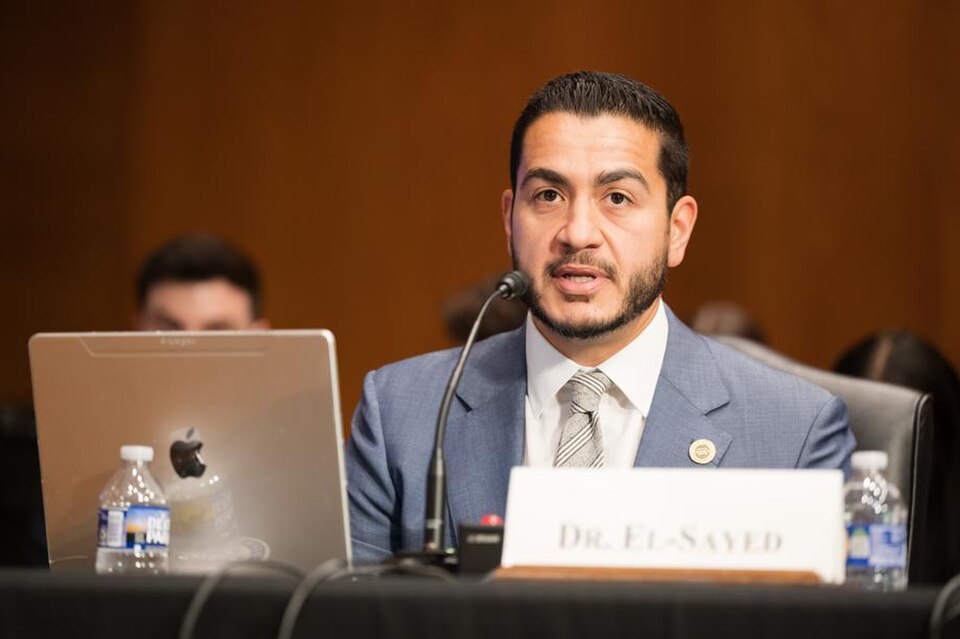
By: Megan Guzman Abbott and Aziz Hellal / Arab America Contributing Writer
UPDATE: Abdul El-Sayed has won Michigan’s U.S. Senate race, defeating Mike Rogers.
Decision Desk HQ called the race for El-Sayed at 1:15 a.m. Wednesday. With about 75.9% of the expected vote counted, El-Sayed defeated Rogers, 1,942,973 votes to 1,732,496, according to AP’s election-night figures.
In his victory speech, El-Sayed said the attacks on his name and faith were attacks on America itself. He said America is big enough for all of us, no matter what we look like or how we pray.
Opponents spent a record $350 million against his campaign, including $70 million in the primary. He said the campaign built a movement, and the victory belongs to the people he met during the campaign.
This win ends a campaign that focused on Arab and Muslim American representation, healthcare, and affordability in Michigan. El-Sayed is a former Michigan public health official and the son of an immigrant.
El-Sayed’s win came on a night when Democrats retook the Senate and were projected to win the House. Democrats flipped Senate seats in Texas, Ohio, Kansas, Iowa, Maine, and South Carolina.
Campaigning on Healthcare, Affordability, and Muslim American Identity
Throughout the final week of October, El-Sayed took his campaign to the next steps. On October 28, El-Sayed canvassed in Wyandotte, Michigan, where he criticized federal Medicaid cuts. He argued that the changes would place additional pressure on rural communities and that, instead, we should redirect federal spending towards domestic priorities such as education and healthcare. The next day, he continued campaigning, reaching Western Michigan University’s Miller Auditorium in Kalamazoo alongside Sen. Elissa Slotkin. Slotkin expressed her excitement to work with El-Sayed despite their differences on policy issues. Throughout this, he spoke out on political attacks targeting his MUslim identity, emphasizing that faith should not define what’s at stake in this election.
“My name and my faith are not the reason you can’t afford your groceries. My name and my faith are not the reason you can’t afford your gas. My name and my faith are not the reason you can’t see a doctor.”
He connected his backlash around his Muslim identity to the economic and healthcare concerns he aims to place at the center of his campaign. For Arab and Muslim Americans, this finally brings to light broader questions about religious representation in government and shows the extent to which minority candidates are expected to address and justify their identities, over and over.
Democratic Divisions
However, the final week of campaigning was also marked by growing divisions within the Democratic Party. Rep. Haley Stevens, El-Sayed’s former primary opponent, endorsed the opposition after Stevens called on him to condemn an advertisement made by an outside political group, which was connected to US military assistance to Israel and the war in Gaza. El-Sayed stated that the advertisement was not affiliated with his campaign and that he disagreed with it. Nevertheless, on November 1, Stevens announced her endorsement for Republican Senate candidate Mike Rogers after being seen next to him at a church service. Stevens had previously made her position on Israel very clear during an August 7 interview with CNN, identifying herself as a zionist Democrat in Michigan.
“I’m still very much in this party. I am joyfully in this party. I know where my values are.”
Her comments are one of the major policy differences between the two candidates, particularly regarding U.S. support for Israel and the direction of American foreign policy in the Middle East. Yet, at the start, Stevens had previously endorsed El-Sayed following her defeat in the Democratic primary, making her decision to support Rogers a major development in the final days of the race. As Democratic leaders continued to get support for El-Sayed, many criticized Stevens’ decision. Meanwhile, when El-Sayed was confronted with his thoughts, he stated that the attention should be towards Michigan voters, not her.
“At the end of the day, I actually don’t think about Haley Stevens. I’m just less interested in the politics of it all than I am in the policies of it all… This is a state of 10 million people who deserve a lot better from their government. I’m a lot more focused on the 9,999,998 that are not the ones you guys are talking about… They pay too much in gas, they pay too much in groceries, they’re worried about the quality of their kids’ schools, they’re worried about the quality of the air and water they drink.”
Following the endorsement, El-Sayed campaign raised more than $2.4 million in a single day, from over 65K donors.
On November 2, El-Sayed joined Sen. Elizabeth Warren at Eastern Michigan University in Ypsilanti for a final campaign rally. He also made multiple appearances at an event hosted by United Auto Workers, and later this week will be at our Arab America’s 2026 CONNECT Empowerment Summit, taking place November 7, where discussions will bring together Arab Americans involved in public service, government, and civic leadership. Throughout all his speeches, he continues to emphasize solidarity across different races, religions, and identities, focusing on bringing communities together around shared economic and social priorities.
Every pre-election indicator had pointed the same way: a Mitchell Research poll in the final week gave El-Sayed a 51% to 44% lead, a New York Times poll put him ahead 53% to 42%, and forecasters gave him an 88% chance of winning. Senate Minority Leader Chuck Schumer said on Election Day that El-Sayed “is going to win tonight” because he talked about what Michiganders care about — the cost of groceries, gas, and health care.
Want more articles like this? Sign up for our e-newsletter!
Check out our blog here!