

Subscribe
to receive news by email

Poll
Will the Trump Administration Shift U.S. Policy in Favor of Palestine?
- No (86%)
- Yes (14%)
 Loading ...
Copyright © 2026 Arab America
Go topThe Middle East Is Outgrowing the US–Israel Axis
By: Ghassan Rubeiz / Arab America Contributing Writer
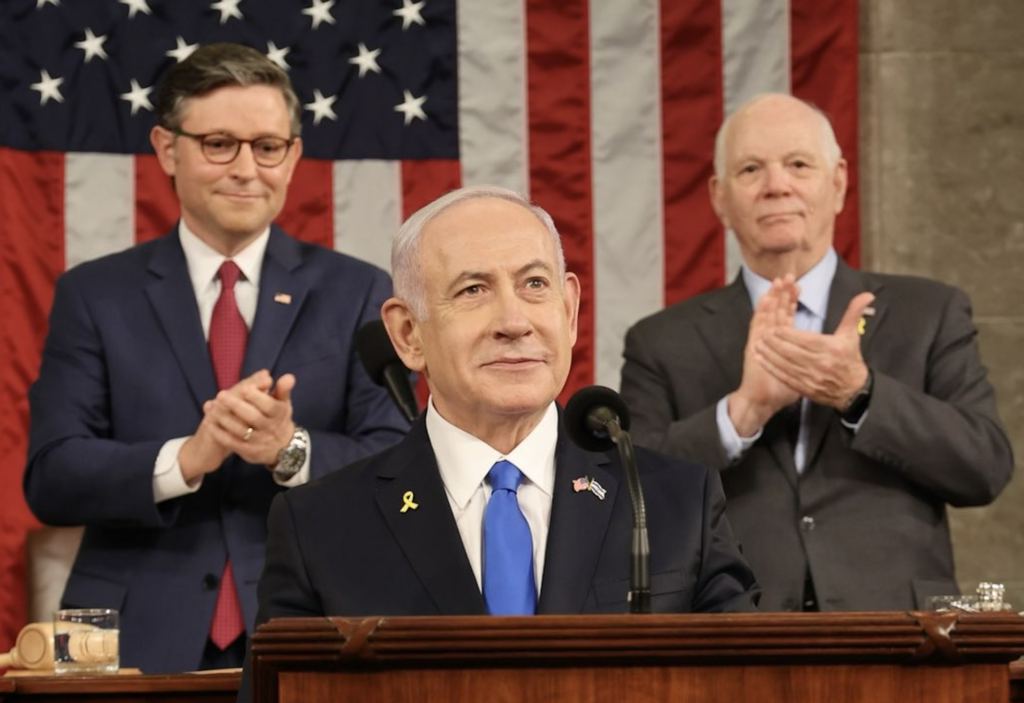
Stopping the war in Lebanon has become the immediate test of whether a larger ceasefire can hold between Iran and the US- Israel axis. Over the past weekend, Iran and the United States finalized a new agreement to open the Strait of Hormuz and extend the ceasefire across all fronts, including Lebanon. But Israel remains reluctant to end its campaign against Hezbollah. On Sunday, Israel bombed a Hezbollah position in Beirut’s southern suburbs — signaling open defiance of the new deal. While Netanyahu may yield to Trump’s dictates, he can easily find pretexts to keep fighting by blaming Hezbollah for violations.
The rift between Washington and Jerusalem is now on the record in the president’s own words. In a New York Times interview, Trump called Netanyahu “a very difficult guy” and declared that Israel “should be very thankful” for the US-Iran agreement, warning that without American intervention, Israel could not survive a nuclear-armed Iran. To Axios, Trump was blunter: enraged by the Beirut strike that nearly derailed the deal, he told Netanyahu he had “no f—ing judgment.” Israeli officials described themselves as stunned. A senior aide called Trump’s rebuke “a resounding slap in the face,” adding that the expectation Israel would not strike anywhere in Lebanon was “incompatible with the behavior of a strategic ally.” Trump’s reported proposal that Israel physically withdraw from southern Lebanon as part of the Iran framework deepened the shock — Washington is now negotiating the terms of Israeli military conduct without Israeli input, let alone consent. The stakes are immediate: the US-Iran memorandum of understanding is scheduled to be signed in Switzerland this Friday. If Israel continues to strike in Lebanon before then, it risks collapsing the agreement entirely.
What is the deeper significance of this rupture? For more than six decades, the United States and Israel have been conjoined in an arrangement so tight, so unexamined, and so insulated from challenge that it was treated as a natural phenomenon rather than a choice. That illusion is now cracking. To understand why, one must look at the questionable foundations of the symbiosis itself.
Despite their differences — America a superpower built on the promise of diversity, Israel a small state built to shelter a single religious community — the two countries developed a mutually reinforcing interdependence across economic, strategic, demographic, and ideological lines. Both embraced unregulated free-market capitalism and heavy investment in military industries, and both cultivated a national assumption of exceptionalism. Their military-industrial cooperation is structural: capital, technology, and weapons flow across their borders in a cycle that enriches both states and entrenches their partnership. War serves procurement contracts and corporate profits far more reliably than it serves defense.
That shared monopoly of power, one global and the other regional, has carried a heavy moral cost. Millions of Palestinians live without basic rights. The United States provided Israel with over $18 billion in emergency military assistance even as more than 73,000 Palestinians — the majority civilians — were killed in Gaza before the ceasefire. No other American foreign policy relationship combines that magnitude of financial commitment with that scale of documented civilian death. Gaza did not cause the fracture in the alliance, but it accelerated it — crossing a threshold of visibility and global outrage that previous conflicts had not reached.
The geopolitical landscape is shifting further. The war with Iran has alienated Arab opinion almost everywhere. Zogby Research surveys show dramatic declines in favorable views of the United States across Arab states, with majorities citing Gaza as the primary driver. Less than half of Americans now believe that supporting Israel serves their national interest. Facing these pressures, Congress is moving to deepen formal military integration between the two states — institutionalizing dependency rather than addressing its costs. What is required instead is a serious debate about the nature, conditions, and limits of American support.
The region itself is reconfiguring. Gulf states are deepening integration. Lebanon and Syria, emerging from years of conflict, may find common ground in rebuilding legitimate state institutions. Palestinian equality — long treated as negotiable — will become a non-negotiable regional demand. Iran’s internal transformation, driven by its own people, may one day reshape the power balance; Iranians are too enlightened and globally connected to indefinitely accept a regime that is ideologically regressive and strategically isolated. Israel will have to elect leadership willing to recognize the occupation of Arab land and listen to its own peace activists.
Washington will eventually have to recognize that anchoring its regional policy to Israel is not worth alienating half a billion Arabs and an Islamic world that constitutes one-fifth of humanity. The US–Israel symbiosis will not collapse overnight, but its slow fraying is inevitable. Lasting peace will come only when Israelis, Palestinians, Lebanese, and Iranians think regionally and act collectively. The United States and Israel will either adapt to that new reality or be overtaken by it.
Ghassan Rubeiz is the former Middle East Secretary of the World Council of Churches. Earlier, he taught psychology and social work in his country of birth, Lebanon, and later in the United States, where he currently lives. He has contributed to political commentary for the past twenty years and has delivered occasional public talks on peace, justice, and interfaith topics. You can reach him at rubeizg@gmail.com
The views and opinions expressed in this article are those of the author and do not necessarily reflect the position of Arab America. The reproduction of this article is permissible with proper credit to Arab America and the author.
Want more articles like this? Sign up for our e-newsletter!
Check our blog here!