
Subscribe
to receive news by email

Poll
Will the Trump Administration Shift U.S. Policy in Favor of Palestine?
- No (86%)
- Yes (14%)
 Loading ...
Copyright © 2026 Arab America
Go topThe Rise and Fall of Manhattan’s First Arab Neighborhood
By: Megan Guzman Abbott / Arab America Contributing Writer
If you stand at the Brooklyn Battery Tunnel in lower Manhattan today, the roar of traffic would easily drown out any sound from the past: the hurried commuters with the World Trade Center just around the corner. But if you were to walk down Washington Street just over a century ago, the air would have been filled with the scent of roasting lamb and cardamom coffee, while the political debates of its Lebanese, Syrian, and Palestinian residents echoed from the sidewalks. These blocks were known as Little Syria, the first Arab immigrant neighborhood in New York City and the intellectual center of the Arab diaspora in the United States.
From the 1880s to the 1940s, Little Syria served as a sanctuary for immigrants fleeing the Ottoman Empire. Despite its economic success and influence on Arabic American culture, Little Syria did not survive the 20th century. With immigration quotas and the trend of urban renewal, the neighborhood was systematically erased from the New York City map. Today, only three physical remnants remain, and historians and activists continue working to ensure its history is recognized and remembered.
Commerce and Culture on Washington St
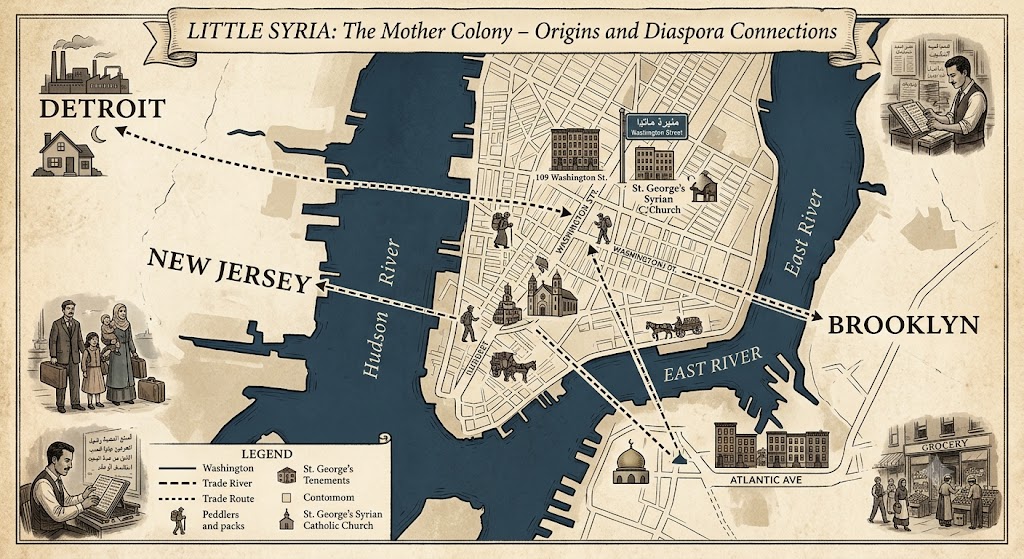
Between the 1880s and 1924, the first major wave of Arab immigration brought more than 95,000 people from the Ottoman Empire to the United States. Many came from present-day Lebanon, Syria, Palestine, and Jordan. After passing through Ellis Island, many settled just south on Washington Street because of its proximity to the Hudson River docks, making it an ideal location for trade. They began their journey serving as traveling peddlers. Many would carry 100-pound packs of lace, silk, and goods on their backs and sold them across New England to as far west as Oklahoma. They would then return weeks later with cash to deposit in Syrian-owned banks on Washington Street. By 1908, there was over 300 Syrian-owned businesses: establishments like Sahadi sold bulgur wheat, olive oil, and pickled turnips, bringing them a taste of home to New York City.
Yet Little Syria was as much an intellectual center as it was a commercial one. The neighborhood became the birthplace of the Pen League (Al-Rabita al-Qalamiyya). This literary movement included writers such as Kahlil Gibran, Mikhail Naimy, Ameen Rihani, and Elia Abu Madi. Their discussions transformed modern Arabic literature by emphasizing individualism, human experience, and artistic freedom. This neighborhood also became home to the first successful Arabic-language printing press in North America, after the linotype machine was adapted for Arabic script. This allowed newspapers published there to influence readers across the Arab world and the diaspora in the U.S.
By the late nineteenth and early twentieth centuries, Little Syria became a popular destination for slumming: a pastime where the wealthy people of the city would go looking for entertainment. Newspapers portrayed the community as an exotic destination where wealthy New Yorkers could experience the “mysteries of the East” without ever leaving Manhattan. Despite this fascination, Arab Americans built successful businesses, established influential literary institutions, and integrated into New York’s economy. Yet city officials never viewed this historic community as one worth preserving.
The Erasure
The demise of Little Syria did not begin with wrecking balls but instead with a pen. Following the end of World War I, the United States adopted a xenophobic stance on immigration restriction. The Emergency Quota Act of 1921, followed by the Immigration Act of 1924, effectively put an end to Arab immigration. The quotas for the Middle East and Asia were extremely restrictive, allowing only a few hundred immigrants to enter the U.S. each year. Without a steady influx of new arrivals, Little Syria’s growth stalled. At the same time, many children of immigrant families moved to Brooklyn and New Jersey, causing the neighborhood’s population to decline.
Nevertheless, the community remained a vital point in Arab American culture, where Arab Americans from across the boroughs would gather every Sunday to worship, shop, and debate. However, this came to a halt once Robert Moses set his eyes on Washington Street.
In the late 1930s, Robert Moses was an urban planner for New York City. He envisioned a massive infrastructure project: a tunnel connecting the southern tip of Manhattan to Brooklyn, what we now call the Brooklyn Battery Tunnel. To achieve this, Moses needed land, and that pointed to Washington Street.
To make way for the project, the city used eminent domain to seize private property and displace residents. The Arab American residents lacked the political leverage needed to stop this from passing.
In August 1946, the city issued eviction notices on houses, churches, restaurants, and any building on Washington Street. The city relocated 300 families, while many historians predict the amount to be much larger. Additionally, assistance and financial compensation during these times were minimal to non-existent. In less than a decade, the epicenter of the Arab diaspora in the US was reduced to none.
From Little Syria to Legacy
Although the physical destruction of Little Syria was relatively quick, the city miscalculated the resilience of the community. Many relocated to Brooklyn, where they established new communities along Atlantic Avenue in neighborhoods like Bay Ridge and Cobble Hill. Others moved across the Hudson to New Jersey, and others west towards Detroit. They didn’t admit defeat; they rebuilt: reopened social clubs and founded new ways to continue sharing their culture. Yet back on Washington Street, three structures still stand: the Downtown Community House and St. George’s Syrian Catholic Church, which was designated a historic landmark in 2009.
For over a decade, activists have worked tirelessly against the city’s bureaucratic indifference to claim these areas. In recent years, organizations such as the Washington Street Historical Society and the Washington Street Advocacy Group have worked to preserve Little Syria’s legacy through historical research, educational programs, public memorials, and campaigns to protect the neighborhood’s remaining historic buildings. One of the activists and historians leading this is Todd Fine, founder of the Save Washington Street project. When asked how young advocates and writers can best support these ongoing efforts today, Fine stated:
“With the growing crisis of affordable housing, young advocates need to articulate a new paradigm of how preservation and affordability can combine,” Fine explained. “I believe that some historical awareness and shared identity are required for people to build the necessary social solidarity to fight oligarchic interests that encourage cultural atomization and feelings of helplessness.”
Ultimately, the fight for Little Syria asks us to consider who gets to write New York’s history. These organizations ensure that the story of Arab America’s beginnings will not be quietly paved over, but will stand as a testament to the immigrants who helped build the city.
Want more articles like this? Sign up for our e-newsletter!
Check out our blog here!