Subscribe
to receive news by email
Poll
Will the Trump Administration Shift U.S. Policy in Favor of Palestine?
- No (86%)
- Yes (14%)
 Loading ...
Copyright © 2026 Arab America
Go topArab Heritage in The World Nomad Games
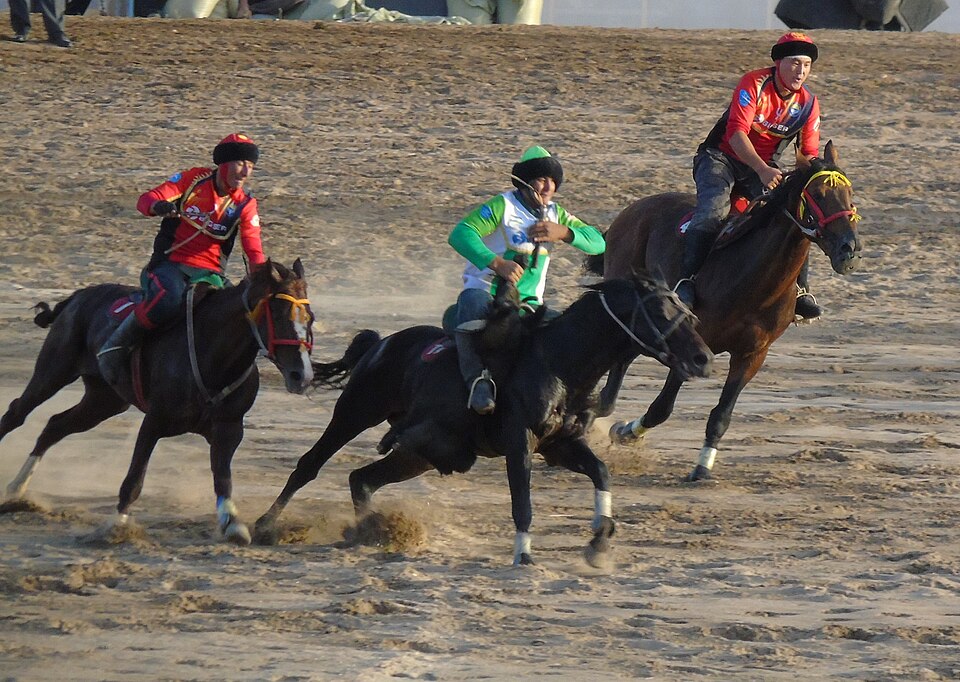
By: Connor Buss / Arab America Contributing Writer
Every two years, one hundred nations compete for a medal in the World Nomad Games. The games are an international multi-sport event made to celebrate nomadic culture and traditions from across the world. The celebration comes in the form of traditional nomadic sports centered on the Turkic people of Central Asia. It is kind of like nomadic Olympics.
The competition took place from 31 August to 6 September of 2026 in Kyrgyzstan. This is the fourth time Kyrgyzstan has hosted The World Nomad Games, with Kazakhstan and Turkey hosting the other two.
Nomadic Heritage
Despite the competition being primarily focused on Central Asian countries and Turkic identity, the games also offer a space for minority communities with a strong nomadic heritage to express their identity. Additionally, nations that used to be nomadic can also celebrate their history. For example, Hungarians haven’t been nomadic for over a thousand years, but they landed in eighth place!
The Arab world is filled with communities that have a strong nomadic heritage. For example, the Bedouins. The Bedouins are a semi-nomadic group that have historically inhabited much of the Arab world. Many of the competing representatives from Arab countries were Bedouins, with the games acting as an opportunity to showcase the groups’ nomadic heritage on the international stage.
In terms of Arab countries that competed, it is uncertain which specific countries actually played in the competition. Sources have declared that 104 countries competed this year, with over 3000 athletes, a new record. While many more Arab countries likely did compete, they probably did not earn medals and as such were not featured on the leaderboard. The confirmed Arab countries that competed were Saudi Arabia (won a silver medal), Qatar, and the UAE.
Additionally, Saudi Arabia held an exhibition match in 2019 as part of the King Abdul Aziz Camel Festival in Riyadh. Qatar also broadened their diplomatic outreach, sending an ambassador during the 2024 games.
Why Haven’t I Heard About This Before?
The World Nomad Games have gotten a lot more popular over the years. Specifically, I have asked myself the question: If this is the sixth World Nomad Games, how come I haven’t heard of the other ones?
The answer can be broken down into a lot of different things. First off, UNESCO added the games to its Intangible Cultural Heritage “Register of Best Safeguarding Practices.” This register essentially claims that The World Nomad Games are an event that preserves and celebrates culture well, despite not being a permanent physical object. Additionally, the UNESCO name gives the event more legitimacy and puts it on peoples’ radar.
The rapid growth of the games also plays a part, with the 2026 games containing over 3000 athletes from 104 countries. For reference, the original 2014 games had 583 athletes from 19 countries. News headlines covered the rapid growth alone.
Future Impact
However, the biggest factor is international attention. Just as the Olympics are a way for a country or city to show off, the World Nomad Games are also a way for countries and groups to show off. Over the past few years, Central Asia has gotten a lot of attention from tourism. Being a host country or city for over 3000 people with rapidly growing news coverage means a lot more people are going to be interested in visiting. Given that the region is economically underdeveloped, the attention and tourism could mean a lot in terms of modernizing the countries.
Though, modernizing does not mean erasing old cultural traditions. The whole point of the World Nomad Games is to celebrate and showcase nomadic traditions from across the world. The often overlooked group of countries are beginning to become international icons, with communities and competitors from across the Arab world glad to be a part of the region’s growth.
Want more articles like this? Sign up for our e-newsletter!
Check out our blog here!