

Subscribe
to receive news by email

Poll
Will the Trump Administration Shift U.S. Policy in Favor of Palestine?
- No (86%)
- Yes (14%)
 Loading ...
Copyright © 2026 Arab America
Go topTrump's Iran Deal is Netanyahu's Nightmare
By: Ghassan Rubeiz / Arab America Contributing Writer
With Iran, the US seems to have reached the limits of use of force and with Israel, the limits of unconditional support.
Hesitantly, Trump has decided to offer an olive branch to Iran while delivering a sharp rebuke and a threat to Netanyahu: “Bibi, you better be careful, or you will be on your own very soon.” Vice President Vance echoed the same threatening language. These are signs that America is now annoyed with Israel but not yet wholeheartedly committed to act decisively about injustice. What to expect?
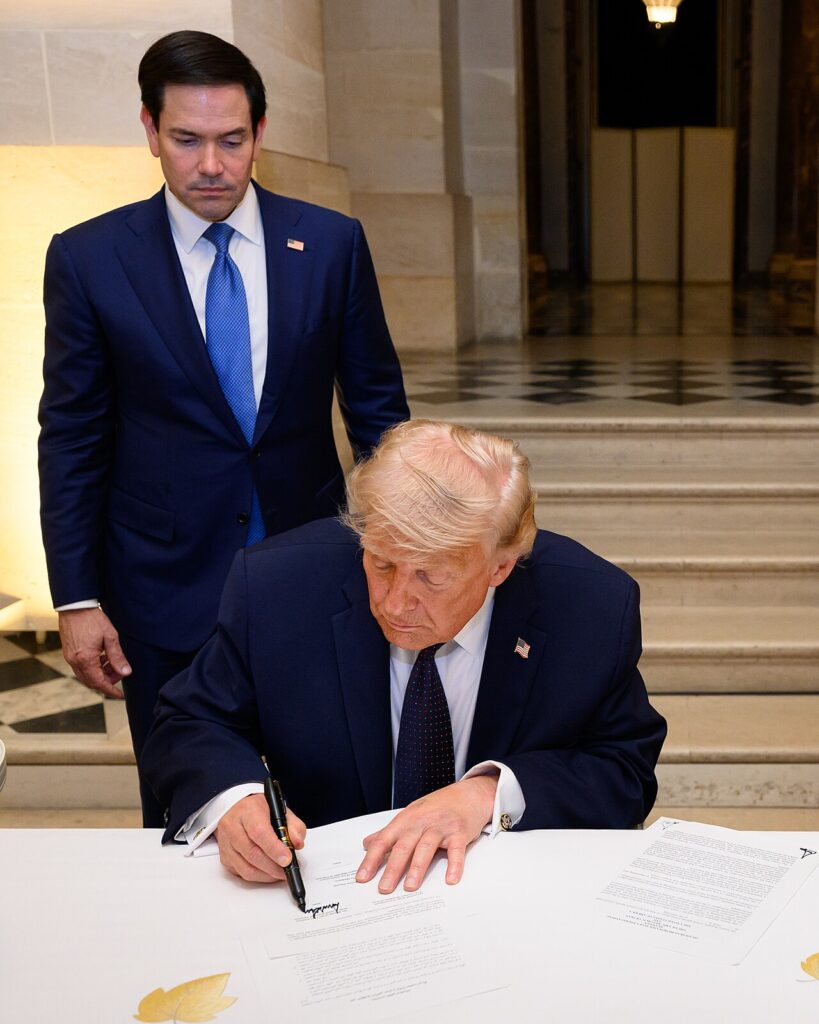
The new Memorandum of Understanding (MoU) between the United States and Iran is not a historic breakthrough, but it is a promising interruption of the cycle of destructive confrontations. Reached on Sunday, June 15, and formally signed a few days later, the MoU calls for the opening of the Strait of Hormuz and creates a 60-day window to negotiate a broader final settlement of the conflict. Sanctions relief—including the resumption of Iranian oil exports—comes in exchange for Iran halting its nuclear program while talks continue. The MoU framework also provides for regional de-escalation, stipulating a ceasefire on all fronts, including Lebanon and the Gulf states. Some measures of economic relief for Iran were part of the deal.
This initial, imperfect agreement matters only if it is treated as the first step towards a broader peace. For some observers, Washington and Tehran are meeting nearly halfway, not out of trust, but because the alternative of continued escalation has become untenable for both. For other observers, Iran received too many concessions it has not “deserved.” Those who consider the deal too generous to Tehran and too disadvantageous to Israel seem to overlook the fact that it was Israel and the United States who started a cruel and unnecessary war — one that caused immense harm to Iran, Lebanon, and the Arab Gulf states. Moreover, the war on Iran and Lebanon followed a genocidal massacre in Gaza and prolonged ethnic cleansing of Palestinian towns and villages in the West Bank. Measuring concessions is a subjective matter, and assessing the quality of the MoU looks both good or bad depending on one’s frame of reference, in particular one’s attitude toward war as a “perfect solution.”
What is certain is that the MoU is fragile. With a warning, Trita Parsi, executive vice president of the Quincy Institute for Responsible Statecraft, put it plainly: “The Israelis are trying to destroy this deal, and they will continue to try. It will require persistent, consistent pressure by Trump on the Israelis in order to hold them back.” Netanyahu has given them reason to try: he declared that Israel’s “struggle is not over” and vowed to keep troops in southern Lebanon indefinitely.
Israel’s refusal to withdraw from Lebanon gives Iran grounds to declare the agreement already violated, and any renewed Hezbollah-Israel exchange of fire could rapidly escalate into a wider confrontation that would unravel the deal entirely.
Israel’s defiance, however, cannot indefinitely substitute for a regional strategy — and Washington increasingly knows it. The devastation wrought across the region over recent months has exhausted the moral and political foundations of the maximalist approach. A different framework is not merely desirable; for a US administration seeking a legacy, it is necessary.
That framework must include a serious reckoning with Iran’s capacity to resist change imposed by force. For nearly five decades, the Islamic Republic has survived isolation, a U.S.-backed war with Iraq that lasted nine years, waves of sanctions, and sustained international pressure. The MoU challenges the premise that peace requires one side’s unconditional surrender — and acknowledges, however reluctantly, that both parties must compromise to find common ground. This acknowledgment matters because Iran is not a society frozen in the Islamic Revolution of 1979. Iran is highly educated, culturally rich, and historically one of the region’s most creative civilizations — one that gives Iranians the space to mobilize for change themselves.
There are many ways this deal can be interrupted. But if it is protected and expanded — treated as the beginning of a new political experiment — it could mark the moment the stakeholders of the Middle East chose a different course. Having reached an ambitious initial step toward agreement with Iran, it has now become clear that applying maximal pressure on Israel to withdraw from Lebanon would be a significant step toward saving this agreement. To discourage Israel’s ceasefire-sabotage attempts, will Hezbollah refrain from returning fire to Israel over the next few days?
The US State Department keeps encouraging Beirut to continue direct negotiations with Israel; a fourth meeting is taking place at the end of this week in Washington. Hezbollah would be easier to persuade toward a ceasefire if Lebanon is fully freed from Israeli military occupation. Does Trump have the personal will and political capacity to enforce Israeli compliance with the MoU? Will this agreement survive the public campaign being mobilized against it by Israel’s possessive friends within the US?
Peace will not come from missiles, sanctions, or moral grandstanding. It will come from the recognition that no nation can dominate the region, and no society can reform under siege. The MoU is not a developed plan yet — but it is an opportunity. That opportunity grows as America’s eroding patience toward Israel turns to alarm with a commitment to do justice. And in a region exhausted by war, an opportunity is worth more than another victory claimed through ruin.
Ghassan Rubeiz is the former Middle East Secretary of the World Council of Churches. Earlier, he taught psychology and social work in his country of birth, Lebanon, and later in the United States, where he currently lives. He has contributed to political commentary for the past twenty years and has delivered occasional public talks on peace, justice, and interfaith topics. You can reach him at rubeizg@gmail.com
The views and opinions expressed in this article are those of the author and do not necessarily reflect the position of Arab America. The reproduction of this article is permissible with proper credit to Arab America and the author.
Want more articles like this? Sign up for our e-newsletter!
Check our blog here!