Subscribe
to receive news by email

Poll
Will the Trump Administration Shift U.S. Policy in Favor of Palestine?
- No (86%)
- Yes (14%)
 Loading ...
Copyright © 2026 Arab America
Go topHijacking Green Energy in Palestine
By: Rami Balin / Arab America Contributing Writer
The plan to connect the Palestinian electricity network to Israel’s central electricity grid was set in motion in 1967, immediately after the Naksa, when Israel occupied the West Bank and Gaza Strip.
The move was part of a broader strategy aimed at asserting control over the occupied territories by restructuring their infrastructure. This allowed Israeli authorities and companies to make decisions affecting not only economic conditions but also the accessibility and availability of water, electricity, and other essential resources.
Moshe Dayan, then Israel’s defense minister, argued that cutting electricity to entire towns and regions could be more effective than direct military intervention in responding to unrest or resistance to the occupation.
The complete integration of the infrastructure did not occur until the Oslo Accords of the 1990s, when the West Bank was divided into Areas A, B, and C. Much of the territory remained under Israeli jurisdiction, while the energy supply was placed under the authority of the Israeli Electricity Corporation.
Today, electrical grids in the West Bank and Gaza remain largely dependent on Israel, leaving Palestinian communities increasingly vulnerable as tensions rise and Israeli control intensifies across historic Palestine.
Despite these challenges, Palestinians are finding new ways to gain greater control over their electricity supply and create energy solutions that provide increased autonomy. One of the most promising solutions is solar power.
With the region’s abundance of sunlight, solar energy has become nothing less than a lifeline for communities that might otherwise have little or no access to electricity. At a time when the world is searching for environmentally sustainable technologies, Palestinians are also raising questions about what it means to develop energy sources that sustain not only the environment but life itself.
Gaza
The Israeli land and sea blockade of Gaza has long included restrictions on electricity. Even during periods of relative calm, neighborhoods in the Gaza Strip often received an average of only eight hours of electricity per day, with power cuts occurring at different and frequently unpredictable times.
These outages severely disrupted everyday life. Residents were forced to organize work, education, cooking, communication, medical care, and other essential activities around an unreliable power supply. Under such conditions, the need for dependable and locally controlled electricity became urgent.
In response, local organizations and initiatives such as Sunbox developed alternatives to less environmentally friendly generators and candles.
Despite the difficulty of obtaining Israeli approval to import solar panels into Gaza, Sunbox has worked on major projects, including powering desalination plants with solar energy and installing solar-powered streetlights. It has also provided households with smaller and relatively inexpensive solar systems capable of supporting individual families.
International humanitarian organizations have similarly developed projects to provide solar power to farms, hospitals, schools, and other essential facilities.
Although these initiatives cannot yet serve Gaza’s entire population, they have begun to reduce total dependence on externally controlled electricity by locating sources of energy within the Gaza Strip itself.
Amid the humanitarian catastrophe imposed on Gaza and the uncertainty of the current ceasefire, the development of locally controlled infrastructure is critical. These efforts represent one of the many examples of Palestinian resilience and determination.
West Bank
Conditions in the West Bank differ significantly because of active Israeli incursions, expanding settlements, settler violence, road construction, land seizures, and other practices that separate Palestinians from their land and make it increasingly difficult for them to remain there.
Although the West Bank is not subject to the same blockade imposed on Gaza, Palestinians face an extensive system of checkpoints, walls, fences, restricted roads, and other barriers created to support Israeli settlements and territorial control.
For some Palestinian communities, solar power has become their only source of electricity because Israel refuses to connect them to the electrical grid, despite its obligations under international law.
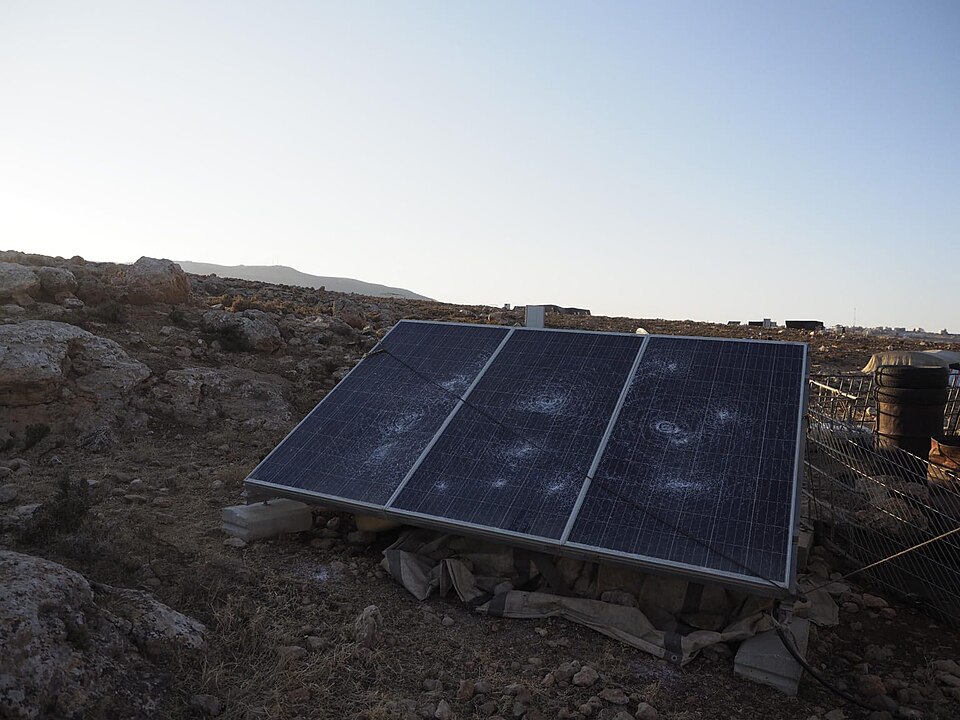
Solar panels are frequently destroyed or confiscated by Israeli settlers or the Israeli military. Replacing them can be impossible for families already experiencing financial hardship and isolation from other parts of the occupied Palestinian territories.
At the same time that Israel promotes itself as a leader in green technology, it is increasingly powering settlements through solar farms constructed on land taken from Palestinians who often struggle to meet their own basic energy needs. This practice has come to be described as energy apartheid.
Because of these conditions, the West Bank remains even more reliant on Israeli electrical infrastructure than Gaza.
Organizations such as Comet-ME, which provides renewable energy to Palestinian communities in Area C, are working to close that gap and help Palestinians regain greater control over electricity production and distribution.
However, Israeli authorities require permits for nearly every form of infrastructure development, including electrical installations. According to local organizations, such construction permits have not been approved since October 7, 2023.
The Future
The future of renewable energy in the West Bank and Gaza Strip remains uncertain.
As tensions escalate and Israeli control tightens across the occupied Palestinian territories, opportunities for infrastructure development—and for Palestinian life more broadly—continue to shrink.
In this environment, community-based renewable energy projects are more important than ever. They can reduce dependence on external energy sources, protect essential services, strengthen local resilience, and help sustain both Palestinian communities and the environment throughout historic Palestine.
Further References
- Sunbox
- Anera: Sustainable Energy in Palestine and Lebanon Through Solar Power
- Comet-ME
- The Occupation of the Sun — Caravan Collective
Want more articles like this? Sign up for our e-newsletter!
Check our blog here!