Subscribe
to receive news by email

Poll
Will the Trump Administration Shift U.S. Policy in Favor of Palestine?
- No (86%)
- Yes (14%)
 Loading ...
Copyright © 2026 Arab America
Go topUnder Chemical Conditions: The Lasting Consequences of Chemical Warfare in the Arab World (Part 1)
By Mitzi Tapang / Arab America Contributing Writer
Since the end of the Cold War, military undertakings continue to take the center stage for world expenditure with $2.7 trillion worth in 2024 alone. In the Middle East, estimates have shown a 15% rise from 2023, with over $243 billion spent on militaries.
Amid the protracted venues of conflict and the rapid military exchanges, the exponentially disproportionate share of gross domestic product (GDP) apportioned for military expenditure presents a global military burden that could reach more than twice the spending in the last two years, potentially between $4.7 to $6.6 trillion by 2035.
On a grander scheme, this exchange could also mean brutal, more enduring effects of ecological degradation beyond economic means. And, with a handful of advancements at one leader’s disposal, there is only so much to account for after the reservations displayed when the Geneva Protocol of 1925 emerged as an effort to address chemical agents used in World War I, or even after Chemical Weapons Convention of 1997, for which 98% of the world population is living in protection.
Now, a more subtle, more radically employed destruction is working in the confines of such military burden, a feat that could easily be discarded as muscle pains or growing spasms caused simply by biological or natural mechanisms. Nonetheless, these forces cannot be divorced from the network and economies of toxic exchange that had been part and parcel of almost every warfare.
*This is the first installation of a three-part series that looks into the long-standing effects and consequences of chemical weapons usage within and against the Arab World.
Political origins
In 1962, North Yemen saw the collapse of a fragile political order that had already lost much of its legitimacy among educated elites and military officers in parts of the urban population. Yemen had been ruled by the Zaydi imamate under Imam Muhammad al-Badr and his father Ahmad, in a system rooted in religious authority and autocratic governance.
Many younger Yemenis resented the concentration of power in the imam’s household and the limited opportunities for advancement. The army, in particular, became a center of conspiracy because military officers had gained organizational capacity but remained politically subordinate to a hereditary monarch.
Once al-Badr escaped and called for resistance, many northern tribes rallied to his side, in part as a response to the remnants of monarchic local legitimacy, especially in the Zaydi highlands, but more so out of fear of what the republican project would entail for rural control. For many northern tribes, the imamate, however imperfect, was a known political arrangement that preserved their local power, and carried heavy disdain on the protracted vehicle of external control that is the republican concern.
Egyptian intervention
Gamal Abdel Nasser, then Egyptian President, responded by ordering military intervention because he saw the Yemeni republicans as allies in his wider Arab nationalist project, viewing the conflict as a strategic opportunity to weaken conservative monarchies in the Arabian Peninsula. Nasser had, after all, helped overthrow Egypt’s own king a decade earlier, and he treated the Yemeni war as an extension of the same anti-monarchical politics that had brought him to power.
But the intervention soon became a protracted military entanglement when the region witnessed its first reported use of poison gas against Yemeni tribesmen. Egyptian forces were accused of using chemical weapons during the conflict, and the campaign would later come to be described as “Nasser’s Vietnam,” mirroring the environmentally costly quagmire of warfare during the Vietnam War. From 1962 to 1971, the United States sprayed almost 80 million litres of herbicide, including Agent Orange, leaving dioxin contamination across roughly 2.9 million hectares of land.
Nasser denied the accusations of chemical warfare, arguing that his commanders in the field made their own strategic decisions and that he was not personally responsible for every military action taken in Yemen. That denial, however, added more fuel to the rich controversy. Investigations, including those taken by the International Red Cross, reported that Egypt had begun experimenting with poison and chemical bombs in 1963, at a point when local opposition to the Egyptian presence was growing and tribes were increasingly shifting their support to the royalist camp.
Soviet backing
Augmented by a Soviet shipment of new gas bombs, Egypt had begun a project code-named “Izlis,” whose real purpose was concealed behind the veil of its first chemical weapons production facility. This facility, located in an industrial zone about 10 kilometers northeast of Cairo and bordering the desert, was secretly known as “Military Plant 801” and operated under the Egyptian Ministry of Defense.
Still, it is also likely that Egypt had access to limited stocks of mustard gas left behind by the British army after its final withdrawal from the Suez Canal Zone in 1956 in the aftermath of the Suez Crisis, which marked the end of a major phase of British military presence in Egypt. The same episode also saw the first ever recorded seaborne invasion by the Royal Marine Commandos, coming ashore from Landing Craft Tanks (LCTs), followed by the 2nd Battalion of The Parachute Regiment, with the 3rd Battalion already launching air attacks after the Anglo-French plan (known also as Operation Musketeer; believed to be an allusion to Alexandre Dumas’ most celebrated novel The Three Musketeers) hatched alongside Israel’s “peacemaking” tactic (a guise for a larger project of reopening the Straits of Tiran and halting border raids by Fedayeen militants after the 1949 Armistice Agreements and the later Six-Day War of 1967).
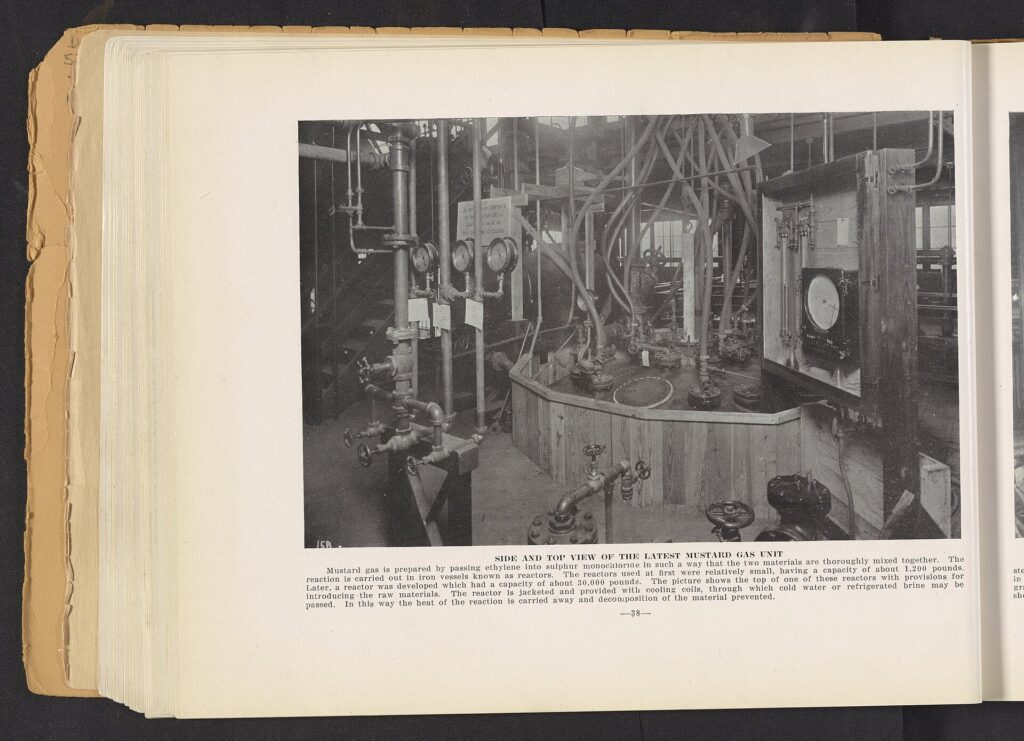
Nevertheless, a more potent cause holds that for five years from 1963 onward, the Egyptian Air Force employed chemical weapons in Yemen, delivering them mainly with Soviet-made Ilyushin-28 aircraft. The chemical munitions reportedly included KHAB-200, R5 aerial bombs filled with sulfur mustard, and AOkh-25 submunitions filled with phosgene (an irritant six times more deadly than chlorine), the latter being a toxic gas first used in combat by German forces during World War I, with more than 1.3 million reported casualties and 90,000 deaths.
Cold War manifestations
Egypt’s turn toward Moscow after the Suez Crisis built a foundation for a burgeoning threat of relations. A relationship that, since the Eisenhower administration, which also brought the Suez operation to a premature end, proved to be a concerted push-and-pull between US intervention and the gradual enfoldment of Arab states into Soviet influence.
In large part, this meant that Egypt was no longer operating within the boundaries of East through West, rather it was becoming part of a contested zone of Cold War interest in which Moscow offered the most political leverage while the United States feared for the enfoldment. A fear that seven years later would perforate through the Kennedy administration’s “restrained diplomacy” as a response to Egypt’s deployment of chemical weapons, which eventually took form in Lyndon Johnson’s, Kennedy’s successor, withholding of economic aid to the country.
Arab nationalism at the forefront
Firsthand accounts of Egypt’s use of chemical weapons quickly reached Britain in just a few months after the civil war in Yemen began. For British officials and parliamentarians, the issue simply was not grounded on the alleged use of poison gas, alarmingly confirming that Nasser’s Egypt had become willing to push military escalation beyond the limits of conventional pursuit of regional influence.
The so-called Aden Group, a mainly Conservative alliance of backbench parliamentarians, interpreted Nasser and Egypt precisely through the Cold War lens and saw him as the embodiment of Arab nationalism, which they regarded as a direct threat to British interests in South Arabia, a crucial Crown Colony and military base. Aden in particular was of exceptional importance within Britain’s wider imperial communications and logistics network, as it sat at the southern gate of the Red Sea, near the Bab al-Mandeb strait, which made it one of the key maritime chokepoints connecting the Indian Ocean to the Suez route and, by extension, Britain’s imperial arteries to India and beyond. Any threat to Aden raised fears about the security of shipping routes and Britain’s ability to project force across the Gulf, as it also housed the Middle East Land Forces (MELF) during the the early 1960s after it replaced Cyprus as a British base.
More broadly, Nasser’s growing influence and the apparent upper hand he was gaining in Yemen threatened the dynastic regimes across the Arabian Peninsula, whose political survival mattered both to regional order and the economies dependent on their oil production. If such influence would prevail, the legitimacy of monarchies aligned with Britain and the West could be weakened and opposition movements likely more emboldened, undermining the supposed political architecture on which stability was nestled. Britain relied heavily on the Gulf for their oil economy, as did France, the Netherlands, and the Scandinavian states.
Oil, monarchy, and order were bound together, so a challenge to one was always a challenge to all—and that dependence gave the Yemeni war a stage far beyond the peninsula itself, the war toxins spreading in unparalleled extremes across later armed conflicts and within the currents of US-Israel-Iran war.
Want more articles like this? Sign up for our e-newsletter!
Check our blog here!