Subscribe
to receive news by email
Poll
Will the Trump Administration Shift U.S. Policy in Favor of Palestine?
- No (86%)
- Yes (14%)
 Loading ...
Copyright © 2026 Arab America
Go topHistory of the Strait of Hormuz
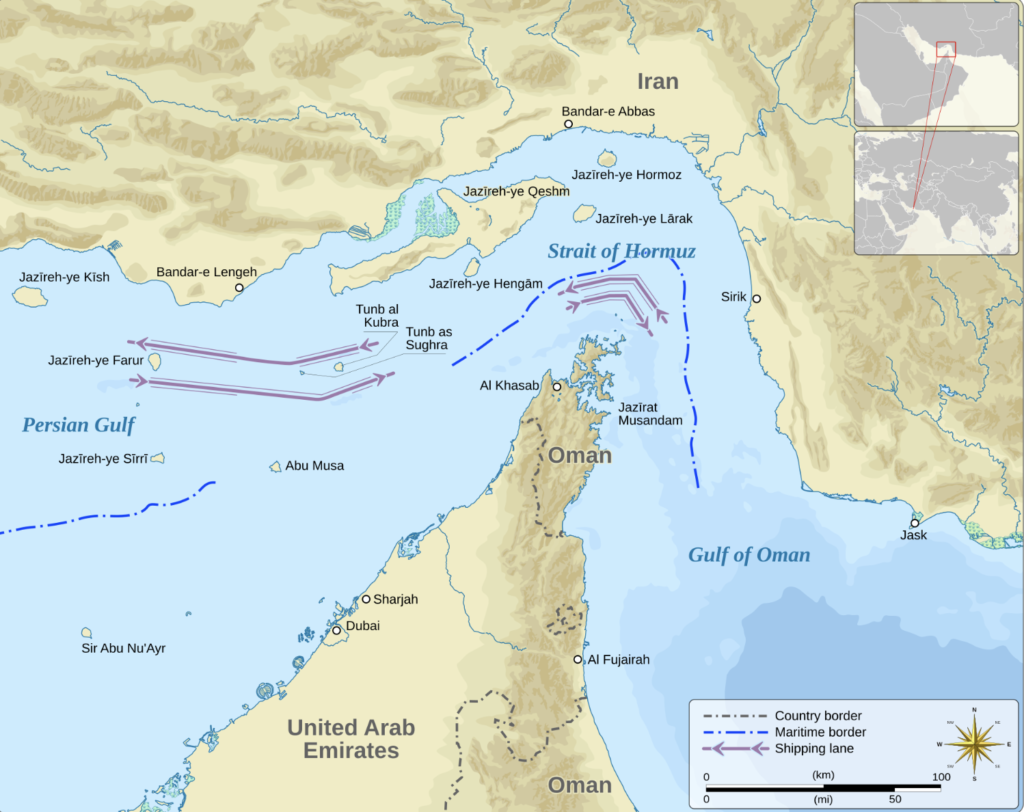
Map of the Strait of Hormuz. Photo Credit: Goran_tek-en, CC BY-SA 4.0, via Wikimedia Commons
By Jake Harris / Arab America Contributing Writer
During the 2026 Iran War, the controversy related to passage of international shipping has become a crucial talking point. Iran closed the Strait of Hormuz in the first week of the war. They have used their main point of economic leverage to try to economically disincentivize President Trump from making the conflict a long term operation. Prior to the Iran War, there has been long periods of hypothetical speculation as to how a war with Iran and the United States would unfold. Closure of the Strait was one of the main talking points when discussing hypothetical drawbacks to launching the operation. The Strait of Hormuz is referred to as a “choke point”, a military term to describe a geographical feature such as a valley, bridge, or waterway that if restricted militarily, could serve as a huge barrier to troop, and resource movement for the opposing force.
Significance in Global Oil Trade
The Strait is a thin sliver of waterway between the pointed northern borders of Oman and the United Arab Emirates, and Iran. It is a crucial waterway that facilitates international shipping between the east and west. The waterway accounts for around 20 percent of the global oil trade. Since Iran closed the passage, oil prices around the world have skyrocketed. Despite the United States being significantly less reliant on foreign oil than they were in the Oil Crisis of the 1970s, prices are still set based on international supply. The average price of gasoline in the United States has peaked at over 4 dollars per gallon during the war.
History of the Strait: Arab, Persian, and Portuguese Control
For a large part of the Middle Ages, the Portuguese controlled the strait through their own vassal state in Persia. This state was called the Kingdom of Ormus. The Kingdom was initially under the control of Arab princes before being under Persian jurisdiction. Mohamed Diramku, referred to by historians as a “merchant prince” was from Oman, and founded the Kingdom in the 11th century.
The first Portuguese conquest of the area began in 1507. Alphonso of Albuquerque, a military general and viceroy of India, completed the conquest of the Kingdom of Hormuz in 1515. Recognizing the importance of the choke point, Alphonso used control of the strait as a way of indirectly controlling trade between the Persian Gulf, and India. The Portuguese built a fortress coinciding with their occupation. In 1622, other European powers, specifically England, grew wary of Portuguese control over the chokepoint. The East India Company allied with Safavid Iran to launch an operation to retake the island of Hormuz. After 107 years of Portuguese control, the Anglo-Persian coalition reopened access to the crucial trade route.
Discovery of Oil in West Asia
The 20th century saw the discovery of oil throughout the region. Oil’s status as one of the most valuable natural resources was solidified by the industrial revolution. Oil was used to power utilities in homes, power newly-invented motor vehicles, and power military weaponry, and transportation.
British Blockade, and 1953 Coup
The British Empire had large stakes in Iranian oil companies throughout the first half of the 20th century. There was a major turning point in Iranian history in 1951, when Prime Minister Mohammad Mossadegh declared that Iran should be the primary benefactors of their own oil. He nationalized Iranian oil to the dismay of the British and Americans. Britain responded by blockading the Strait of Hormuz for a period to put pressure on the government. In 1953, the CIA, in collaboration with the British launched a coup, giving absolute power back to the Shah, who would be friendly to western interests.
The Tanker War and further threats to close the Strait
The Iranian Revolution of 1979 and the Islamic Republic that followed have consistently used the Strait of Hormuz as leverage to deter military intervention from the United States. The Iran-Iraq War during the 1980’s had a phase referred to as the “Tanker War”. This involved Iraq and Iran consistently targeting shipping vessels in the Strait of Hormuz and the Persian Gulf. While there were marginal effects on global shipping, it was nothing compared to the full closure in the current war.
The future of the area remains uncertain. Questions remain as to how a negotiated reopening will work, and how much there will be long-lasting caution for shipping vessels. It is unlikely that shipping would immediately return to pre-war levels.
Want more articles like this? Sign up for our e-newsletter!
Check out our blog here!