

Subscribe
to receive news by email

Poll
Will the Trump Administration Shift U.S. Policy in Favor of Palestine?
- No (86%)
- Yes (14%)
 Loading ...
Copyright © 2026 Arab America
Go topPossible “Off-Ramps” for the President in the Iran War
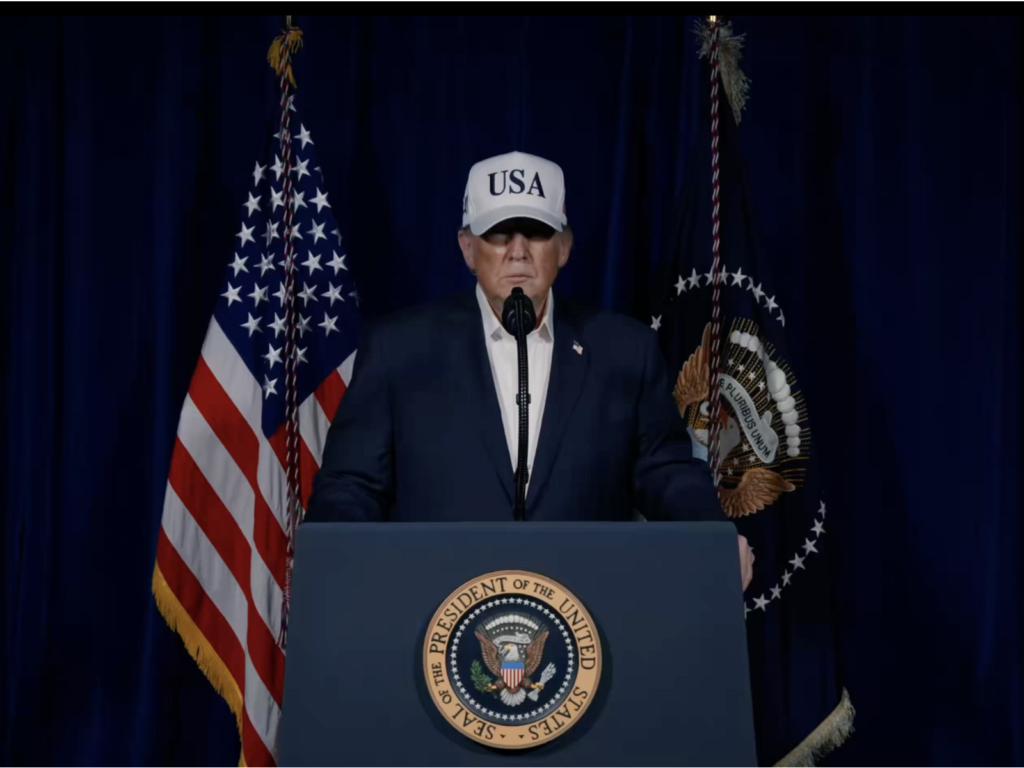
President Trump Announces “Operation Epic Fury” on February 28th 2026. Donald J. Trump, Public domain, via Wikimedia Commons
By Jake Harris / Arab America Contributing Writer
The Trump Administration’s initial timetable for the 2026 Iran War was 4-6 weeks. As of May 19th 2026, negotiations continue to stall, the Strait of Hormuz continues to be shut, and the U.S. economy continues to reckon with high oil prices. Trump has said publicly that the economic fallout from the war does not put any pressure on him, but it is clear the current conditions are unsustainable in the long term, particularly for the Republican Party as the midterm elections rapidly approach. The president will not be eligible to run for re-election in 2028, but the results of the midterms will be crucial in deciding the trajectory of his final two years in office. The questions remain: what “off-ramps” does President Trump have? How does he end the war without it being seen as a defeat?
The Negotiated Settlement
The most painless option is a negotiated settlement. The United States and Iran have been negotiating indirectly through Pakistan. The country has been playing the role of a third-party mediator. Iran and the United States have not had any diplomatic relations since the revolution in 1979 deposed the Shah. The Trump Administration has continued to maintain that the most important element in any negotiations is Iran’s enriched uranium. On April 16th, Trump claimed that the two sides were very close to a deal and that Iran had agreed to hand over enriched uranium. Over a month later, the two sides still failed to come up with any kind of agreement. Contrary to the White House’s claims that the U.S had “all the cards”, Iran continues to control the Strait of Hormuz. They also continue to launch attacks on Arab countries in the Gulf that have U.S military presence.
The bottom line is that there are going to have to be concessions on both sides for a negotiated peace agreement to be plausible. Further complications arise for the Trump administration on this front. The president has to make a deal that exceeds the benefits of Barack Obama’s 2015 Iran Nuclear Agreement. The JCPOA, signed by Barack Obama, provided Iran sanctions relief in exchange for limits on uranium enrichment and consistent inspections from the International Atomic Energy Agency. Trump left the agreement in 2018, claiming it was not tough enough on Iran and gave them a path to a nuclear weapon. If Trump signs an agreement that is similar to Obama’s deal, the whole war will be seen as a totally pointless misadventure. A detour to end up at the same starting point as before.
Possibility of a Ground Operation
If negotiations continue to stall, Trump may see an expanded military operation as his only avenue to achieving his aims. Military analysts have sounded the alarms on the difficulties of a ground operation. Iran’s geography is a significant obstacle. Mountainous terrain makes the country particularly difficult to invade, not to mention the population of over 90 million people. Whether a proposed ground operation would eventually succeed is separate from the likeliness that casualties would be enormous.
Trump has alternatively threatened strikes on Iran’s power plants and civilian infrastructure as a measure of forcing the Iranian government into submission. Attacking this infrastructure would put Iranian civilians in life-threatening danger. These would be actions that are completely contrary to the administration’s messaging that advocated for the freedom and prosperity of Iran’s people against an oppressive government. Bombing Iran’s civilian infrastructure could have the exact opposite impact on public opinion of the regime in Iran.
As of today, it is difficult to see a plausible off-ramp that doesn’t include caveats. In the future, conditions may change that allow for the United States and Iran to find a reasonable middle ground that allows for both sides to cut their losses without hurting their political capital at home.
The views and opinions expressed in this article are those of the author and do not necessarily reflect the position of Arab America. The reproduction of this article is permissible with proper credit to Arab America and the author.
Want more articles like this? Sign up for our e-newsletter!
Check our blog here!