
Subscribe
to receive news by email
Poll
Will the Trump Administration Shift U.S. Policy in Favor of Palestine?
- No (86%)
- Yes (14%)
 Loading ...
Copyright © 2026 Arab America
Go topWhen Brands Learn Arabic: How Global Companies Translate Themselves for Arab Consumers
Photo by Bent Van Aeken on Unsplash
By Shayla Frank / Arab America Contributing Writer
In 2019, a sneaker became a scandal. Nike’s Air Max 270 had been one of its biggest hits, until a customer noticed that the curving logo on the sole resembled the Arabic script for “Allah.” A petition followed, arguing that every step would grind the name of God into the ground, and more than fifteen thousand people signed it. Nike answered that the mark was only a stylized version of its Air Max trademark, with no other meaning intended. What unsettled the company was not that it had acted deliberately, but that it had never seen the problem at all.
This wasn’t the first time, in 1997, Nike recalled some 38,000 pairs after a flame-shaped logo drew the same objection, then apologized and funded a playground at an Islamic school. Two decades apart, the same brand had stumbled over the same script, and both times, no one tried looking at it through Muslim or Arab eyes.
Nike’s trouble belongs to an older way of thinking about the world. For much of the late twentieth century, a Western brand “went global” by exporting itself unchanged, and the Arab consumer was an afterthought, a market to enter rather than a culture to learn. That, in the end, is how a logo could come to resemble the name of God and still reach production.
What globalizing means now is almost the reverse. The Arab world is a young market, heavily online, with consumers who no longer wait for the pitch but watch how a brand behaves and decide for themselves whether it knows them. Getting it wrong costs more than it once did, because the audience notices quickly and has alternatives of its own. And getting it right is the difference between a company that speaks at the Arab consumer and one that has learned to speak with them.
First, the name itself
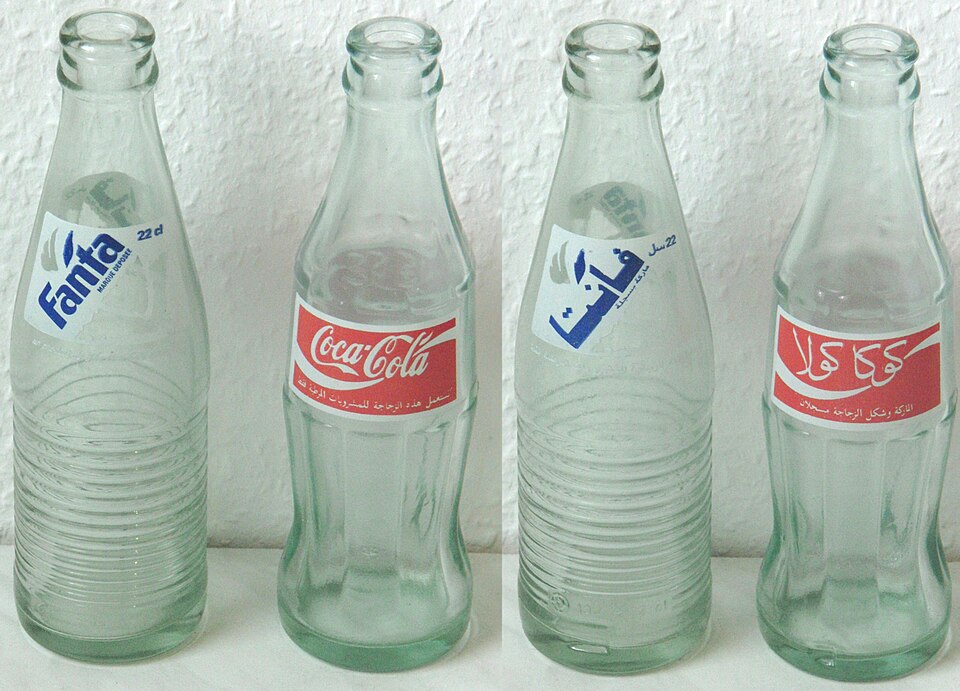
Photo by Bernard Landenthin, CC BY 4.0 Wikimedia Commons
Before a brand can win anyone over, it has to be sayable, and the gap between English and Arabic opens at a single letter. Arabic has no v and no p; those sounds simply do not exist in its classical inventory. A name like Volvo, then, cannot survive the crossing unchanged. To carry it across, Arabic borrows its closest neighbor, the letter for the f sound, and crowns it with three dots. The result, ڤولڤو, reads closer to “Folvo.” The same gap reshapes other names on the shelf. Pepsi becomes “Bibsi,” and Pepe Jeans shifts toward “Bebe Jeans,” the missing P giving way to a B. Guess is subtler still: its hard G belongs only to certain dialects, so it reads for most Arabic speakers as “Jess,” shorter and shorn of the serifs that once shaped it.
This is the difference between translating a brand and transliterating it. A translation carries the meaning; a transliteration carries the sound, spelling the name in Arabic letters so a reader can sound it out at all. Across the region, transliteration is the more common choice, and the reason is simple: a company wants its name to stay recognizable, not to trade it for an Arabic word that means the same thing.
The logo is the next test, because Arabic runs right to left and flipping a wordmark rarely finishes the job. Some brands handle it with real care. Coca-Cola redraws its famous script so that a wordmark reading bottom to top in English reads top to bottom in Arabic, and Schweppes, tapering left to right in English, tapers the other way. Starbucks went further still. It built an Arabic logo to echo the English one, then filled its Gulf cafes with Arabesque detail so the space feels native rather than imported.
The menu and the closet
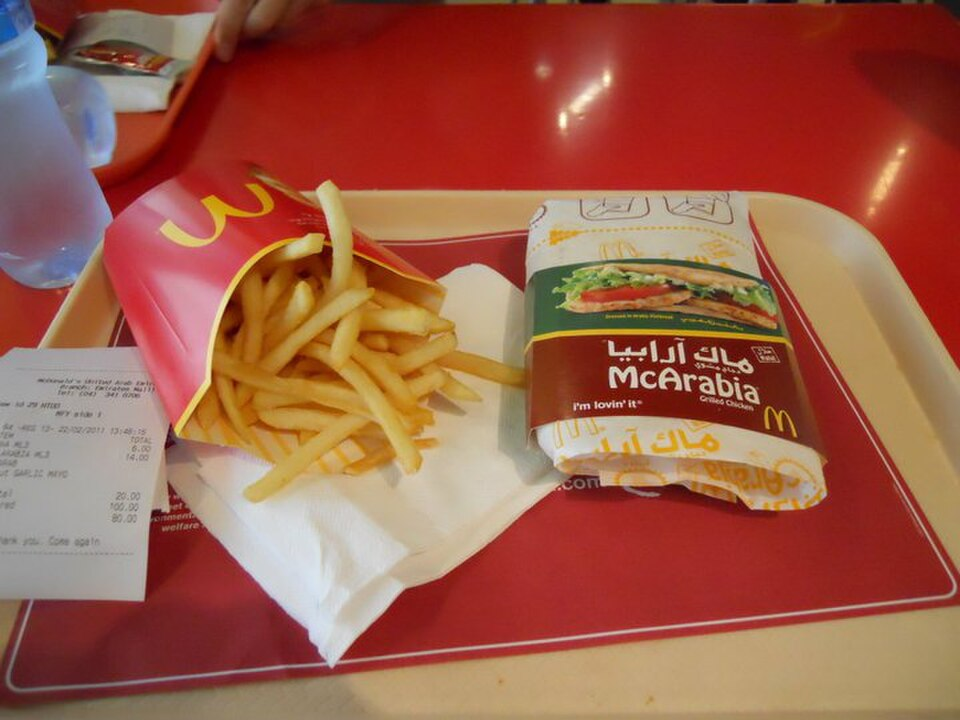
Photo by Robivy64, CC BY 3.0 Creative Commons Attribution-Share Alike
Names and logos are only the surface; the deeper work begins when the recipe itself changes. The simplest move is also the most sweeping. Across the Gulf, the big American chains run entirely halal, keeping pork off the menu and following Islamic rules of slaughter. Names from Shake Shack to KFC meet that standard in the region, even though their American branches do not. McDonald’s shows what fuller adaptation looks like in the McArabia, halal grilled chicken folded into Arabic flatbread. The chain introduced it in Saudi Arabia and the United Arab Emirates in 2003 and has kept it ever since. The McArabia arrived as boycotts hit American brands over the Iraq war, and a recognizably Arab product helped win those customers back.
Fashion has moved the same way, and the names are familiar. In 2016, Dolce and Gabbana set aside its figure-hugging silhouettes to release its first collection of abayas and hijabs, long robes in muted georgette and lace. It aimed the line at Gulf shoppers, and it was not alone. Tommy Hilfiger, DKNY, Oscar de la Renta, and Mango have all built Ramadan capsule collections. H&M cast Mariah Idrissi as its first hijab-wearing model, and Uniqlo brought in the designer Hana Tajima to shape a modest line of its own. Nike, meanwhile, pushed the idea into performance. It released its Pro Hijab in 2017, refining it over rounds of testing with Muslim athletes. Among them were the Emirati weightlifter Amna Al Haddad and the figure skater Zahra Lari. Women who cover could finally train and compete without improvising and the pull behind all of it is plain. Muslim consumers spent around 230 billion dollars on clothing in 2014, close to a tenth of the global fashion market.
When brands get it right
Photo Credit: Public Domain
If one product shows what it means for a brand to belong, it is a deep purple cordial that began in Manchester in 1908. Vimto was a British health tonic with no link to the Arab world, until a Saudi trading family, the Aujans, carried it to the Gulf in 1927. A century later, it is inseparable from Ramadan. More than 25 million bottles sell across the region during the holy month each year. The local recipe runs sweeter and more concentrated than the British one, matching the body’s craving for sugar after a long fast. Yet what fixed it in place was not the flavor alone, but the ritual around it. Families mix it by hand rather than pour it from a can. A parent then prepares it and passes it to the children, a small ceremony at the iftar table that one generation hands to the next.
Belonging on that scale is rare, but the everyday work of getting Ramadan right is visible the moment the sun goes down. Trade slows through the fasting hours, then surges after iftar, with a second rush near midnight for suhoor, the meal before dawn. McDonald’s keeps its Gulf restaurants closed through much of the day and opens only in the evening. The luxury retailer Ounass stretched its overnight ordering into the early morning. It had noticed customers browsing at midnight and buying at two or three. Serving people, it decided, means meeting them in their own rhythm. Around it, the whole night economy adjusts, with malls glowing past midnight and transport running later to match.
The marketing follows the same rule, rewarding feeling over the hard sell. In 2015, Coca-Cola ran a Ramadan campaign across the region that stripped its own name off the can. The line said that labels belong on bottles and not on people, a quiet argument against prejudice during a month of reflection. Nike’s own arc closes the case. The company that once stamped a sacred word onto a sole without seeing it later changed course. And it built a campaign from inside the culture rather than on top of it. Nike filmed its “Style By” series in the old quarters of Dubai. The campaign treated everyday modest dressing as a personal choice and a form of self-expression, drawing on local creatives and artisans in the telling. It resonated because it mirrored a life people actually lived, not a foreign idea of one. That is the whole distinction in miniature, the difference between talking at people and speaking their language.
When they get it wrong
The failures tend to share a root, and it is rarely malice. More often, a brand simply speaks before it has listened. Nike’s logo was the plainest version, a design that shipped because no one had read it in Arabic. Nivea managed something worse on purpose. In 2017, its Middle East account promoted a deodorant with the line “White is purity” beneath a woman robed in white. The slogan proved so tone-deaf that white supremacists online embraced it, before the company pulled the ad and apologized. The misread cut deepest in a region where colorism is a live nerve. Nivea, after all, had pushed an idea into the market with no feel for how it would land.
A quieter failure is the brand that adapts without conviction, and even the fashion houses courting Muslim shoppers have drawn that charge. Critics noted that the same labels arriving with abaya collections had overlooked Muslim women for years. The timing, they said, tracked the size of the market more than any change of heart. The pattern returns every Ramadan. Companies reach for the month’s furniture, the lanterns and the crescent moon, with none of the meaning beneath them. As one regional brand adviser put it, consumers can tell at a glance. They know which companies understand the month, and which are only decorating around it.
The political layer sits underneath all of this, and it is not new. The McArabia grew out of one boycott, and the region has seen others since. In the Arab world, shoppers read a brand as an actor rather than a neutral object. They will turn from a company they feel has taken the wrong side. The triggers change with the news. After the war in Gaza intensified in late 2023, several well-known Western brands reported softer sales across the region. They pointed to boycotts, and the pressure persisted well into 2025. Here, a brand is never only a product.
These, together, are the terms a global brand now faces in the Arab world. The script will bend to hold a foreign name, and the menu and the wardrobe will rearrange themselves to fit. But the audience beyond it has grown harder to win and quicker to judge. It can tell the difference between a company that learned the language and one that only borrowed the alphabet.
Growing Inside the Market
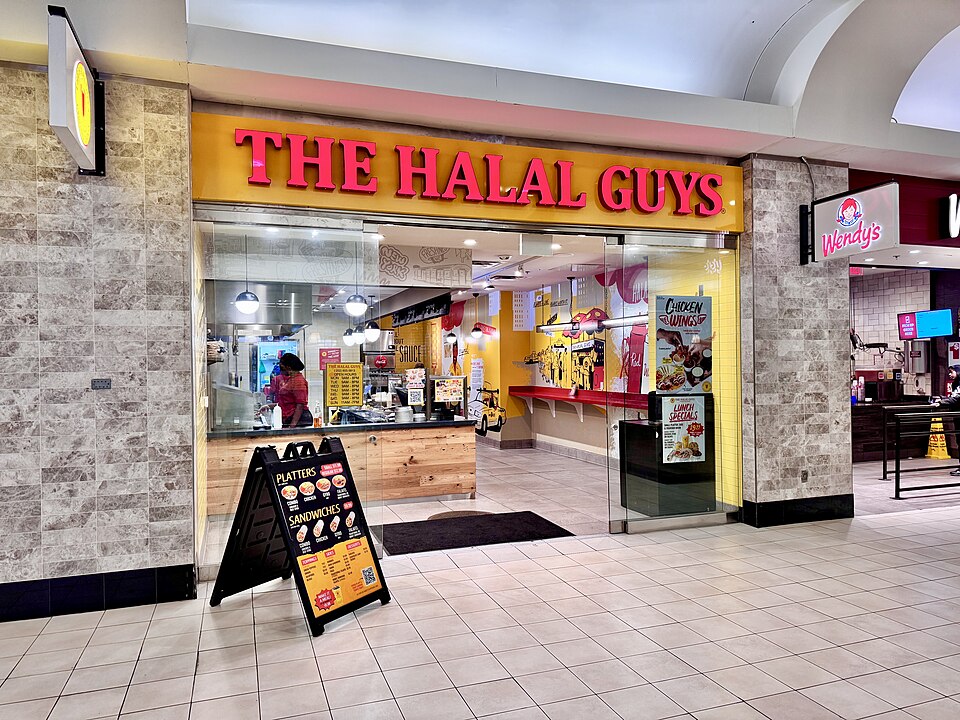
Photo by Harrison Keely, CC BY 4.0 Wikimedia Commons
It helps to remember that some brands never had to learn it, because they grew up inside it. The Halal Guys began in 1990 as a single hot dog cart in Manhattan, run by three Egyptian immigrants. They switched to halal platters for the city’s Muslim cab drivers, then grew into a global chain. In Brooklyn, Sahadi’s, a Middle Eastern grocer, has anchored Atlantic Avenue since 1948. It still sells the spices and sweets of home to whoever walks in. A newer wave of Yemeni-American coffeehouses does the same, with spiced qahwa and the slow ritual of sitting together. These are mostly small businesses, run by Arab Americans. And they carry the feeling the multinationals keep trying to manufacture, without a focus group to find it. For a reader deciding where to spend, they are worth seeking out beside the global names.
Learning Arabic, for a brand, was never about the letters. It was about whether anyone bothered to understand the people who speak it. Some, it turns out, never had to be told.
Want more articles like this? Sign up for our e-newsletter! Check out our blog here!