
Subscribe
to receive news by email

Poll
Will the Trump Administration Shift U.S. Policy in Favor of Palestine?
- No (86%)
- Yes (14%)
 Loading ...
Copyright © 2026 Arab America
Go topBeyond the Blockade: Why Gaza Flotillas Continue Despite Sanctions and Seizures
By Aziz Hellal / Arab America Contributing Writer
For nearly twenty years, the sea has been one of the few ways activists have tried to challenge the blockade on Gaza. Since 2007, the movement of people and goods in and out of the strip has been tightly controlled. This blockade shapes every part of daily life for over two million Palestinians.
While many international efforts happen in government buildings, the “Gaza Flotillas” take the struggle directly into the water.
Even after years of boat seizures and the deadly 2010 Mavi Marmara raid, these missions have not stopped. Instead, they have become a symbol of global solidarity and a way to keep the world’s attention on Gaza.
The Origins of the Gaza Flotilla Movement
The Gaza flotilla movement began as a grassroots effort to challenge the blockade by sea. This became a priority after 2007, when Israel tightened restrictions on the territory following Hamas’s takeover. For the two million people living there, the blockade didn’t just mean security checks—it meant a total shift in daily life, with severe limits on food, medicine, and travel.
Israel argued that the blockade was necessary for security reasons and to prevent weapons from reaching Hamas. While critics described it as collective punishment that worsened humanitarian conditions inside Gaza.
Activists from different countries sought ways to reach the territory without relying on heavily restricted land crossings. The idea was simple but politically powerful: civilian boats would sail toward Gaza carrying humanitarian aid and international activists.
The first major move came in August 2008 from the Free Gaza Movement. Two small boats sailed from Cyprus toward Gaza with medical supplies and 44 activists from 17 countries. Unlike most missions that followed, these boats reached Gaza. They stayed for several days, proving that the sea could be a new space for international solidarity.
From the start, these missions were about more than just delivering supplies. Since they couldn’t carry enough aid to sustain a whole population, the real goal was to grab the world’s attention.
The sea turned a “closed” territory into a visible international issue, putting pressure on governments to address a crisis they had mostly ignored through traditional diplomacy.
The Turning Point: The Mavi Marmara Raid
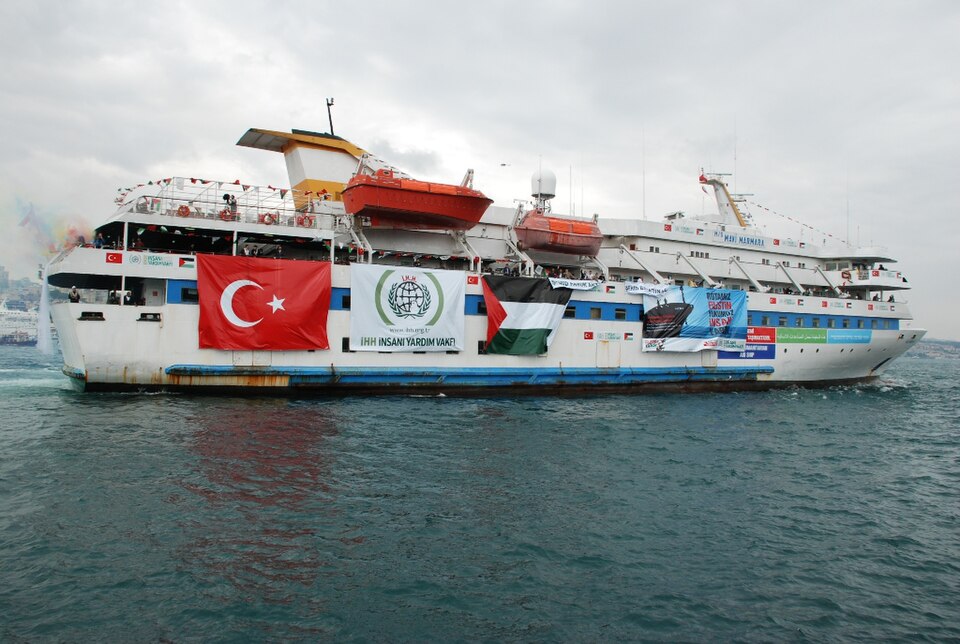
The flotilla movement gained international attention in May 2010 during the raid on the Mavi Marmara. This Turkish ship was part of the larger “Freedom Flotilla” coalition. The convoy consisted of about six vessels carrying nearly 750 activists from 40 countries, along with humanitarian aid and construction materials.
Before 2010, flotilla missions were relatively small. The Mavi Marmara changed everything. As the ships moved through international waters toward Gaza, Israeli naval forces intercepted them. During the boarding of the Turkish vessel, violence broke out, leading to the deaths of 10 activists and injuring dozens more.
Israel defended the raid as a necessary security operation to enforce the naval blockade. However, critics saw it as an excessive use of force against civilian activists attempting to deliver humanitarian aid in international waters.
The incident quickly became a global political crisis. Turkey withdrew its ambassador and froze military cooperation with Israel, and the raid triggered protests and investigations around the world.
More importantly, the Mavi Marmara transformed the movement into a global symbol. After 2010, the flotillas began attracting lawmakers, journalists, and public figures. Even when missions were blocked, they generated a level of political pressure that earlier campaigns never could.
This legacy of high-stakes activism set the stage for the massive Global Sumud Flotilla we are seeing today in 2026, where once again, the Mediterranean has become the center of a global diplomatic standoff.
Why the Flotillas Never Disappeared
Despite years of boat seizures and legal threats, the Gaza flotilla movement persists. Activists understand that even if they don’t reach shore, their efforts draw media attention and prompt discussions about the blockade.
While these boats often carry a symbolic amount of aid, organizers admit that their main goal isn’t just delivery. Their goal is political and symbolic: to challenge the normalization of Gaza’s isolation and pressure governments that have failed to change the situation through diplomacy.
When a ship is intercepted in international waters, it creates a media event and a diplomatic headache that humanitarian aid trucks don’t. Images of detained activists and halted ships in international waters turned the flotillas into significant political events rather than simple humanitarian deliveries.
That pattern appeared again in May 2026, when the Global Sumud Flotilla was intercepted, and hundreds of activists were detained or deported. With some reporting injuries and abuse after detention.
Those actions pushed countries such as Ireland, Spain, and Turkey to summon Israeli ambassadors, the crackdown did not end the movement. Instead, it showed why the flotillas continue to keep Gaza in the global conversation.
Will Sanctions Stop the Movement?
The new sanctions on organizers might make it harder to sustain the flotilla movement. These legal moves can limit fundraising, restrict travel, and create deep uncertainty for volunteers.
On May 19, 2026, when the U.S. Treasury sanctioned four European activists from the Global Sumud Flotilla, labeling the mission “pro-terror.” For organizers, being branded as a security threat makes it easier for governments to justify stopping their ships before they get close to Gaza.
However, for many supporters, this crackdown has the opposite effect. They argue that humanitarian solidarity is being criminalized, which only makes the missions more symbolic. Instead of fading away, the pressure can turn the flotillas into a stronger form of resistance.
These missions aren’t just judged by whether they reach the shore. Their success depends on keeping the blockade in the global spotlight.
If every interception or sanction creates an international outcry—like the one we see now after the 422 activists were deported back to Istanbul—then the movement remains politically effective. Even when the ships are physically blocked, they still manage to turn the world’s attention back toward Gaza.
In the end, nearly two decades after the first flotillas sailed toward Gaza, the movement continues to survive despite raids, sanctions, and repeated failures at sea.
Whether viewed as humanitarian activism or political provocation, the flotillas have succeeded in keeping Gaza’s blockade part of the global conversation. And as long as activists believe the world is still looking away, ships will likely continue sailing toward Gaza’s shores.
Want more articles like this? Sign up for our e-newsletter!
Check out our blog here!