Subscribe
to receive news by email

Poll
Will the Trump Administration Shift U.S. Policy in Favor of Palestine?
- No (86%)
- Yes (14%)
 Loading ...
Copyright © 2026 Arab America
Go topWashington Must Accommodate Pro-Palestinian Advocacy
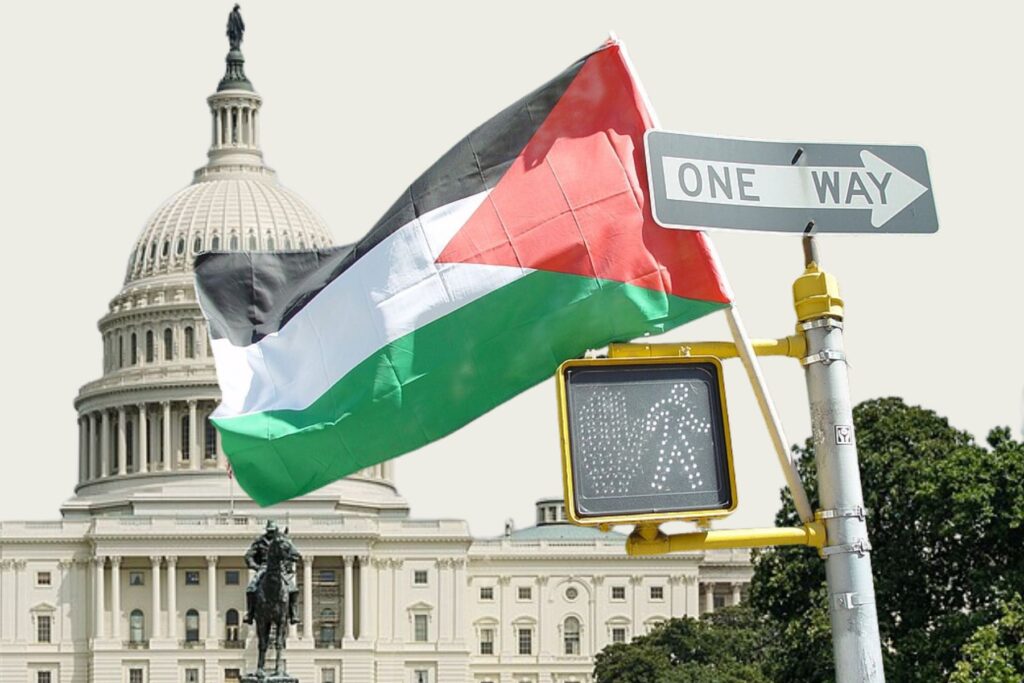
Photo collage by Rami Balin
By: Ghassan Rubeiz / Arab America Contributing Writer
Palestinian Americans have become one of the most influential moral and political forces shaping Washington’s response to the Palestinian crisis. Their activism is no longer episodic or symbolic; it is sustained, organized, and increasingly impossible for policymakers to ignore. Since October 2023, civic engagement among Palestinian Americans has reached levels unprecedented in modern U.S. Middle East politics. It began in the streets, with the November 2023 march in Washington — the largest pro-Palestinian demonstration in U.S. history, drawing an estimated 200,000 to 300,000 people. Three years later, it is reshaping ballots and votes in Congress.
This month, Abdul El-Sayed won Michigan’s Democratic Senate primary running on a platform centered on affordability plus emphasis on Palestinian rights and an end to unconditional military aid to Israel. He beat back over $60 million in outside spending against him, roughly $30 million of it from AIPAC, the largest and most powerful lobbying organization for Israel — and still won by one percentage point, although he was outspent by his opponent in the ratio of 10 to 1. This result shows that the old money advantage no longer guarantees the desired result. In New York Democratic primaries, Gaza activist Daria Liza Avila Chevalier unseated a five-term incumbent backed by an AIPAC-affiliated super PAC. The U.S. Campaign for Palestinian Rights Action endorsed sixteen candidates this cycle on a platform rejecting AIPAC funding; eleven of the fourteen who have faced primaries so far have won. Pro-Palestinian candidates are no longer fighting the Democratic establishment from the outside, but rather they are growing to be a significant part of the Democratic Party itself.
Congress is registering the same shift, though not yet a majority. In July, the House voted on an amendment to strip $3.3 billion in military financing to Israel from the annual State Department spending bill. It failed, 314 to 104 — but 103 of 212 House Democrats voted to cut off the aid, including Democratic Whip Katherine Clark and former Speaker Nancy Pelosi. Republicans held firm; only one of the amendment’s own sponsors crossed party lines. What matters is not that the amendment did not pass but that nearly half the Democratic caucus was willing to vote for it at all, a position unthinkable a decade ago. This follows a December letter from 49 members of Congress to the White House protesting Israeli violations of the Gaza ceasefire, and a February bill, backed by 25 co-sponsors, to condition future weapons transfers on Israeli compliance with the ceasefire. This shift reflects sustained advocacy from organizations such as the American-Arab Anti-Discrimination Committee, the U.S. Campaign for Palestinian Rights, the Arab American Institute, and Arab America, alongside a younger generation of activists skilled in digital mobilization.
Chief among the allies driving this shift is a growing bloc of Jewish American youth. Groups like Jewish Voice for Peace, IfNotNow, and Jewish Currents — led largely by young Jewish Americans — have lobbied for Palestinian rights, staged sit-ins on Capitol Hill, and disrupted political events, challenging the presumption that unconditional support for Israel reflects American Jewish consensus. When they stand alongside Arab and Palestinian Americans at the ballot box and in the streets, they form a coalition with moral authority Washington struggles to dismiss — one that recalls, in its fusion of churches, unions, campuses, and civil rights groups, the coalition that eventually forced Washington to confront apartheid in South Africa.
U.S. Public opinion has moved with them. A Gallup poll last summer found American approval of Israel’s military conduct at 32 percent, a record low, with disapproval at 60 percent. The erosion is sharpest among Democrats and independents; Israeli Prime Minister Netanyahu’s favorability among Americans has fallen to its lowest point on record. These numbers give Palestinian American advocacy significant results, undermining the old Washington assumption that their voices were marginal.
Their influence is also strategic. Coalition-building has pushed major news outlets to sharpen coverage; investigations by The New York Times and The Washington Post have documented civilian casualties and the destruction of Gaza’s infrastructure, corroborating claims Palestinian Americans have made for years. Several State Department staff members have resigned publicly, citing moral objections to U.S. policy on the issue.
What distinguishes Palestinian Americans today is their insistence on accountability — asking why Washington continues to arm a campaign that has killed civilians even after a ceasefire was supposed to take effect last October, and exposing the gap between American rhetoric and policy.
This is not a temporary surge of activism but a structural realignment inside the Democratic Party — Republicans have shown no comparable shift, which means the political fight is not yet won. But within the Democratic Party, Palestinian Americans have become a constituency it must engage, not out of courtesy, but necessity. Joined by a rising generation of Jewish American youth unwilling to accept that recent Israeli policy as morally defensible, they are reshaping primaries, Congressional votes, and public opinion alike — perhaps the early stages of a reckoning that may yet reshape America’s role in the world.
Ghassan Rubeiz is the former Middle East Secretary of the World Council of Churches. Earlier, he taught psychology and social work in his country of birth, Lebanon, and later in the United States, where he currently lives. He has contributed to political commentary for the past twenty years and has delivered occasional public talks on peace, justice, and interfaith topics. You can reach him at rubeizg@gmail.com
The views and opinions expressed in this article are those of the author and do not necessarily reflect the position of Arab America. The reproduction of this article is permissible with proper credit to Arab America and the author.
Want more articles like this? Sign up for our e-newsletter!
Check our blog here!