

Subscribe
to receive news by email

Poll
Will the Trump Administration Shift U.S. Policy in Favor of Palestine?
- No (86%)
- Yes (14%)
 Loading ...
Copyright © 2026 Arab America
Go topAmeen Rihani at 150: The Poet with His Own Foreign Policy
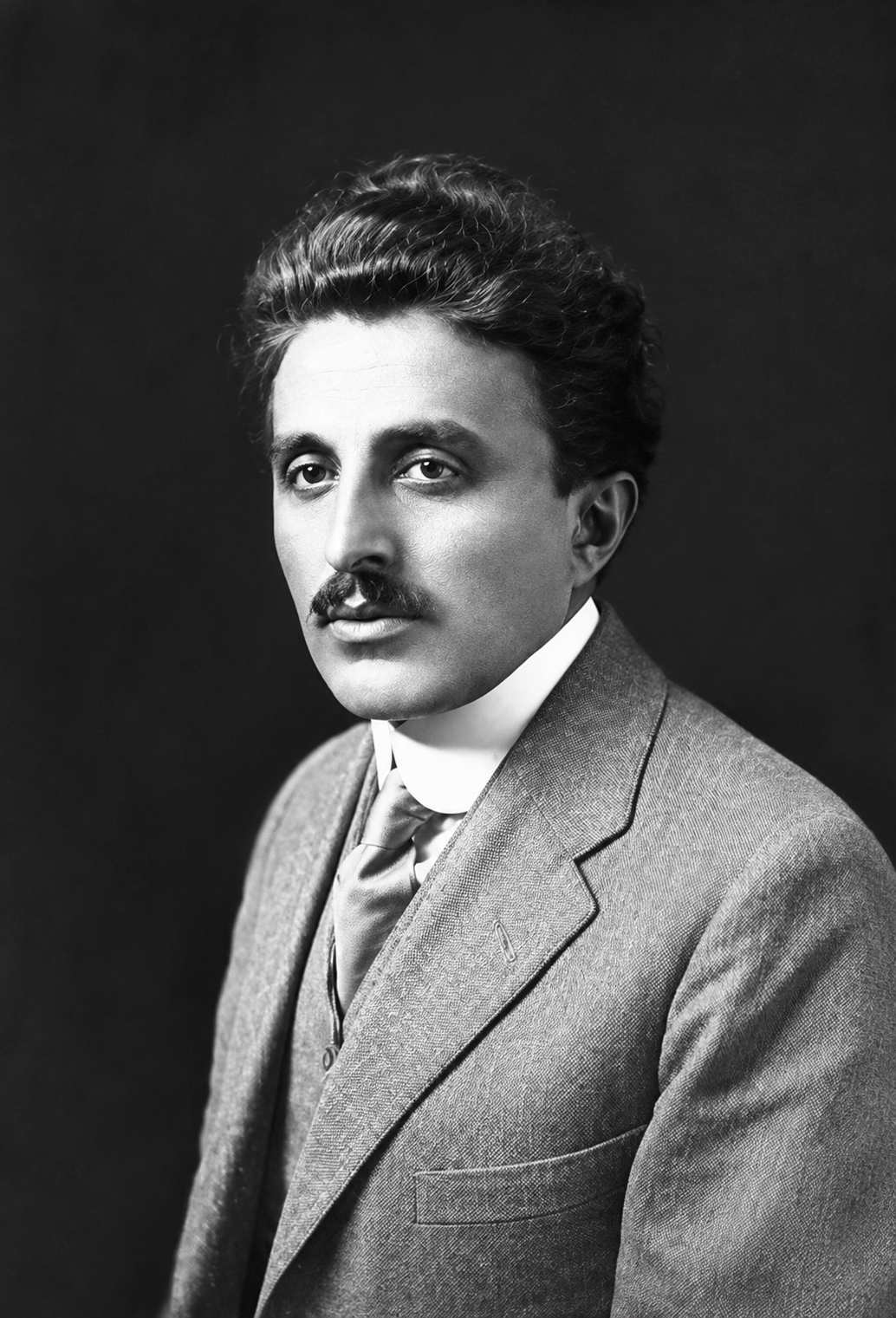
By Todd Fine / Arab America Contributing Writer
Ameen Rihani was born 150 years ago today in Freike, in Mount Lebanon. He is remembered as a founding figure of Arab American literature, including for The Book of Khalid (1911), the first novel in English by an Arab American. But in our time of genocide, moral cowardice, corruption, and resurgent fascism, we should elevate another Rihani: a private citizen who refused to leave international politics to governments.
Rihani reached New York with his uncle in 1888, not yet twelve. In the preface to Mulūk al-ʿArab (Kings of the Arabs, 1924), he recalls that Ralph Waldo Emerson led him to Thomas Carlyle, and that Carlyle “was the first to bring me back across the seas to the land of the Arabs.” Carlyle’s On Heroes also taught him that individuals make history. At home in two languages and two rising worlds, American and Arab, he felt bound to use his rare position to act in politics himself.
After World War I, Washington shelved its own King-Crane report, which found Syrians wanted independence or an American mandate, and stood aside as Britain and France divided the region. As a counter, Rihani looked to Arabia, where Arab rulers still held their own thrones and the contest among King Hussein of the Hijaz, Ibn Saud of Najd, the Idrisi of Asir, and the Zaydi Imam Yahya of Yemen remained open.
In 1922 he set out to meet them all. No Arab king knew the others, he observed. Only the British Colonial Office knew the whole peninsula, and it had no interest in introducing them. “So here I am in this book,” he stated, “without pride and without apology, introducing my lords the kings of the Arabs to one another.”
“King Hussein’s subjects obey him and fear him,” he wrote. “Ibn Saud’s subjects obey him and love him.” Imam Yahya’s obeyed “without love and without fear.” He called sectarianism, Wahhabism in Najd and Zaydism in Yemen, the “first disease” blocking Arab unity, and warned that even if most of Arabia submitted to Ibn Saud, Yemen would remain “rebellious, defiant, at war.”
Rihani would become an independent diplomat in this morass. In Sanaa in May 1922, carrying a letter from King Hussein, he negotiated a treaty of alliance between the King and the Imam, clause by clause. In Sanaa in May 1922, carrying a letter from King Hussein, he negotiated a treaty of alliance between the King and the Imam, clause by clause. Hussein, who insisted on being recognized as King of the Arabs, never signed it.
Ibn Saud, Hussein’s great rival, mattered most for any prospect of Arab unity. Earlier that spring, Rihani had written from Lahej, near Aden, asking to visit Najd. Between them lay, as he put it, “the Indian Ocean, the Nufoud, the Dahna — and the English.” British officials kept him waiting six weeks in Aden for permission, then routed him through Bombay and Baghdad. He finally reached the Gulf port of Uqair in November 1922, as Ibn Saud and Sir Percy Cox, Britain’s high commissioner in Iraq, met to settle the borders of Najd, Kuwait, and Iraq. Neither had a good interpreter, so Rihani translated for both.
There, Frank Holmes, a New Zealand-born engineer and acquaintance of Rihani’s, wanted an oil concession for al-Hasa, in what is now Saudi Arabia’s Eastern Province. Rihani went over the contract by kerosene lamp and “strongly recommended” it. The rival Anglo-Persian Oil Company was, he noted, “virtually the British Government.” Cox asked Ibn Saud to write Holmes that he could give no answer until he had consulted the British government, and to send Cox a copy. “Three times the Sultan refused,” Rihani recorded, “and three times the High Commissioner insisted.” In the end the letter was written. Ibn Saud’s treaty with Britain required a British company, Rihani argued, but not London’s choice: “Your Highness is sovereign in your land.” In April 1923, with Holmes ready to quit, Rihani encouraged him: “Never mind what Sir Percy Cox says.” Ibn Saud agreed with Rihani and signed with Holmes that May.
Holmes’s concession would lapse, and in 1933 Standard Oil of California, whose subsidiary became Aramco, won the next. Had, instead, al-Hasa’s oil gone to a British government company, the century to come might have looked very different.
From Uqair, Rihani rode by camel to Riyadh. For six weeks, he wrote, “the Sultan visited me every evening” to talk of Arab unity, and when malaria struck, Ibn Saud brought him medicine himself. Still weak, he left in late January 1923 to cross the desert to Kuwait. The congress of Arab rulers he proposed never met.
Some critics fault Rihani’s admiration for Ibn Saud. “I have now met all the Kings of Arabia,” he wrote, “and I find no one among them bigger than this man.” But he did not back him blindly, insisting that Ibn Saud’s rule over his neighbors carry “no sectarian coloring,” and hoping “the sovereignty of reason, justice, and tolerance” would one day replace the rule of sect. Maker of Modern Arabia (1928) introduced Americans to a kingdom that became an anchor of U.S. foreign policy for nearly a century.
That book and two more in 1930, Around the Coasts of Arabia and Arabian Peak and Desert, made Rihani’s name by depicting these Arab rulers with histories and reasonable aims of their own. He spent that standing on Palestine. By 1930 the Jewish Telegraphic Agency called him the “American spokesman for the Palestine Arabs.” He debated Zionist leaders, lobbied Congress, and called for a halt to Jewish immigration and for a joint Arab-Jewish assembly to govern the country.
In 1922, Rihani held no office or mandate, and no government sent him. He went anyway, at real personal risk, translated in both directions, and told British officials, Arab kings, and the U.S. Congress what they did not want to hear.
Palestine is where his example resounds strongest today. The American government did not merely look away from genocide in Gaza. It supplied the bombs and, at the United Nations, vetoed effort after effort to halt the destruction. Like Rihani, we cannot wait for Washington to find its conscience. He never asked whether a poet was allowed to make foreign policy. Each of us must find our own way to act.
Todd Fine has a PhD in American history from the Graduate Center of the City University of New York. He is the editor of a critical edition of Ameen Rihani’s The Book of Khalid with Syracuse University Press.
Want more articles like this? Sign up for our e-newsletter!
Check out our blog here!