Subscribe
to receive news by email

Poll
Will the Trump Administration Shift U.S. Policy in Favor of Palestine?
- No (86%)
- Yes (14%)
 Loading ...
Copyright © 2026 Arab America
Go topAbdul El-Sayed Is Making Headway But Not Just With Progressives
By: Megan Guzman Abbott / Arab America Contributing Writer
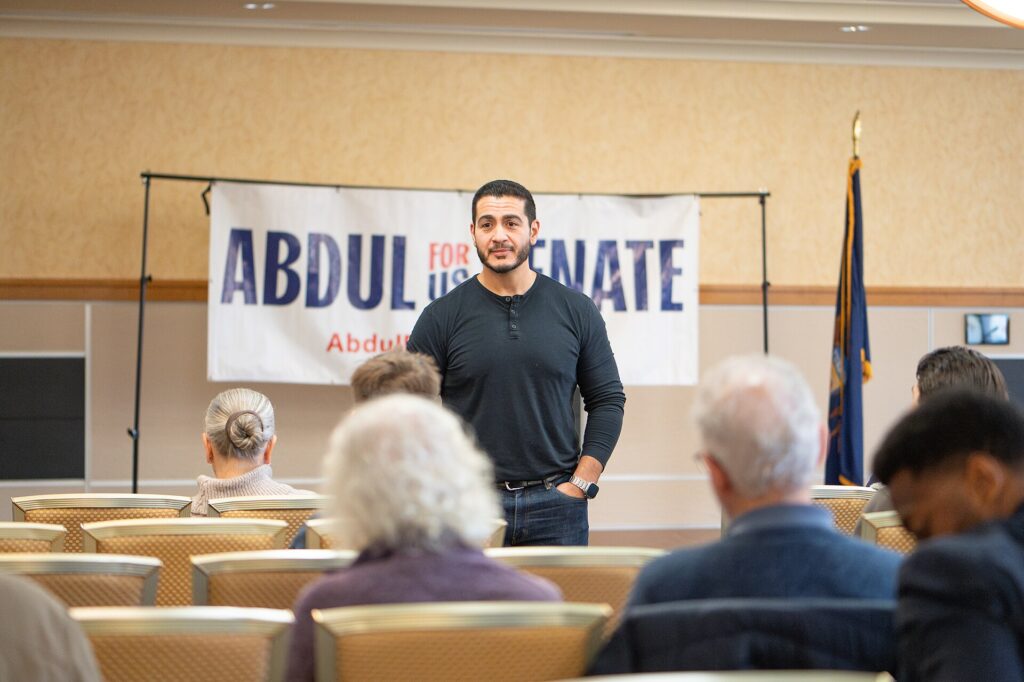
Abdul El-Sayed entered Michigan’s 2026 U.S. Senate general election as the Democratic nominee after narrowly defeating Rep. Haley Stevens in the primaries, winning by just under one percentage point. Now facing Mike Rogers, the Republican nominee, El-Sayed is trying to reach voters beyond his progressive base.
El-Sayed’s primary campaign was centered on grassroots movements, gaining support from prominent figures such as Sen. Bernie Sanders, Rep. Alexandria Ocasio-Cortez, and Rep. Rashida Tlaib, while emphasizing issues such as health care, affordability, and opposition to outside spending. Throughout the campaign, he also made U.S. policy toward Israel and Gaza an important issue.
Nevertheless, a Washington Post analysis found that El-Sayed performed very well with young voters, but when it came to Black voters, he underperformed, showing one of the areas where his campaign would need to expand in the general election.
Reaching Black Voters
Black voters are an important constituency for any Democrat seeking office in Michigan. To improve his outreach, El-Sayed recently appeared with former Vice President Kamala Harris in Detroit, where she joined him for a roundtable at Birth Detroit focused on Black maternal health. Here, El-Sayed emphasized his background in medicine and public health while speaking alongside one of the most popular Democratic figures amongst the Black population.
Nevertheless, this also revealed the two politicians’ complicated political history. During the 2024 presidential campaign, El-Sayed criticized the Biden administration’s approach to Israel and Gaza. Yet, during the Detroit event, El-Sayed made a public statement directly addressing the disagreement, saying:
“My disagreements with the then-vice president’s positions on Gaza are clear, and I still disagree with the position on which she ran in 2024,” El-Sayed said. “There are going to be issues on which there are disagreements in the party, and there are a lot of issues on which there are agreements.”
This presents much more than just an endorsement, but a sense of partnership and an effort to find common ground in a political environment where everyone will have competing views.
Outreach to Jewish Voters
Jewish voters make up another constituency El-Sayed has worked on engaging following the primary. Being an open critic of Israel and opposing U.S. military aid to Israel became major issues during the Democratic primary, particularly as AIPAC and affiliated groups spent close to $30 million supporting Haley Stevens, who ran against El-Sayed in the primary.
This issue has continued to follow El-Sayed into the general election, with some Jewish leaders and voters criticizing his position while others have supported his candidacy. In September, former Sen. Al Franken and more than two dozen Jewish Americans endorsed El-Sayed, arguing that El-Sayed’s position on Israel and international law is less outside the mainstream foreign-policy debate than some believed.
A more notable endorsement came from former Rep. Sander Levin, a longtime Michigan Jewish Democrat, who endorsed El-Sayed despite describing disagreements with him over Israel. Sander Levin posted a statement on X, saying:
“I have some significant disagreement with Abdul in his approach to the conflict involving Israel and the Palestinians… I have been a strong proponent of a two-state solution to that crisis, and he has not supported this approach. Yet, as I reflect, I must say that I have had disagreements with many colleagues in the House and Senate over the decades, but I have never failed to support the full Democratic ticket.”
And although the response among Michigan’s Jewish voters has remained divided, support for El-Sayed has become increasingly visible. In September, more than 600 Michigan Jews signed an open letter pledging to vote for him, including progressive Jewish leaders and Democratic figures. Alongside this support, others continued to express concerns about El-Sayed’s positions on Israel and called for stronger commitments to Jewish safety and Israel’s security.
The conversation has continued to evolve in these final weeks. On September 29, the Jewish Telegraphic Agency reported that Michigan Jewish activists were pressing El-Sayed on his views toward Israel. For now, the Jewish Democratic Council of America has not endorsed either candidate.
Building Beyond the Progressive Movement
El-Sayed’s outreach has also begun extending beyond traditional Democratic constituencies. On September 29, The Washington Post reported that his campaign is trying to focus on supporters of the Make America Healthy Again movement, including voters concerned about pesticides, food safety, and corporate influence in agriculture. His “Building a Healthier America” agenda calls for tighter pesticide regulations, stronger drinking-water protections, action on PFAS, and other public-health measures.
His outreach to Black voters addresses one of the clearest gaps exposed by the primary. His engagement with Jewish voters has shown an effort to communicate with a community where his position on Israel has drawn both strong opposition and support. His newest collaboration with Kamala Harris places him alongside one of the country’s most prominent Democratic figures and allows his campaign to appeal to voters who may be less connected to the progressive movement.
At the same time, El-Sayed has not abandoned the political identity that he brought into the primary. Progressive organizations and voters remain a major part of his coalition; his positions on health care, economic inequality, campaign finance, and U.S. foreign policy continue to remain central to his campaign.
For Arab Americans, El-Sayed’s candidacy carries additional significance. If elected, he would become the first Muslim U.S. senator. It has been clear to see the impact Arab Americans have had throughout the race, particularly in debates over U.S. policy toward the Middle East.
Recent polling shows a competitive election. A New York Times/Siena poll conducted in late September found El-Sayed leading Mike Rogers 49-44% among likely voters, while a Rasmussen survey conducted around the same time showed El-Sayed ahead 47-44%. Still, the race remains very close.
Now, it’s up to whether El-Sayed can continue expanding the coalition that brought him through the Democratic primary.
Want more articles like this? Sign up for our e-newsletter!
Check out our blog here!