
Subscribe
to receive news by email
Poll
Will the Trump Administration Shift U.S. Policy in Favor of Palestine?
- No (86%)
- Yes (14%)
 Loading ...
Copyright © 2026 Arab America
Go topNaming Culture: The Struggle for Palestinian Heritage
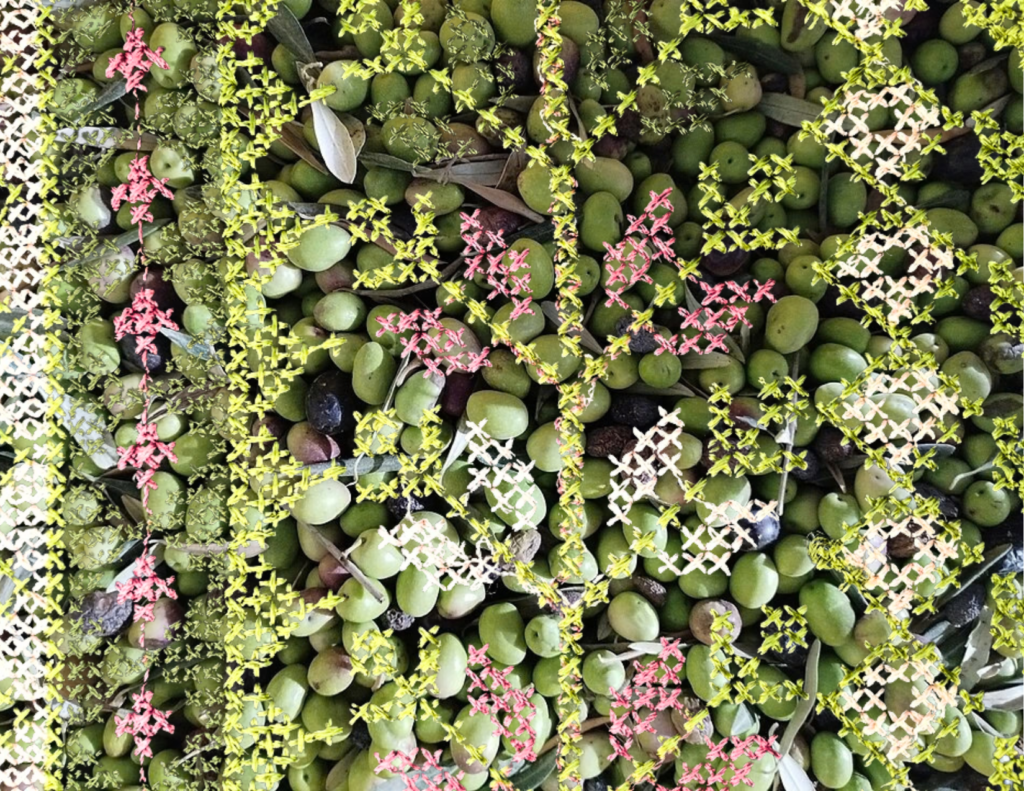
Collage by Rami Balin.
By: Rami Balin / Arab America Contributing Writer
Middle Eastern, Mediterranean, Levantine – these descriptors are used when referring to music, art, food, architecture, dance, and many other aspects of life and culture in the geographic regions they are encompassing. However, all these terms have been routinely appropriated as they signify abstracted notions of culture without accounting for its multiplicity, connection to distinct places and interactions of diverse populations within them. For Palestinian culture under settler-colonial occupation, names and definitions are a huge part of the emancipatory struggle for self-determination.
In the episode of Tarwida, a podcast about Palestinian arts, culture and heritage, Palestinian chef Joudie Kalla talks about her decisive choice to refer to the food that she learned to cook from her mother and aunts as Palestinian food, arguing that the term “Levantine” generalizes local knowledge, creating an amalgamation of meanings and thus not acknowledging the significance of recipes and of food as heritage and a mode of resistance to colonial appropriation of culture. In the same vein, Palestinian chef Fadi Kattan insists on the particularity of food as unique to the location, and ultimately the land it is inextricably tied to, from the availability of specific ingredients to the functions of seasons and whole ecosystems.
Culture Rooted in the Land
After the 1948 Nakba, the ethnic cleansing campaign carried out by the Zionists against Palestinians in historic Palestine that led to the exodus of 800 000 Palestinians, with many killed by the Zionist militias, the state of Israel was established. Since then, Palestinian dispossession has been defining cultural preservation. Zionists have been employing a number of tactics to justify and legitimize the settler-colonial project, namely eradicating Palestinian people, their culture and their land. If they can’t resort to destruction, appropriation is the order of the day. One of the stark examples of that is renaming Palestine, Hebraizing placenames and therefore erasing Palestinian presence in the land while creating narratives of a deep-rooted Jewish connection to olive trees, attempting to symbolically replace Palestinian Indigenous connection to the land. In his book “Tolerance is a Wasteland”, Saree Makdisi calls this process of material and symbolic alienation of the landscape from its Indigenous inhabitants by claiming it and transforming it. This cannot be achieved without significant damage to the land itself and ecosystems that depend on it.
Palestinian culture is linked to and ingrained in the land, which does not only signify a location on the map but a connection, ways and rhythms of life, material ties to specific places and their meanings. The woven pattern of the kuffiyeh represents olives and leaves of olive trees. In dabke dancers stomp their feet on the ground, like a heartbeat, literally performing belonging to the land through movement. Palestinian houses are maintaining visual harmony with the hills they stand on. The ingredients used in food depend on the rhythms of the land, the location and the seasons.
Naming Culture
Sources on Palestinian culture before the 1948 ethnic cleansing campaign indicate seismic differences between foods from coastal Palestine, the Naqab (Negev) desert, the Galilee, etc. Fadi Kattan also mentions this, recounting the stories of his parents who were from different areas of Palestine and for whom each other’s food was completely foreign. This variety within Palestine alone renders terms such as Middle Eastern and Mediterranean utterly inadequate, even as broad definitions.
During European colonization spree around the globe that continues to this day albeit somewhat less explicitly and sometimes takes different forms than those of the 19th century and before then, East Asia got the moniker “Far East,” which indicated its position relative to Europe. The lands between Far East and Europe therefore logically got labelled as “Middle Eastern,” a colonial name for the region, which is otherwise known as West Asia, a term that has gained popularity in recent years due to increasing visibility of some decolonial struggles and shifts in discourses around them. On the other hand, Mediterranean is a legitimate name, however, there are seismic differences between, for example, Greek and Palestinian cultures, both of which fall under that category.
Levantine is a different story altogether. The Levant, encompassing Lebanon, Syria, Palestine and Jordan, until relatively recently had been known as Bilad al-Sham, having retained that name through centuries of turmoil. Levant is derived from the French verb lever, the French colonizers calling it the land where the sun rises. Since the borders of the Levant were drawn by French and British colonizers, some argue that invoking the legacy of Bilad al-Sham constitutes denial of those barriers, drawn literally in the sand. Nonetheless, people’s identities and cultures in the region have been impacted by these borders and the nation states that were formed within them as separate projects. Moreover, these countries have different histories of imposed colonialism and have been impacted by it in contrasting ways.
Palestinian Heritage as Resistance
When it comes to Palestine, denying generalization is key to resisting colonial erasure through the Zionist premise that there never was a Palestine as a separate political entity, much less a Palestinian people in it. When we call something Palestinian, we are countering this erasure achieved through destruction and appropriation. To refer back to the example of food, so-called Israeli restaurants are being marketed as Middle Eastern or Mediterranean and serve inauthentic Palestinian dishes. I happen to know of one called “Yalla” – they not only stole the food itself but also the Arabic word translated as “let’s go.”
Palestinian shops, studios, and other enterprises, whether in historic Palestine or outside of it, are a celebration of culture that is by definition political. It disrupts the colonial discourse and the status quo, affirming Palestinian identity and heritage, their history and their Indigenous connection to the land that cannot be broken, even in exile.