
Subscribe
to receive news by email

Poll
Will the Trump Administration Shift U.S. Policy in Favor of Palestine?
- No (86%)
- Yes (14%)
 Loading ...
Copyright © 2026 Arab America
Go topUnderstanding the Reaction to El-Sayed's Summit Remarks
By: Megan Guzman Abbott and Aziz / Arab America Contributing Writer
Abdul El-Sayed’s appearance at our 2026 Arab America CONNECT Empowerment Summit has sparked an online debate about Arab American identity, political representation, and national belonging! Just days after making history in last week’s midterm elections as the first Muslim elected to the United States Senate, he came to our summit, where remarks about being Arab American quickly circulated across social media.
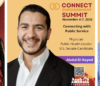
The Arab America Foundation hosted its two-day CONNECT Empowerment Summit on November 6–7 at the Westfields Marriott Washington Dulles. Bringing together more than 300 participants, the summit focused on leadership, education, civic engagement, entrepreneurship, and much more, showcasing the contributions of Arab Americans across the country.
El-Sayeds Remarks
El-Sayed was introduced during the summit’s opening session as a featured guest. Beginning his remarks with Ahlan wa sahlan (أهلاً وسهلاً), meaning “welcome” in Arabic, he introduced himself by his full name, Abdulrahman Mohamed El-Sayed.
“I’m honored to be the next United States senator from the great state of Michigan. I know we’re here in D.C., which of course is the capital of the United States of America, but Michigan is the capital of Arab America.”
The audience roared with cheers; however, following the event, a video of the remarks circulated online, attracting criticism from conservative news networks and much more.
From Community Pride to Online Controversy
“Capital of Arab America” became the center of discussion, with many critics interpreting the saying as an attempt to separate Arab American identity from American national identity. Many individuals on Facebook, Instagram, and TikTok have said things like: “We have been invaded!” “Did they forget September 11?” Turning Point USA CEO Erika Kirk also shared the video, writing, “There is no Arab America. There is only the United States of America.”
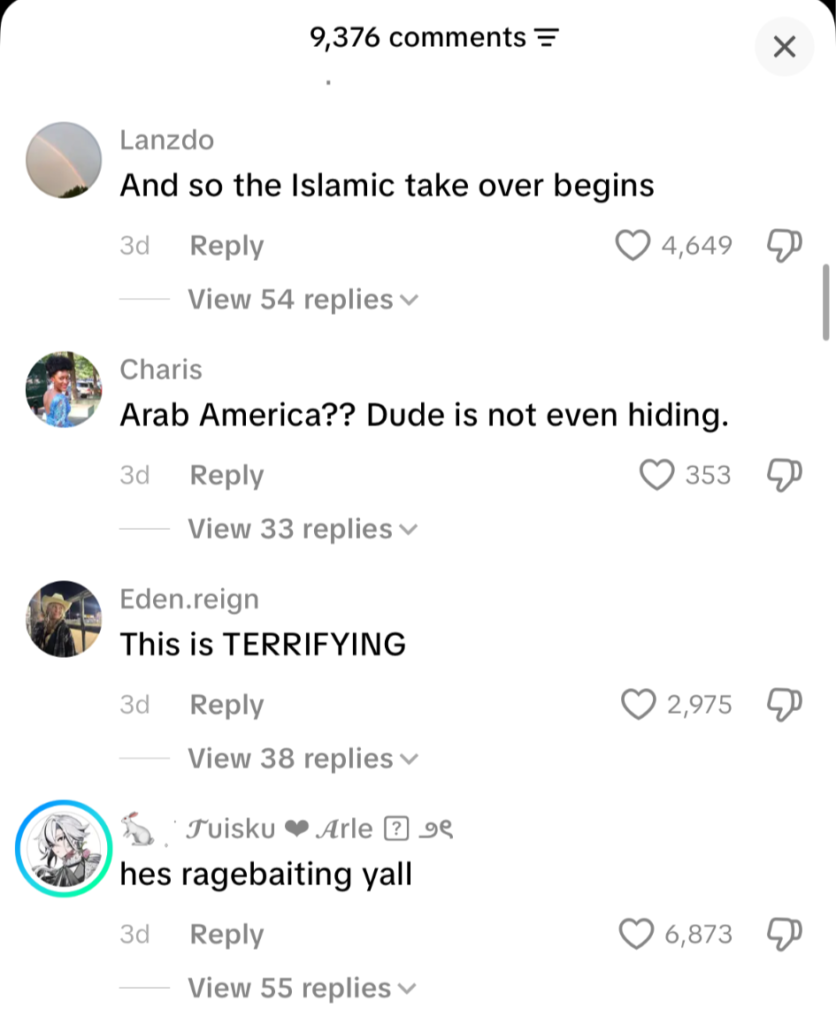
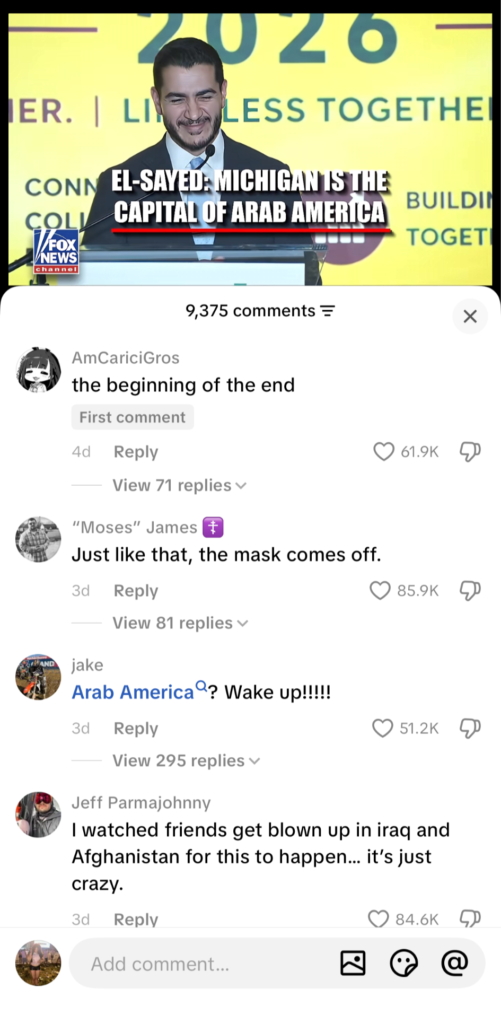
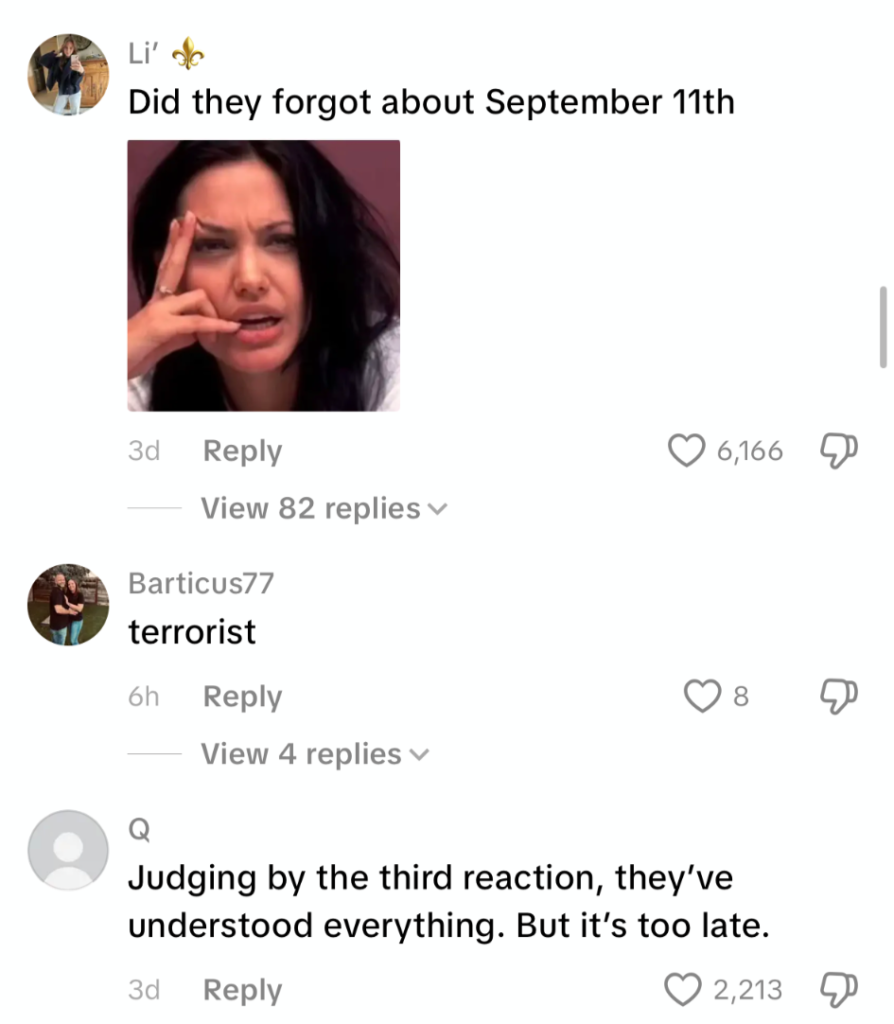
These responses failed to pay attention to the setting in which El-Sayed made his remarks and immediately went to questions about whether celebrating his ethnic background and community was American enough.
Yet, other people had a different reaction. Some acknowledged Michigan’s longstanding Arab American presence and the political influence of its communities, dating back to the late 1920s. Instead, this discussion prompted renewed attention to the state’s demographic history and the presence of Arab Americans in national politics. For Arab Americans, it has regenerated a newfound pride and love of their Arab culture.
But understanding El-Sayed’s statement requires looking at the community he was speaking to. Michigan has long been an important center of Arab American life. Dearborn, just outside Detroit, is home to one of the largest Arab-majority cities in the United States. Describing Michigan as the “capital of Arab America” was not meant in a literal sense, but instead was said to establish the Arabs’ strong cultural presence in the area and the concentration of Arab American communities in the region. Likewise, the conference he said this in was hosted by us, Arab America. His statement matches the theme of the conference as well.
A Wider Pattern of Anti-Arab and Anti-Muslim Rhetoric
These reactions to El-Sayed’s remarks also come against the trend of his Senate campaign, where his Arab American background and Muslim faith were faced with recurring political attacks. During the months leading up to the November election, El-Sayed faced criticism from Republican officials and conservative commentators who questioned his national allegiance and attempted to associate him with the Muslim Brotherhood. President Donald Trump also joined in on those attacks during an October 25 campaign rally in Port Huron, Michigan, calling El-Sayed a “jihadist.”
El-Sayed repeatedly denied having ties to extremist organizations, but nevertheless, this is a common pattern for people of Arab and Muslim backgrounds, who are often expected to defend their identities and prove their loyalty to the United States. White political candidates, for example, are never expected to publicly deny associations with extremist organizations such as the Ku Klux Klan (KKK) because of their racial identity.
Wolverine 1, Buckeye 0
Not only Trump but Vice President JD Vance has often criticized El-Sayed for repeatedly referencing his family, particularly his wife, Second Lady Usha Vance. Vance told the Democratic candidate to “keep my wife’s name the hell out of your mouth,” accusing him of disrespecting his family.
Yet this disagreement began with Vance’s comments about his grandfather, saying he believed in his grandfather’s traditional Democratic identity, and because of that, he would not recognize the modern Democratic Party. El-Sayed responded by questioning whether Vance would introduce his wife, Usha (daughter of Indian immigrants and Hindu), to his grandfather, highlighting the contradiction he saw in Vance’s rhetoric about American identity. At an October rally in Michigan, Vance called El-Sayed a “little weasel who should shut his mouth and show a little gratitude to the country.” El-Sayed responded with:
“I’m a Wolverine, not a weasel… you can take your Buckeye and shove it somewhere else.”
Shakira Law
The feud continued with broader questions about El-Sayed’s Muslim identity. During the campaign, Vance questioned El-Sayed’s political positions on Sharia law. El-Sayed denied having ties to extremist organizations. Yet, as accusations continued to grow around Sharia law, El-Sayed responded with humor, embracing an internet joke that had resurfaced, known as “Shakira Law.” The meme plays on the similarity between Sharia, the Islamic religious framework, and Shakira, the Colombian singer.
El-Sayed brought the joke into his own campaign, where in one video shared on his TikTok account on October 14, he stated:
“No one is trying to push Sharia law on anyone. But there is Sharia law, and Sharia law has one commandment: the hips don’t lie.”
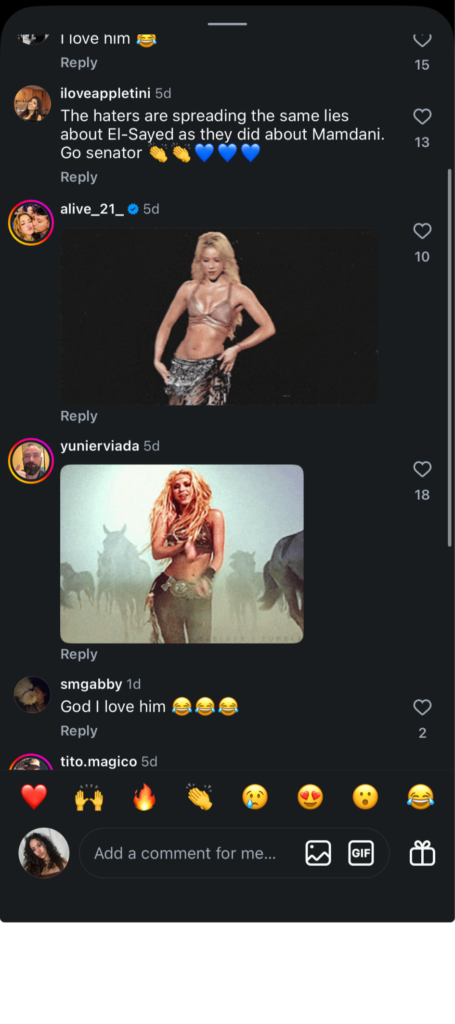
The video gained approximately 2.4 million views and more than 335,000 likes within three weeks. The online humor also expanded into variations such as “Shawarma Law” and “Shania Law.”
While the meme was largely used as political humor, its circulation also showed the broader debate surrounding Muslim representation in American politics. By turning accusations about his religion into a funny, recognizable internet joke, El-Sayed addressed the controversy through a different form of political communication that resonated with audiences beyond traditional campaign messaging.
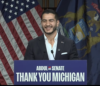
Following his November 3 election victory over Republican Mike Rogers, El-Sayed revisited the feud during his victory speech on November 4. He said:
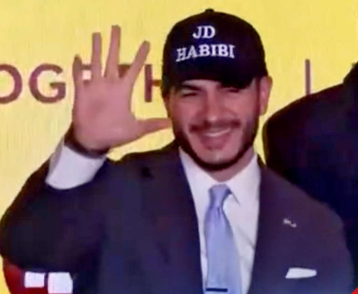
“JD, habibi, there is this delicious irony in the fact that you’re constitutionally obligated to swear me in in January…. Wolverine 1, Buckeye 0.”
The Arabic word habibi (حبيبي), commonly translated as “my dear” or “my beloved,” and El-Sayed’s use of the term were widely seen as a sarcastic, playful response to Vance’s months of personal attacks. This became a huge meme after the campaign. At our summit, he also wore a JD Habibi hat that went viral across socials.
Arab American Representation in American Politics
El-Sayed’s appearance at our CONNECT summit was only days after he became the first Muslim elected to the United States Senate, a historic moment for Muslim representation in the federal government. Born in Michigan to Egyptian immigrant parents, El-Sayed served as director of the Detroit Health Department and Wayne County’s Department of Health and Human Services. His political rise also shows the growing visibility of Arab Americans and Muslim Americans in US politics: from local government to Congress and now the Senate, members of these communities have continued to take on public leadership roles while navigating political debates on whether they are American enough to hold these positions.
The CONNECT Empowerment Summit was organized around this idea: creating opportunities for Arab Americans to tell their own stories, recognize their contributions, and participate in shaping the country’s future. El-Sayed’s appearance became a valuable part of that conversation.
Want more articles like this? Sign up for our e-newsletter!
Check out our blog here!