


Advertisement Close

Arts/Entertainment

Palestinian supergroup 47Soul stay true to their roots 
Rob Garratt


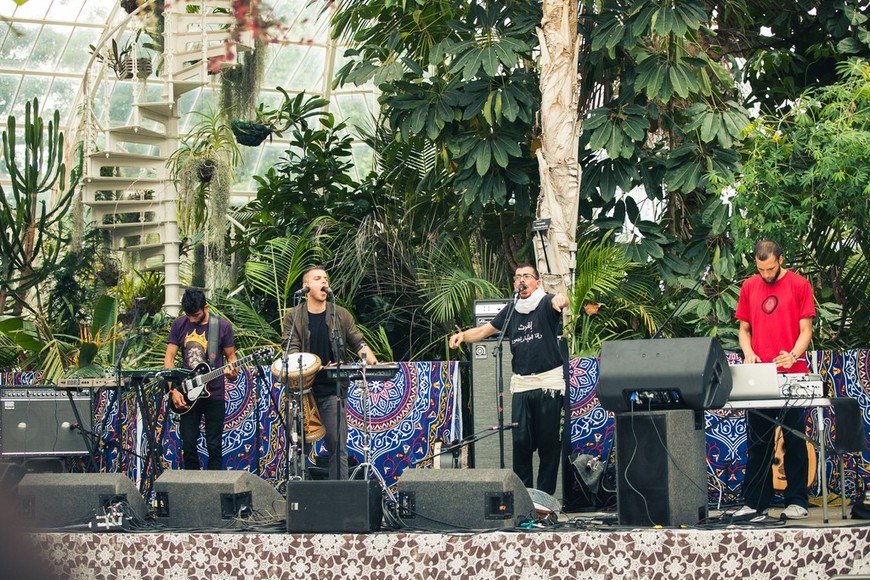
Last month, something special happened. 47Soul – a supergroup uniting four alternative-music figureheads who share roots in Palestine – performed in the West Bank.

For the musicians, it was an emotional homecoming. Despite having rocked huge crowds across Europe – including at the UK’s Glastonbury Festival and Womad (World of Music, Arts and Dance) – the group’s headline slot on July 27 at the Palestine International Festival marked the first time the four members were permitted to perform their twisted electro take on the country’s street music to a native audience.

Why? Passports. The band members share Palestinian heritage – but due to population displacement, they are scattered and none have Palestinian Authority papers.

“It’s home, it’s the home that’s been banned for us to go to, or be in certain places, to be a part of it,” says singer Walaa Sbeit.

“We are Palestinians originally, all of us, with different passports and documents – and those documents put us in a position where we cannot perform where we are originally from.”

The “glue” of the band – which was formed in Jordan in 2013 and is now based in London – is Ramzy Suleiman, better known as electronic artist Z the People. He grew up in Washington DC but decided to trace his father’s roots, moving to Palestine to learn the Arabic quarter-tone keyboard.

He began working with ­Jordan-based acoustic folk-­rapper Tareq Abu Kwaik. Better known as El Far3i, he is a former member of renowned Middle Eastern underground rock act El Morabba3 (The Square). He shared a flat with Hamza Arnaout, guitarist with rival Amman alt-rock act Autostrad, also known as El Jehaz.

The final piece of the puzzle is Sbeit, who has a background in theatre and poetry and also brings a reggae sensibility to the fold, as a former member of Palestine’s Ministry of Dub-Key.

Despite – or, rather, because of – their distinct musical backgrounds, together these four “brothers” have brokered a border­less, genre-less sound by focusing on the one thing they have in common – repurposing the region’s traditional dabke street dance into frenzied 21st-century electronica.

On the surface, 47Soul might recall Egypt’s electro-shaabi craze, but careful listening reveals a cosmopolitan blend, peppered with elements of hip-hop, rock and reggae. Politically charged but party-starting chants and raps fly in Arabic and English.

Listeners have called it “futuristic Levant wedding music”. The band call it “shamstep”. Whatever the name, this quixotic sound has translated easily to international audiences. Lead single Intro to ShamStep has clocked more than a million views on YouTube.

But reaching those audiences live has been problematic; visa issues mean many gigs have had to go ahead at the last minute, with just two of three of the members present. Much of the globe remains ­inaccessible. Abu Kwaik’s and Arnaout’s parents fled Palestine in 1948 and, as refugees, became Jordanian citizens, which can complicate European travel. Suleiman is an American, while Sbeit was raised in Haifa and holds an Israeli passport, which limits his ability to travel to the Arab world.

“We are stuck like Humpty Dumpty on the wall,” says Sbeit. But his humour hides darker existential issues associated with growing up as a citizen of an alien country, with limited rights and restricted freedom of movement into Palestine.

“My parents and grandparents were displaced from their home in 1948, and forced internally into what became Israel – internal refugees,” he says.

“I’m an indigenous minority – a Palestinian with an Israeli ­passport. It’s not fun to be a ­second-class citizen, to feel disenfranchised all the time, unwanted in your own homeland – that’s something that I don’t wish for anybody.” Unafraid to stand up for what he believes, Sbeit has clashed with Israeli authorities on a number of occasions. In June 2014 he was reportedly one of three activists arrested during direct action to reclaim his family’s historical Palestinian village of Igrit, close to the Lebanon border.

“This is one of many, many encounters,” he says, recalling instead a separate incident during which he was interrogated after performing politically sensitive material at a street festival.

“Very simply, we are activists,” he says. “We fight for equality, for being a normal human – and through that you try to do socially and politically conscious work.

“The Israeli system does not accept that, and you can easily be arrested, be accused of attacking officers, waging terror or violence – just by using lyrics and art and performance. This is something that every artist deals with as long as he wants to be not in the mainstream.”

Despite their often charged lyrics – the subject of checkpoints crop up more than once – 47Soul are wary of being defined by their individual politics. United, they do not want any single message to eclipse the infectious power of their music.

“A solo song by any one of us would be talking about the reason these checkpoints exist – and how we should rise up to make them not exist anymore,” says Abu Kwaik neatly.

“A 47Soul song would be about someone trying to meet a girl at a party – and getting stuck because of the checkpoint.

“We just want the world to dance to our sound – and then have a good political discussion after the show with the people you dance next to.”

“My goal for 47Soul,” adds Sbeit, with a laugh, “is to teach the world some new moves besides the Macarena.”

Source: www.thenational.ae
This 22-year-old playwright wants to give Palestinians a voice in American culture

Liv McConnell

Being a hormone-ridden teenager is, in and of itself, punishment enough. You’re stuck in a terribly inadequate education system, susceptible to sneak attacks of acne, and constantly feeling the pressure to assimilate to fit your peers’ expectations. In a word, it sucks.
But how does the pubescent experience change when assimilating to American-teen norms means forsaking your culture in your parents’ eyes?
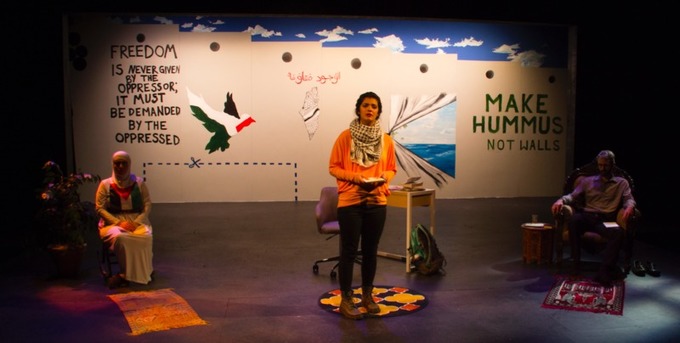
That’s one question playwright and slam poet Summer Awad explores in her new play,  “Walls: A Play for Palestine.” Currently showing in New York City as a selection of The New York International Fringe Festival, “Walls” is equal parts personal and political, drawing on the writer’s own experiences as a second-generation Palestinian immigrant as well as exploring the impact of Israeli occupation on her ancestral homeland.

Awad was inspired to the write “Walls” after starring in a production of Eve Ensler’s “The Vagina Monologues” in college.

“I really liked the fact ‘The Vagina Monologues’ had these interviews with hundreds of women and then turned them into monologues,” Awad told Revelist. “This was the same time when I was trying to learn Arabic and trying to learn more about my Palestinian heritage, so I started thinking wouldn’t it be cool if I could do something like this for Palestinians? What if I did the ‘Palestinian Monologues’?”

Feeling invigorated by the prospect of activism through theater, Awad designed her own major around literary activism and got a research internship to conduct interviews at Palestinian refugee camps.

After her Middle Eastern travels, though, she realized the story she felt most compelled to share was, in fact, her own. Thus, Awad’s unique upbringing growing up in Tennessee with a conservative, West Bank-born Muslim father became the backbone of “Walls.”
“I really started exploring my own experience growing up Palestinian-American, my relationship with my very conservative Muslim dad who wouldn’t let me date or go to prom or talk to boys or anything like that,” she said. “While at the same time, we’re weaving Palestinian history and culture and historical facts throughout this narrative and trying to put the personal and political together.”

Stylized as monologues and slam poems, “Walls” is brought to life by three characters: A young American woman, her conservative Muslim father, and a female embodiment of their ancestral land, “Mother Palestine.” Though the play does carry a very specific political message (namely, that Palestine should be freed of Israeli occupation), Awad believes it’s overarching themes are relatable to all second-generation Americans.

“I’ve actually had a lot of people from different ethnic and racial backgrounds say they can relate to the show, and I think it’s especially true of immigrants,” Awad said. “I think some of it has to do with the fact that when your parents are assimilating, they want to keep a very clean reputation. They don’t want anything to go wrong for you. They’re trying to fit in with the immigrant community that they found, but also fit in with this new American community. So a lot of people have this experience of their parents being very strict.”

This strictness can apply to women, especially, as many parents are coming from cultures where gender roles are “a little more defined,” Awad said. For both she and her play’s protagonist, that manifested in being forbidden from partaking in certain American events and institutions.

“The (protagonist) is going behind her dad’s back and wearing a two-piece swimsuit, even though he told her not to. Or she’s trying to figure out a way to go to prom even though she’s staying with her dad on Saturday night and he doesn’t allow her to,” she said. “I think for a lot of immigrant parents, these seemingly small things are a much bigger deal because it’s your reputation not only among your community in your new country, but it could even reach your relatives back home if they hear what your Americanized child is doing.”
Through her work, Awad hopes to illuminate different aspects of the immigrant experience, as well as provide a platform for the underrepresented Palestinian voice in America.

“My main goal with this particular play is to tell the story of the Palestinians who don’t get a voice in the Western media,” Awad explained. “We get one narrative, which is coming from the Israeli side. A lot of people ask why I don’t include an Israeli perspective in the play, but you can get an Israeli perspective anywhere you look in the U.S. It’s really a tool of education, and that’s what my goal is in theater.”
“Walls” is playing at FringeNYC August 20, 23 and 25. Tickets can be purchased for $18 on the festival’s website.

Source: www.revelist.com

Captivating Cuban Jazz Launches Global Fridays Fall Season Sept. 16

Press Release: Arab American National Museum Music, theater, multimedia performances enhanced by artist workshops Southeast Michigan’s only world music and performance series – Global Fridays at the Arab American National Museum (AANM) – offers cultural experiences this fall that creatively transport audiences to Cuba, Egypt, India and beyond.  The 2016 Fall Season opens Friday, Sept. … Continued

Some of The Best Arabic Dance Songs of All Time

Compiled by Arab America It is wedding season, which means Arab Americans can hear similar playlists of Arab pop music at each joyous celebration. By blending the sounds of traditional Arab instruments with keyboards and guitars, Arabic pop music has evolved to become one of the most popular genres in the world. Unlike in American pop … Continued

America’s Other Orchestras: Arab American Ensemble Series Episode 3

UCLA: The Birthplace BY: Sami Asmar/Contributing Writer Although one of the largest universities in the world, and consistently one of the best in many fields, the campus of the University of California, Los Angeles (UCLA) does not feel crowded. Everybody loves the spacious grounds and unique architecture with Middle Eastern style arches found on many … Continued

Listen to these 6 on point covers by Arab artists

By LEYAL KHALIFE STEPFEED The Arabic language honestly puts an amazing twist to everything that has ever been created, including music. Certain Arab artists have skillfully covered songs, both classical and pop, in Arabic. These are 6 of the most beautifullly put together covers: 1. Mashrou’ Leila cover “Get Lucky” by Pharrell Williams “Get Lucky” … Continued

Tarabband – telling war stories through Arab music

by Homa Khaleeli The Guardian Growing up in Iraq and Egypt, Nadin Al Khalidi had no interest in Arabic music. As a child she studied the violin, as a teenager she idolised Joan Baez, and by her 20s she wanted to form a punk band. So how did she come to be the frontwoman of Tarabband, … Continued

America’s Other Orchestras: Arab American Ensemble Series Episode 2

The Arabic Music Retreat BY: Sami Asmar/Contributing Writer It is rare when an experimental event turns into a national and international institution of historical significance. This is what happened when twenty years ago, a handful of musicians decided to hold a training camp on a college campus, empty for the summer, to allow interested participants … Continued

Lebanon 1970 – Psychedelic Funk Rock

BY:Eugene Smith/Contributing Writer Psychedelic Funk Music of Lebanon in the 60’s and 70’s: Cultural Conversation through Sound Once a tourism advertisement for westerners, this footage offers a grainy window into the joie de vivre of pre-civil war Lebanon. Scantily clad women frequent snow-white beaches and azure Mediterranean waters. Alcohol flows as if pouring from a … Continued

Two Arab Americans Nominated for Emmys

BY: Clara Ana Ruplinger/Contributing Writer This year, 18 minorities have received an Emmy nomination, which is up from 11 the previous year. Included in this list are two Arab Americans: Rami Malek, lead actor on Mr. Robot, was nominated for Outstanding Actor in a Drama Series; and Sam Esmail, a writer for Mr. Robot, was … Continued

646 Results (Page 22 of 54)