
Subscribe
to receive news by email

Poll
Will the Trump Administration Shift U.S. Policy in Favor of Palestine?
- No (86%)
- Yes (14%)
 Loading ...
Copyright © 2026 Arab America
Go topI Feel You Like I Feel Palestine: Lebanon Through the Lens of Rania Matar
By Rami Balin / Arab America Contributing Writer
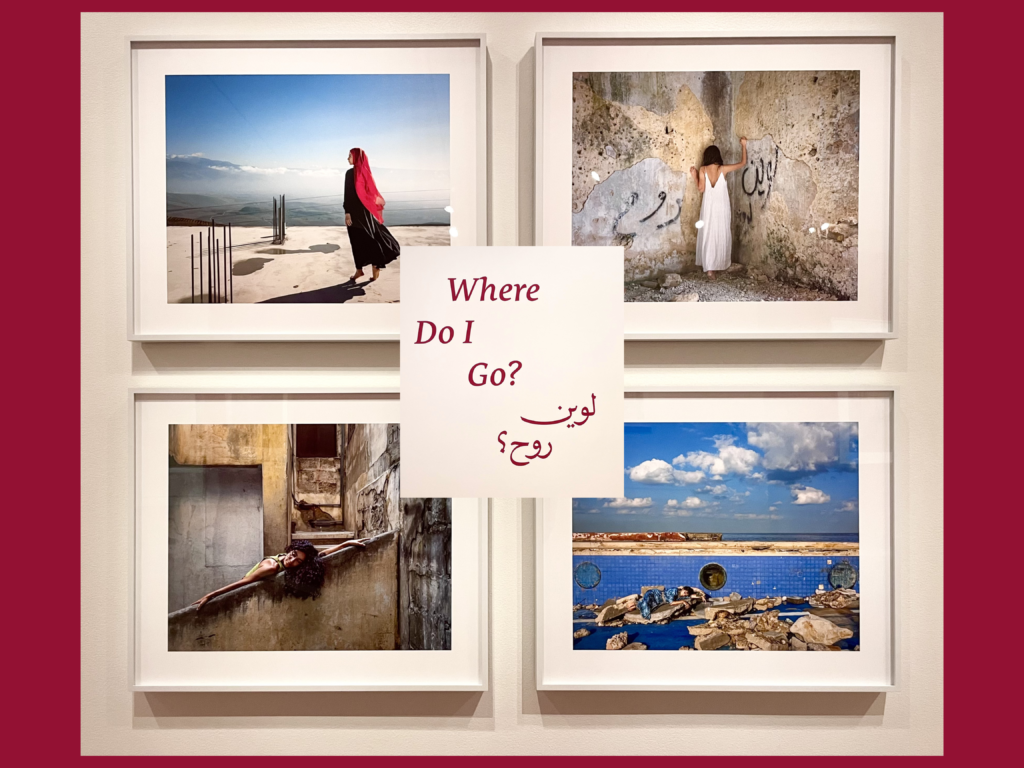
The project “Where Do I Go?” (لوين روح؟) was created by Rania Matar, a Lebanese American photographer of Palestinian descent, to commemorate fifty years since the start of the Lebanese Civil War. It is a collection of photographs of women taken by Matar in Lebanon, exploring the themes of collective and personal identity, trauma and belonging.
Identity Through Places And Environments
As you walk into the space of the exhibition, you encounter stunning photographs of young women in a variety of settings. The photos look carefully staged and accidental at the same time, the women posing and existing in the landscape that surrounds them. The colors in the photographs appear to be carefully curated, the vivid red, green, cerulean, blue-grey, reddish yellow, dusty purple, peony pink, pastels contrasting with the deep saturated hues. The exhibition is an almost immersive archive where all the places, locations, textures and environments are gathered in a dialog, connecting identities of the women in focus.
The women are unsmiling, serious; some of them are resolutely looking at the camera, others look down to the ground or look away. In some of the photographs, their faces are not visible as they stand with their backs to the viewer. The surroundings vary, but there is a sense of something shared: a thread, a line, a branch, a color, a movement or absence of movement. In fact, all of these women chose the locations they wished to be photographed in. At times, the contrast between the women’s bodily presence and the environment they are in is striking, as in “Aya (Draping), Gemmayze, Beirut, Lebanon, 2022”: a woman wearing a light airy gown is laying sideways on a chair in a room of a spacious seemingly abandoned building with lush greenery outside. She is both present and absent, out of place and in harmony with the landscape, noticeable and unnoticeable in a house where so many people have been before her, the possibility of their past here, with her, nonetheless.
Speaking of her exhibition during her talk at Eskenazi Museum of Modern Art in Bloomington, Indiana, Rania Matar noted that she wanted to focus on women who were not born during the Civil War but for whom it is the constant background to their lives. The remains of that war, sometimes literally, linger and stay present in their everyday, constantly amplified by the more recent Beirut Port explosion and the Israeli attacks on Lebanon. For them, the “normal” includes (but is by no means limited to) bullet holes in the walls, ghostly buildings and an abandoned cinema in the center of Beirut. It has shaped their sense of self as well as their attachments to places they mark as important, as extensions of themselves.
The Future of Belonging
Looking at the photos of Rania Matar now is an act of commemoration as well as presence – not only of the Lebanese Civil War and all its victims, but of the very places in the photographs. Some of them, including “Mariam (Over the Border Wall), Kfarkila, Lebanon, 2022”, overlooking historic Palestine, would be life-threatening, if not impossible, to take today as the location is in the zone of intensive military activity, currently under occupation by the Israeli army.
Having spent most of her life in the US after leaving Lebanon at the start of the Civil War, Matar talks about her own identity and life in the West: “I am them and I am us, and how does that make me different person?” She reflects on how lucky she is because she can actually “identify and feel Lebanese,” since her family was exiled from Palestine: so many Palestinians are still denied that identity and the sense of belonging that it brings.
In one of Rania Matar’s photographs Samira, a third-generation Palestinian refugee, is standing among flowers, barbed wire coiling between their stems. In the exhibition space, not far from it, is the photo of Tara who lays down in the grass and the flowers, dissolving into the landscape and almost disappearing. The jarring juxtaposition with the images of abandoned and destroyed spaces doesn’t minimize the fact that these places can be inhabited, albeit temporarily. In that sense, they are places that can be activated at any moment as sites of belonging, that hold a connection to the future as well as the past.
Rania Matar’s website: https://raniamatar.com/
Want more articles like this? Sign up for our e-newsletter!
Check our blog here!