Subscribe
to receive news by email

Poll
Will the Trump Administration Shift U.S. Policy in Favor of Palestine?
- No (86%)
- Yes (14%)
 Loading ...
Copyright © 2026 Arab America
Go topMusic Between Tarab and Arabesque: A Conversation With Firas Zreik
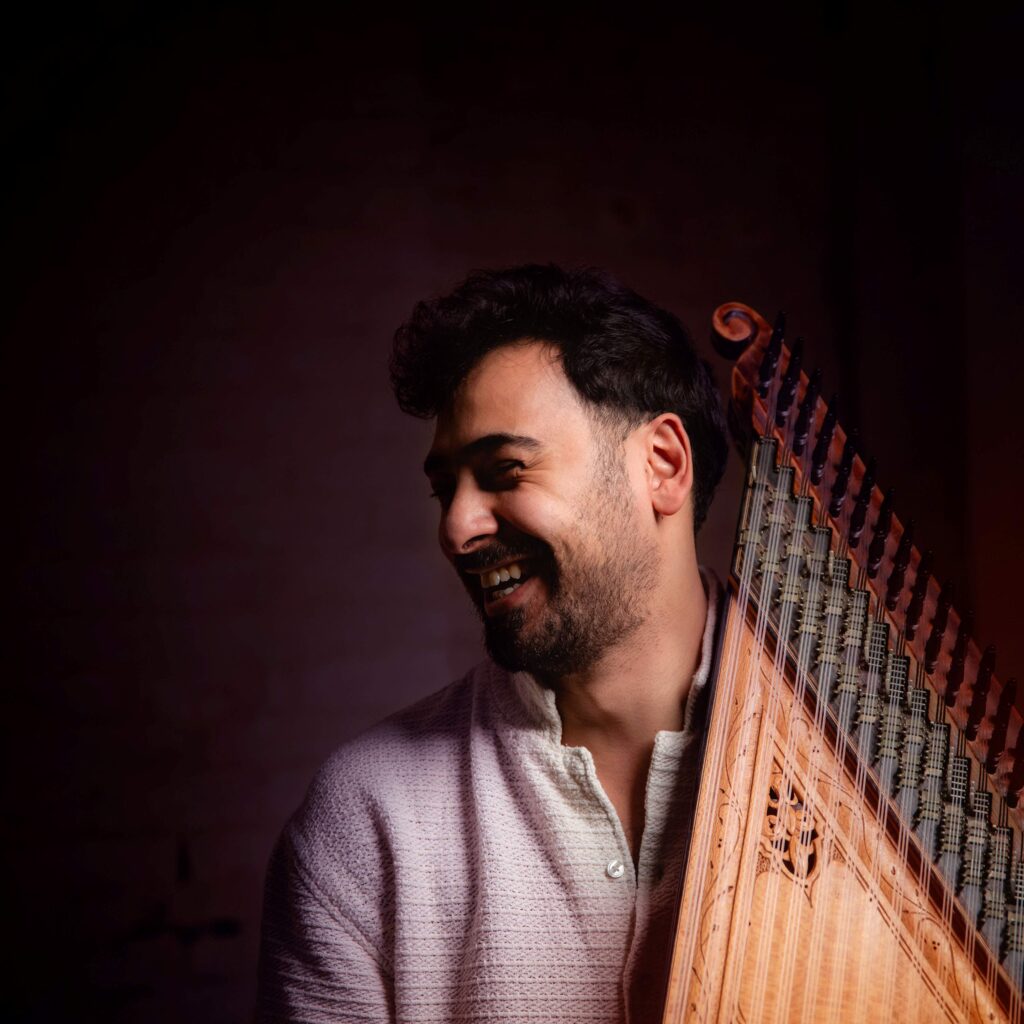
Photo Credit: Oukool Creative
By: Rami Balin / Arab America Contributing Writer
Firas Zreik is a Palestinian musician, composer, and educator currently based in New York City. His bold experimentation across genres blends Arab music, jazz, and many other musical languages, traditions, and cultural influences that shaped him as a musician during different periods of his life. Qanun, his instrument of choice, is central to this experimentation, creating a truly unique, fresh sound that at its core is tied to Zreik’s Palestinian identity.
Upbringing and influences
Firas Zreik: I grew up in an artistic house that is socially active, that is political, intellectual, and we grew up loving our culture, loving our traditions, loving our music, and also other people’s cultures and other people’s music. From early on, I was exposed to different cultures, especially musical cultures. My mom is an artist. She was traveling a lot, touring. Every time she would come back, she would bring a piece of culture from that place. So I was exposed to that. And then she would bring music from all these places. As a musician, or as a person generally, but as a musician more so, you are a product of what you hear, what you listen to. Even though you might be trained in jazz, or classical, or whatever, if you listen to flamenco all your childhood, then this will be part of your vocabulary, right? It will find its way into your music. So in my case, there were a lot of different musical traditions. Of course, predominantly, it was Arabic music at the essence of it.
Why did you choose qanun as your primary instrument?
FZ: Choosing an instrument usually happens early on in life. And when you’re a child, you have very little rationale in these kinds of decisions, you know? So, you might choose an instrument just because it looks good, or sounds good, or the name is tempting, or because your cousin plays it. But in my personal experience, I was always drawn to that instrument from a young age. The name ‘qanun’ means ‘the law’, and it has, you know, all these strings, and it was a rare find. It’s not something you could see every day back home. The oud you would find in every house, sort of like the piano or the guitar in the West. The qanun is an elite, prestigious instrument that became rare at some point, especially back home. I would see it on TV; sometimes I would see it live on a stage at a concert, and I was always drawn to that. The other instrument I was equally drawn to was the cello, which was my first instrument for three years. I studied Western classical music, which was really a great foundation, but then I made that shift towards qanun, and that was a very meaningful and profound shift in my life. As a musician and a person, it reshaped my route.
When did you start making your own music?
FZ: I was exploring since I was eight. We had a piano, and I was making my own melodies, or thinking that they were my own, but obviously they are the product of whatever I know or whatever sound I can produce on the piano. So, whatever I had in front of me, I tried to always make something of it. By the time I was fifteen or sixteen, I started to actually write and transcribe and prepare compositions like a form. But then later, once I finished high school, I went to college and took up composition. I started being much more prolific and systematic in my writing. But I wrote my first song when I was sixteen or seventeen. It’s a practice that I had ever since I was young, but I always knew that I wanted to write my own original compositions, just because I feel like this is my artistic statement, instead of just repeating somebody else’s music, which is a great way to learn, and a great way to preserve, and also great for your own pleasure. I enjoy singing repertoire that I like. But I also want to leave something, I want to enrich the repertoire that we have. And it’s a genie, you know, it gets to you and you want to write something, you want to create.
On growing as a musician outside of Palestine
FZ: The people that I met, the people that I worked with, the people that I played with, the people that I studied with and the music that I was exposed to reshaped and enriched my creative process and my creative inventory. I left home when I was 19, coming to study music in higher education. It’s not like I was this established composer that had already found his sound. I felt like those were the years where I really structured and nourished my musical identity – the first years in Palestine, during the early upbringing and then conservatory training, but then more so in college time, and more than the post-college time, the past six years where I was actually living as a professional musician in New York City, fully occupied by music creation.
New York City is definitely a good place to be in terms of the openness of the place, the magnitude of how many venues there are, how many good musicians there are, audiences, arts organizations, and opportunities, of course. So, in terms of that New York is a great place to be. But it’s also a terrible place to be – it’s expensive, it’s dirty, it’s loud, it’s tiny, it’s crowded, it’s utterly capitalistic. There’s a lot of things that you cannot love about New York, and that was always my relationship with the city. I’m not one of those who are like, ah, New York, best city in the world. I feel that whoever says that is lying. I see the magic in the city, but I also see its wrongs.
When you’ve got a new idea for a project, where do you start?
FZ: Usually, these things happen to me in an accumulative manner. For instance, I might write a piece and have it on the side, and we can perform it a few times with the band. And then later, I’ll write another piece. And suddenly, this can shape up to become a big project. Then I’ll dive deeper into those compositions and see what I can add to them. But oftentimes, every few years, I take out time from my life and go on a music residency, artist residency, where I’m isolated from daily life chores and from the internet for a big part of the time, and I’ll be surrounded by nature, having my own studio, and during these residencies, usually, is where I put the framework for my next big project. Now, that doesn’t mean that I write the majority of my work there, or finish everything there. But it could be as little as writing a piece or two, as little as coming up with a theme, coming up with a title, coming up with a thematic idea. I’ve done Blue Mountain Center residency twice, I did McDowell residency, and oftentimes I just find time by myself as a composer at my apartment in New York to sit and write. I’m always thinking about the next album, always thinking about what’s next, how can we do this.
The idea for Tarabesque started taking shape when I felt that the vocabulary of the music is going in that direction. And often, composers and artists that have a similar culture to mine, who come from a SWANA culture, then dive into other musical languages that they acquire, like jazz, for instance. Sometimes we struggle with labeling them. They call it world music, or fusion, or global jazz. I felt like Tarabesque would be coining a term that articulates exactly this state of affairs, this state of mind and this musical language. Because the word Tarabesque obviously rhymes with arabesque, which is the art of interlace flowing ornamentation found in Arabic and Islamic calligraphy and architecture, originating back in Andalusia during the Umayyad dynasty.
At the essence, it was Arabic arts, but the “-esque” represents all these global influences around it, from Europe, from Catholics, from Jews, from the Spanish, from North Africa, there was a melting pot of cultures that created arabesque. So, Tarabesque is a clever pun, if you may. Tarab is the ecstatic state of mind that the listener finds themselves in when they hear Arabic music. Sometimes it refers to a genre, but more so it refers to a state of mind. It’s the goal of the music to get you into that state of mind. I felt like, even though I have other music vocabularies, and Maqam is still at the heart of it, I’m always searching for Tarab, I’m always guided by Tarab. I felt like Tarabesque would be the most articulate term, because Tarab is the goal, but the “-esque” represents all the other global stylistic influences that found their way into my music, whether deliberately or subconsciously. I can be bold and call it maybe the birth of a genre, that’s the idea.
Do you prefer your music to be a collaborative process or do you focus on composing alone?
FZ: I’m open to collaboration, I love collaborations, as long as they are not my main projects. If I’m to collaborate with another artist, it has to be a new project that we’re creating together. When it’s my project, I’m a totalitarian, when it comes to both forms of the raw version, and the final version. Of course, the raw form of the work is whatever I wrote, whatever I bring to the band. The final product is whatever decision I eventually go with. Between those two versions, there’s a lot of brainstorming with the band. And I value their input highly, they all shape my music so beautifully, whether on stage, or more importantly, off stage, during rehearsals. And I owe them. I always ask them, always consult with them, and I love their input. Sometimes we try multiple versions, and we make the decision. But I feel like the original form and the final form eventually are up to me, as long as they go through that collective process.
There’s no authoritarianism. As a leader of a group, you need to make decisions. By doing so, you’re making their job easier as well. If you leave everything up to them, and you leave it too open, you’re burdening them with indecision. It is on you to make a decision. And not everyone has to be emotionally invested. I would love for them to be emotionally invested, I know they love the music, but sometimes they want to rehearse and go. So, I better have my stuff together.
On reaching audiences
FZ: Often, I see people that I wouldn’t expect to enjoy this music, they love this music. People that are non-Arabs, people that are non-musicians, people that I don’t know. And that makes me so happy, and so proud, and so grateful. I feel really loved, I feel supported, and it gives me a lot of motivation. But the music is gonna happen regardless of that. Marketing, of course, is a necessary process to have people find the music in the first place, to make it as accessible as possible. That’s why this year, with this release, I decided to also have a physical manifestation of it. We have a vinyl. And we have CDs, and of course, they’re available online.
I tried to really mark a milestone with this release, because it is my biggest work to date. It’s my third album, I’m really proud of it, and I’m happy that we did it. As a musician, by the time you release your album, you’re already fed up with the music, you’re fed up with the whole thing. And part of it is like the birth of a child. You do it, and now it’s its own thing. It’s not mine anymore, it’s for people to enjoy it. As much as I would love to talk about it and do shows and promote it, my mind is slowly going to start looking ahead shortly after.
Roots in the folklore of Palestine
FZ: The opening piece, Sanasel, has Palestinian folkloric themes in it. It came to me naturally, but I built on it. Sanasel describes a very vivid and present agricultural landscape in historical Palestine, in the mountainous areas where farmers have to sow their crops in a diagonal piece of land. They use stones to build terraces, and in these terraces, they can finally have a flat land to sow their crops. They put smaller stones and they leave some gaps for the water to go through. It’s a really beautiful agricultural innovation, but more so it’s a beautiful landscape. I felt like this music really manifests that landscape, represents where I’m from, not necessarily as a political statement, maybe in a political understatement, but more so in a cultural way. And it plays a clever game between the scale, or the Maqam, that is called Bayati and the pentatonic scale. We have the horn, the sax is the featured soloist in that piece, and the qanun does the intro with the sax in the beginning, functioning as a horn. It’s a beautiful unique timbre, and then the rhythm is this 6/8 North African polyrhythm. A lot of influences coming together to create something organic. And it’s groovy. I like it. I enjoy it.
Sanasel and Fields of Figs, these are the two pieces that are represented by a landscape. The other two pieces represent a state of mind, like Ambivalent and Hangala. There are three other pieces that have mechanical titles, and I also left that on purpose. Mechanical meaning, when you say Concerto in E minor, right? You’re mentioning the name of the form, the genre, and the name of the key. For instance, Samai Saba is a parallel of that. Samai is the genre, and Saba is the scale. There are hundreds of Samai Sabas in Arabic traditions and we distinguish them by the composer.
Longa is another mechanical name. Longa is an instrumental up-tempo dance form, originated from Eastern Europe, from Polka, actually, making its way into the Ottoman Empire where they really perfected it to be an instrumental up-tempo piece, where it’s almost challenging for the instrumentalist. And from the Ottoman Empire, it made its way into the Arab world. Growing up, most Longas I had to learn were Turkish, which is great, but I wanted to leave something with an Arab influence for upcoming and future generations of qanun players and musicians in the Arab world. Even though it’s a Longa form, Longa rhythms, in the middle of the piece it just flips completely to an Egyptian rhythm. So, I kept some mechanical titles, I kept some landscaping titles, and I kept some state-of-mind titles, but all of that falls under Tarabesque.
What do these compositions mean to you?
FZ: I feel that they’re all parts of me. The fact that I wrote them, the fact that they came out of me, they have to be part of me, but I feel like some of them resemble me more than others, or some of them resemble most of me, let’s say. Some of them just manifest certain parts of myself, certain aspects of myself. I feel like Salute, my previous album, and the title of the piece itself is a good manifestation of who I am. Sanasel also, I feel like it’s the one that I relate to the most. But Samai Saba is a big part of my identity. It’s my training, it’s my roots, it’s my musical identity. Longa has all this craziness and charisma. Fields of Figs, plenty of groove and sweet melody. Ambivalent, dark harmonies and experimentation, and that then goes into a really intense ecstasy, especially in the qanun solo at the end, the build-up. It’s an emotional journey throughout the album. I’m glad it came out so emotionally dynamic.
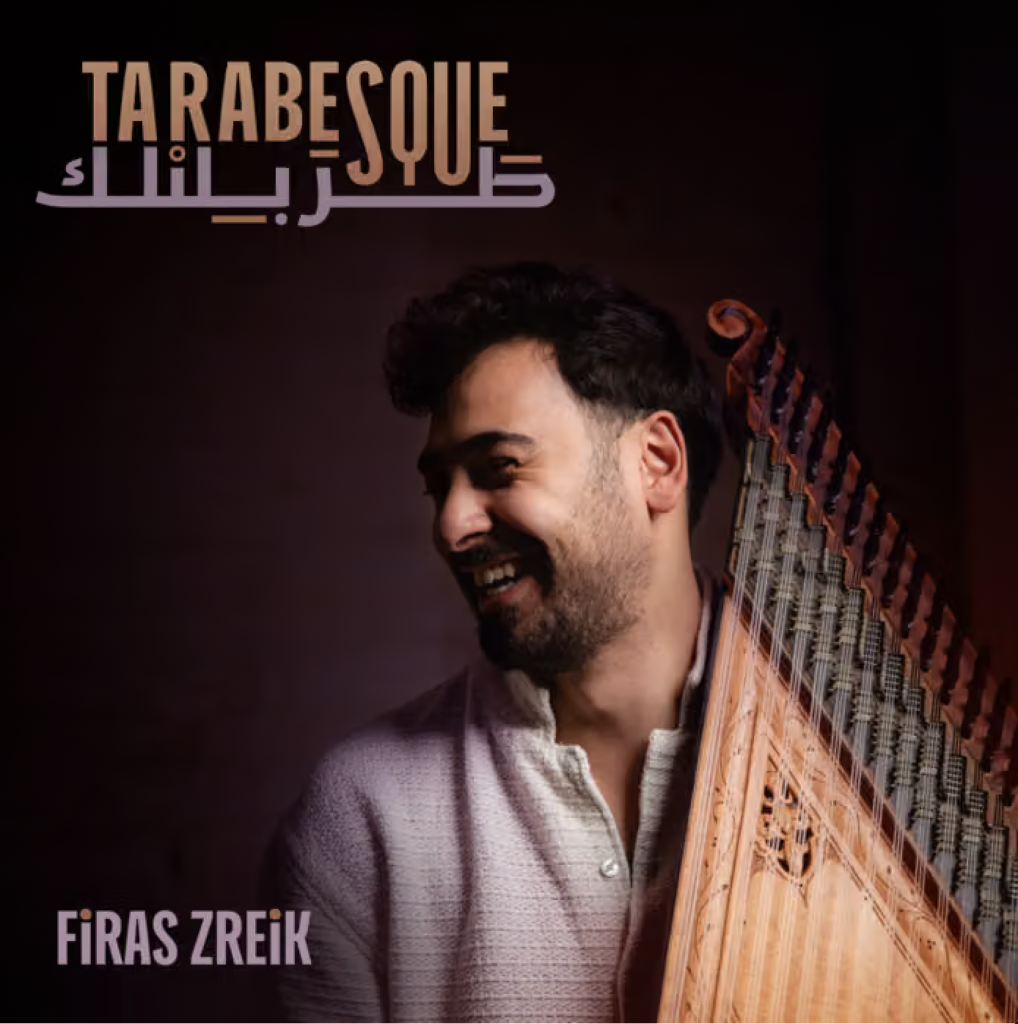
Tarabesque is now out on all platforms, https://www.firaszreik.com
Firas Zreik will perform at the Arab America Foundation’s Connect Empowerment Summit, November 6-7 at the Westfields Marriott Washington Dulles
Want more articles like this? Sign up for our e-newsletter!
Check our blog here!