Subscribe
to receive news by email
Poll
Will the Trump Administration Shift U.S. Policy in Favor of Palestine?
- No (86%)
- Yes (14%)
 Loading ...
Copyright © 2026 Arab America
Go topWhat Happened to Syrian Bread?
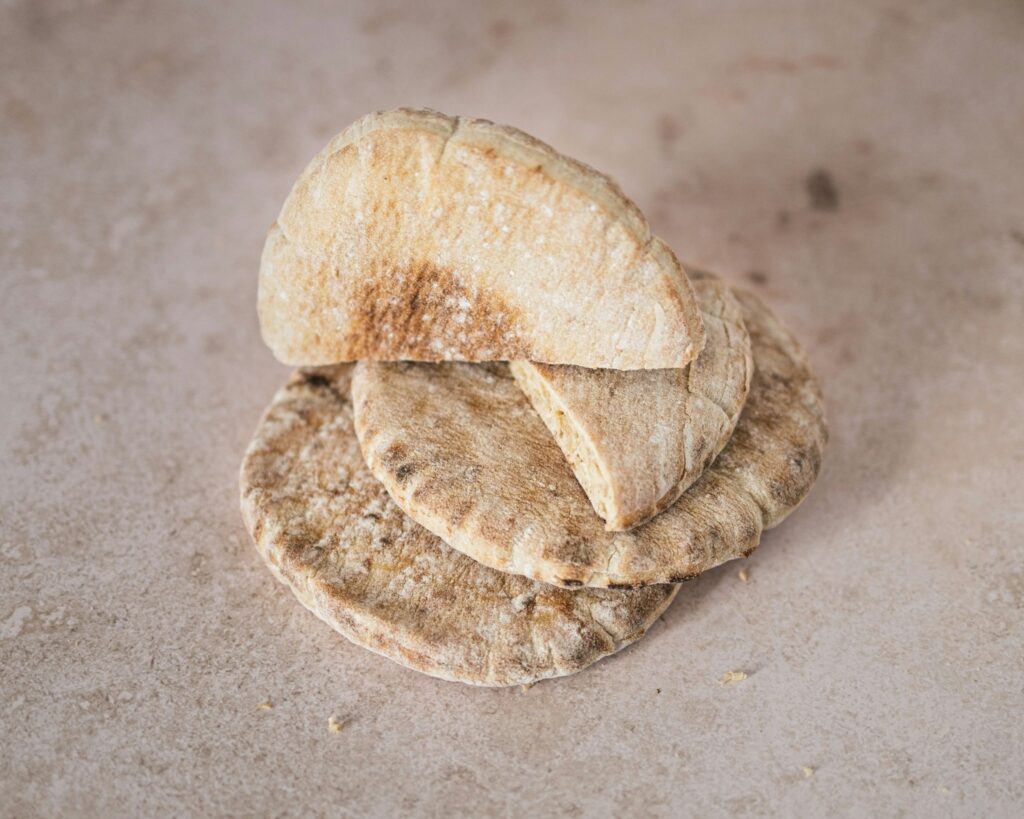
Photo by Stephanie Sarlos on Unsplash
By Shayla Frank / Arab America Contributing Writer
In the summer of 1899, a reporter for the Boston Herald went looking for dinner in a basement on the east side of Chinatown. There was no sign that hung above the door.
What he ate that night ran that July under the headline “As Cooked in Syria.” The article was half review, half cooking lesson for readers who had never met the food. He stopped to describe the bread when the stuffed squash and the coffee arrived, served in cups the size of thimbles.
It came in rounds no thicker than flapjacks, eight to twenty inches across, baked until they took on burnt spots. Damper and tougher than the loaf Americans knew, it was also doing a job that no American bread did. “The Syrian uses one of the cakes for a napkin at table until he has stripped it and eaten it, when he reaches for another.” He also wrote down what it was called. Syrian bread.
Where Syrian Bread Got Its Name
The neighborhood he walked through was Boston’s Little Syria, which had grown up in the late 1880s around Oliver Place, known today as Ping On Alley. From there it spread south along Tyler and Hudson Streets toward Harrison Avenue. Roughly 500 Syrians lived in the colony when the Herald article ran, and the number tripled within two years.
Boston’s Syrian population reached about 3,000 by 1903, second in the country only to New York’s. By 1913 some 5,000 Syrians lived across Greater Boston, though only 2,000 of them remained inside Little Syria itself. In these years, everyone arriving from Ottoman Greater Syria was called Syrian. The label held whether their village sat in what became Lebanon or what became Syria. Thus, the bread carried the same name they did.
Armenian and Greek neighbors picked up the phrase as well, with no family claim to Syria at all. Soon it turned up in recipe columns and in the freezer of anyone who drove home from Boston with a bagful. For the better part of two generations, the bread had one ordinary American name, and nobody gave it much thought.
The Decade the Name Got Quiet
The bread is not what changed.
By the late 1960s the FBI had brought Arabs under COINTELPRO surveillance. After the killings at the 1972 Munich Olympics, the Nixon administration created Operation Boulder, a visa screening and monitoring program that investigated some 150,000 Arabs and Arab Americans before it collapsed. Investigators tapped phones and opened mail, and immigration officers deported students. The community organizations that might have pushed back were themselves under watch.
When the oil embargo followed in 1973, the word Arab arrived on the evening news beside footage of empty gas pumps, and it stayed there. Somewhere in that decade the name changed. Bakers shifted to pita, a Greek word, or to the vaguer geography of Mediterranean bread, and what drove the switch depends on who tells it. Now, many families remember it as caution. It serves as a judgment that the old name had become a liability on a supermarket shelf.
Companies like Toufayan and Pano’s pushed pita into the mass market, selling the pocket as a novelty for the sandwich aisle. Two truths are evident at once. Bakeries decided in 1974 that the older label felt safer and other bakeries decided it moved more units, meaning that the decision became unilateral among these shops.
What the Counter Still Remembers
The split is still audible at the counter. Older customers ask for Syrian bread, their grandchildren ask for pita, and whoever is bagging it answers to both without correcting anyone. That is what the Boston creator Khaled Al-Amriki put in front of 271,000 followers last year. He walked the ground where Little Syria stood and read the 1899 review aloud. The video traveled well outside Arab American feeds. A baking newsletter picked it up. Its writer, whose own parents had always said Syrian bread, announced that he was returning to the older name.
Names are recoverable in a way that neighborhoods are not. Little Syria survives as a shuttered restaurant on Shawmut Avenue and a few plaques on Chinatown corners. The bread sits on every shelf in the country, still waiting on what we decide to call it.
Want more articles like this? Sign up for our e-newsletter!
Check out our blog here!