
Subscribe
to receive news by email

Poll
Will the Trump Administration Shift U.S. Policy in Favor of Palestine?
- No (86%)
- Yes (14%)
 Loading ...
Copyright © 2026 Arab America
Go topCould Arab Women Join the 4B Revolution?
By Jahnvi Chopra / Arab America Contributing Writer
The Four B’s Explained
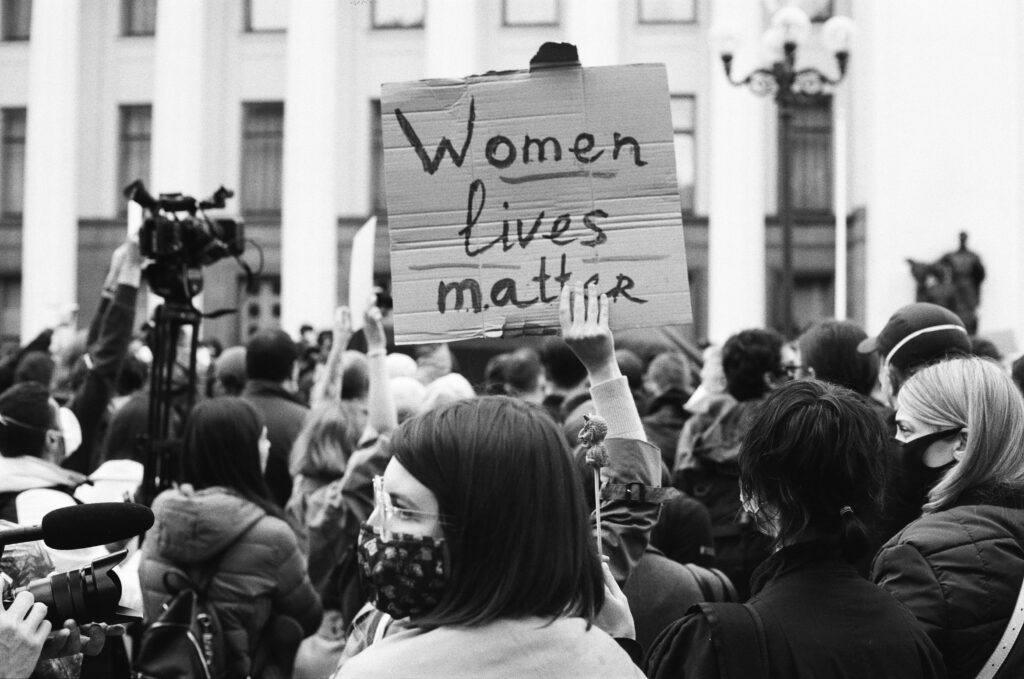
The 4B movement is a radical feminist grassroots movement in South Korea where women reject heteronormative and traditional patriarchal expectations. A patriarchy is a social system where men hold primary structural power, moral authority, social privilege, and dominate roles in leadership and government, resulting in the systematic granting of women less power and fewer opportunities.
Emerging in 2015 as a response to widespread societal misogyny, digital sex crimes, strict beauty standards, and other forms of gender-based violence, the movement was created to empower women to directly counter the strong societal influence to conform to harsh standards. ‘4B’ is defined by the refusal of four things, all starting with the Korean prefix bi:
Biyeonae: No romantic dating with men.
Bisekseu: No sexual relationships with men.
Bihon: No heterosexual marriage.
Bichulsan: No childbearing or motherhood.
The women who subscribe to this movement seek to decenter men entirely from their lives. Followers avoid the disproportionate burden of unpaid domestic labor, career sacrifices, and physical risks often associated with heterosexual partnerships and motherhood. They believe that non-cooperation with patriarchal systems and adherence to a life that doesn’t serve the lives of men is a tool of self-protection and political leverage.
This political protest piece is especially significant in this context, as it involves such a large part of the population taking action against their historic and current oppression. For the most part, this is a movement of passive resistance and liberation. The participating women don’t shrink their lives in any significant way because they are simply abstaining from a lifestyle that involves pandering to or serving men in some way. The movement nonetheless has had an enormous effect on the overall awareness of violence against women, and at the very least, stimulates conversations on the topic as a whole.
South Korea, already possessing the world’s lowest fertility rate due to factors such as high housing costs and extremely long working hours, was hit harder by the 4B movement. The ideology further amplified the birth deficit, proving that women’s ability to say no can have a tremendous impact on the political and demographic framework of a country.
No one expected this movement to resonate the way it did on the global scale. The notion that men have been and continue to be the root of oppression against women is vastly unpopular, yet the tenets of 4B are understood as a logical response to the enduring and overwhelming force that is the patriarchy on women.
The once localized resistance had gone global. It reached Western women, gaining massive traction in the U.S. and Europe after notable political shifts affecting reproductive rights. But what about the Arab World? What is the extent of the impact of the movement on societies in the Arab world? Could Arab women create a 4B movement of their own?
The Application to the Arab World
Despite its immense scope, the Arab world wasn’t quite impacted in the way that other regions were. Many customs and aspects of the Arab culture are specifically male-oriented, generally not allowing women the space to exercise lifestyle choices outside patriarchal structure. For the most part, people living in the Arab world can’t fathom a world where women reject patriarchal norms and expectations to the degree of South Korean women. This is for a variety of reasons.
First, marriage and family remain central to the values in many Arab societies. Matrimony and children are often not seen as personal choices for men and especially women, but as obligations, fueled by long-standing societal expectations rooted in historic priority of men’ s legacy. Religion plays a large role in the traditional sanctity of marriage, framed as ‘deen,’ ‘completing half of one’s faith.’
The systemic nature of male-focused standards perpetuates economic barriers that hinder women from gaining financial independence without the presence of men. Obtaining financial freedom is incredibly difficult for women because independent living is not common or encouraged by society. The West and East Asia have the infrastructure to support a less culturally restricted environment, making a self-sufficient existence more accessible to women of all ages, but this type of freedom doesn’t exist to the same level in the Arab world.
These norms infiltrate justice systems as well, putting women at a disadvantage in legal systems that favor men. In many Arab nations, situations involving divorce, inheritance, guardianship, etc. often leave women legally and financially dependent on male relatives, like fathers or husbands.
The Alternative
A full-fledged 4B movement occurring in the Arab world is unlikely. Feminism designed for the Arab world has and will presumably include navigating patriarchal norms as its main principle, at least for the near future. A more drastic separation from harsh standards in the form of decentering men entirely isn’t the goal for this particular context, but there are some ongoing changes building towards a unique culturally-sensitive feminist movement.
Issues related to patriarchal norms have been addressed through modifying them to improve the autonomy of women and still fit the cultural landscape. Things like delaying marriage to allow women more time to establish themselves and gain more life experience has been a large advancement, along with more women seeking a means of financial independence after marriage and motherhood.
Women’s resistance has mainly manifested through personal development and individually-motivated living. Many women pursue education, career goals, and exploration with relationships in a more covert and private manner. This allows them to adopt their own practices and choices into their life while still operating under the overarching veil of gendered expectations. There are countless online spaces where feminists living in the Arab world converse about dealing with stringent societal norms, and how to navigate them in a way that honors the wider outlook on radical movements.
In conclusion, feminism in the Arab world must be approached carefully and addressed based on existing norms, cultural contexts, and dynamics unique to the region. The most suitable option is that which aligns with feminist goals and gives women increased access to more options. The Arab world will likely not experience a revolutionary switch to the rejection of male centered policies and traditions, but it can undergo a shift in the direction towards a more just word.
Want more articles like this? Sign up for our e-newsletter!
Check out our blog here!