
Subscribe
to receive news by email

Poll
Will the Trump Administration Shift U.S. Policy in Favor of Palestine?
- No (86%)
- Yes (14%)
 Loading ...
Copyright © 2026 Arab America
Go topNUSACC Supports Iraq Higher Education Roadshow to the United States
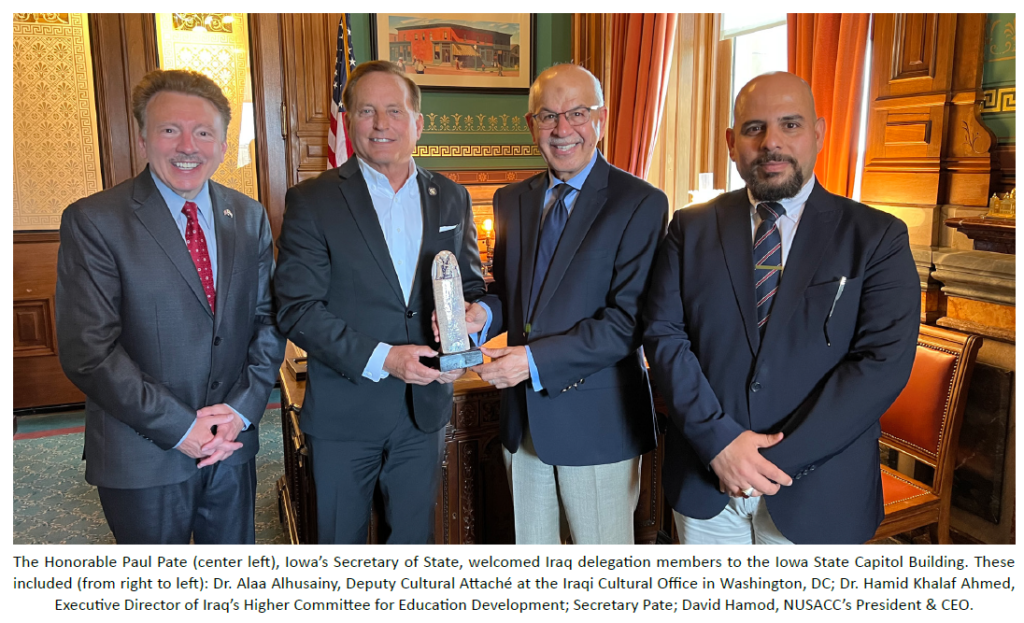
The National U.S. – Arab Chamber of Commerce (NUSACC) – America’s #1 commercial gateway to the Middle East and North Africa (MENA) region – recently completed a historic U.S. roadshow in support of higher education in the Republic of Iraq. In partnership with the Office of the Prime Minister and the Embassy of Iraq in the United States, the tour focused on universities in three states: Colorado, Nebraska, and Iowa.
Leading the delegation was H.E. Dr. Hamid Khalaf Ahmed, Advisor to the Prime Minister and Executive Director of Iraq’s Higher Committee for Education Development (HCED). He was joined by NUSACC’s President & CEO, David Hamod, and two senior officials from the Iraqi Cultural Office in Washington DC: Dr. Hussein Alsheakh, Director of Administration, and Dr. Alaa Alhusainy, Deputy Cultural Attaché.
With decades of experience in higher education, Dr. Hamid is responsible for sending an initial cohort of 1,000 Iraqi graduate students to U.S. universities. In this initiative, he is being supported by NUSACC and the Office of the Cultural Attaché, which represents Iraq’s Ministry of Higher Education and Scientific Research in the United States.
“I am grateful to NUSACC and the Embassy of Iraq for this opportunity to open doors in America’s Heartland,” said Dr. Hamid. “Higher education is a priority for our new Prime Minister, H.E. Ali Al-Zaidi, and the United States has so much to offer.”
“NUSACC was honored to support this historic roadshow, the first of many, we hope,” noted David Hamod, NUSACC’s President & CEO. “We are grateful to Dr. Hamid and the Government of Iraq for the opportunity to be of service, and we thank the U.S. universities for their exceptional hospitality.”
During the visit, HCED signed Memoranda of Cooperation with Colorado State University, the University of Nebraska, and the University of Iowa. These memoranda are expected to pave the way for international exchange, including Iraqi students coming to the USA, American students traveling to Iraq, and faculty exchanges that will benefit both nations.
As part of his tour, Dr. Hamid also visited the University of Colorado, the Colorado School of Mines, and Drake University in Iowa. In Des Moines, he was welcomed to Iowa by the Secretary of State, the Honorable Paul Pate.
Higher Education as a Pillar of Economic Development
Higher education is an essential part of Iraq’s transition from a hydrocarbons-based economy to a knowledge-based economy. This is especially true for students in STEM – Science, Technology, Engineering, and Mathematics – which is considered a top priority for the Republic of Iraq.
By the year 2030, Iraq expects to graduate more than one million high school students annually, and many of these will pursue degrees in higher education. Iraq has 36 state universities and more than 100 private universities and colleges, but study in elite universities overseas represents an important part of Iraq’s strategic planning. Exceptional students will help to drive the next generation of innovation and leadership in Iraq, and some of these will study in the United States.
As such, the Government of Iraq views higher education as an economic issue, not just an education issue. Iraq’s population will soon surpass 50 million people, and approximately 60 percent of that nation’s population is under the age of 25. As Iraq works to diversify beyond oil, the country needs a workforce capable of supporting rapid growth in technology, healthcare, infrastructure, logistics, energy, agriculture, manufacturing, and other private sector-led fields.
In this context, higher education is inexorably tied to strategies covering workforce development, economic development, and nation-building.
Enrollment in Iraqi universities and colleges now exceeds one million students. Access to higher education has expanded considerably over the years, but the system continues to face challenges stemming from decades of conflict, sanctions, underinvestment, and brain drain.
Despite these challenges, Iraq has made meaningful progress in internationalization. In the 2026 Times Higher Education World University Rankings, 25 Iraqi universities secured ranked positions, up from 22 institutions last year.
Iraq is clearly moving in the right direction. Recent data indicate a roughly 10 percent year-over-year improvement in accreditation, quality assurance, research effectiveness, and international competitiveness.
The Ministry of Higher Education and Scientific Research (MOHESR) has introduced stricter standards tied directly to internationally recognized ranking systems, launching its own Iraqi Ranking of Universities to encourage alignment with global benchmarks.
Visit to Colorado State University
Founded in 1870, Colorado State University (CSU) is a public university with about 35,000 students. With approximately 1,500 faculty in eight colleges and 55 academic departments, CSU is classified as an R1 Doctoral University with very high research activity. It is one of more than 100 U.S. land-grant research universities, most of which were founded in the 19th century.
As the State of Colorado’s land-grant university, CSU combines world-class research with a strong commitment to education, workforce development, and public service. CSU is internationally recognized for its expertise in agriculture, water resources, veterinary medicine, engineering, environmental sciences, and public health — fields that are critical to addressing global challenges in food security, natural resource management, economic development, and human well-being.
Through collaborations with institutions, governments, and industry partners around the world, CSU seeks to advance knowledge, build capacity, and develop practical solutions that improve lives and strengthen communities.
“We extend our thanks to Dr. Hamid and the Government of Iraq delegation for visiting Colorado State University,” noted CSU’s President, Amy Parsons. “Collaboration through our Memorandum of Cooperation will support increased opportunities for research, education, and innovation. We are grateful to NUSACC for helping to organize this visit, and we look forward to advancing connections between CSU and Iraq’s higher education institutions.”
Visit to Colorado School of Mines
The Colorado School of Mines (aka Mines) is a public research university with approximately 8,250 students, roughly one-quarter of whom are graduate level. Founded in 1874, the school generally is a STEM-focused university. Mines is a premier energy university, the world’s top-ranked university for minerals and mining engineering, and it is pioneering quantum engineering research and education.
Mines is classified as an R1 Doctoral University with very high research activity. The campus hosts a research building for the United States Geological Survey, which houses the National Earthquake Information Center. Mines also offers multiple innovation facilities, including the Aramco xWorks, the Labriola Innovation Hub, and the Beck Venture Center, which helps to connect innovative technologies with the commercial world.
“It was a distinct privilege to welcome Dr. Hamid Khalaf Ahmed and the HCED/NUSACC delegation to the Colorado School of Mines to explore how our institution can support the next generation of Iraqi leaders through the National Scholarship Program,” noted Dr. John Bradford, Vice President for Global Initiatives. “We see tremendous potential for impactful collaboration between Mines and the Iraqi government, particularly in advancing joint energy research and expanding cutting-edge educational opportunities that benefit both our nations.”
Visit to University of Colorado
Founded in 1876, the University of Colorado (CU) has more than 39,000 undergraduate and graduate students, making it the largest university in Colorado by enrollment. It offers more than 2,500 courses in more than 150 areas of study. CU is spread across four campuses: Boulder, Colorado Springs, Denver, and the Anschutz medical campus.
CU Denver is a public urban research institution serving over 13,000 students in downtown Denver. As an R1 Doctoral University offering more than 150 degree programs, it ranks as the top institution in Colorado for social mobility. CU Anschutz is home to six professional schools in the health sciences, and it is the largest academic health center in the Rocky Mountain region of the United States.
“We are extremely grateful to the Government of Iraq and Dr. Hamid for making time to visit both the CU Denver and CU Anschutz campuses to discuss opportunities for cooperation and collaboration in order to expand learning opportunities for Iraqi students,” said Alana Jones, Associate Vice Chancellor for the Office of International Affairs. “It was a pleasure to host the visit from Dr. Hamid Khalaf Ahmed, Dr. Hussein Alsheakh from the Iraqi Cultural Office in DC, and David Hamod from the National U.S.-Arab Chamber of Commerce. We are grateful to NUSACC for organizing the visit to Colorado, and we look forward to further developing our partnership.”
Visit to University of Nebraska–Lincoln
Founded in 1869, the University of Nebraska–Lincoln (UNL) is a public university with about 24,000 students. UNL has nine colleges, offering more than 150 undergraduate majors, 20 pre-professional programs, and 100 graduate programs. UNL is classified as an R1 Doctoral University with very high research activity.
UNL is one of more than 100 U.S. land-grant research universities, most of which were founded in the 19th century. The Institute of Agriculture and Natural Resources operates three primary Research, Extension and Education Centers (REECs) across the State of Nebraska, and the University of Nebraska Medical Center has one of the top infectious disease divisions in the USA.
“The University of Nebraska–Lincoln was honored to welcome Dr. Hamid Khalaf Ahmed and representatives of the Government of Iraq to campus,” noted Maegan Stevens-Liska, Assistant Vice Chancellor for Global Affairs and Senior International Officer. “We are grateful for the opportunity to formalize our collaboration through the Memorandum of Cooperation, and we thank NUSACC for its partnership in facilitating meaningful connections that strengthen educational and research engagement between our institutions.”
Visit to University of Iowa
Founded in 1847, the University of Iowa (UI) is the oldest and largest university in the State of Iowa, with approximately 32,000 students. Iowa is a public research university that is classified as an R1 Doctoral University with very high research activity. The UI is organized into 12 colleges, offering more than 200 areas of study and seven professional degrees.
Among public universities in the United States, UI was the first to become coeducational. The UI Bachelor of Science in Nursing (BSN) program is ranked #4 in the USA and tied for #1 among public universities, according to U.S. News & World Report, which also recognized nine UI graduate programs among the top 25 in the United States.
UI Health Care consists of three health campuses, four hospitals, a nationally-ranked medical school, and more than 70 facilities across the State of Iowa. The University of Iowa was the original developer of the Master of Fine Arts degree, and it operates the Iowa Writers’ Workshop, whose alumni include 17 of the university’s 46 Pulitzer Prize winners.
More than 100 nations are represented at the University of Iowa. Russell Ganim, Associate Provost and Dean of International Programs, characterized Dr. Hamid’s visit as an “unqualified success.” He noted, “The visit resulted not only in multiple ideas for possible collaboration, but many new friendships that will help to build our partnership.”
Ganim concluded, “We were very pleased to welcome Dr. Hamid and Dr. Alaa to the University of Iowa, and to welcome back David Hamod, President of NUSACC and a UI alumnus.”
Visit to Drake University
Founded in 1881, Drake University is a private, high-quality university in Des Moines, Iowa, with approximately 2,600 undergraduate students and 1,600 graduate/professional students. With a student-to-faculty ratio of 11-1 and average class size of 21 students, Drake University provides students with individualized attention and an exceptional learning experience. Because of Drake’s strong reputation with employers in the American Midwest, the vast majority of Drake’s undergraduate students complete at least one paid internship, with many completing three to five paid internships before they graduate.
With more than a hundred undergraduate programs across seven colleges and schools, Drake is distinguished by exceptional programs in Actuarial Science, Pharmacy, Data Analytics, Artificial Intelligence, Finance, Journalism, Public Relations, Politics, and many more.
“It was a pleasure to host Dr. Hamid at Drake University, and we would like to express our sincere appreciation to him and the Government of Iraq for their visit,” said Annique Kiel, Drake’s Chief Global Affairs Officer & Dean of Global Programs. “The discussions were highly productive and helped to identify several areas of mutual interest that may provide opportunities for future collaboration between Drake University and institutions in Iraq. We look forward to continuing these conversations and exploring potential avenues for partnership.”
She concluded, “We would also like to extend our gratitude to the National U.S. – Arab Chamber of Commerce for the Chamber’s leadership in organizing and facilitating this visit.”
Benefits of Working with U.S. Universities
As Iraq works to diversify its economy, demand is rising rapidly for talent in artificial intelligence, cybersecurity, data analytics, healthcare, engineering, energy, agriculture, logistics, supply chain management, advanced manufacturing, and training.
Educational reform is paramount and, in this regard, one of the biggest challenges that Iraq faces is to produce graduates with skills that are sought by employers. Iraq is looking for partners that can help to bridge the gap between academic study and workforce participation.
American institutions offer a number of advantages in this regard.
First, U.S. universities set the global benchmark in research, innovation, and quality assurance. Accreditation systems such as ABET and AACSB provide internationally recognized standards that can help Iraqi institutions modernize academic programs.
Second, American universities have developed strong links between education and employment. Through internships, cooperative education programs, industry partnerships, experiential learning, and professional certifications, U.S. institutions are very effective at preparing students for the workforce.
Third, the United States offers one of the world’s most advanced innovation ecosystems. Universities routinely work alongside industry through research partnerships, technology transfer offices, startup incubators, and commercialization initiatives.
Finally, American universities – spread across the United States – offer a breadth and depth that no other country can match. Many American schools are unknown in Iraq, yet they possess specialized strengths that align directly with Iraq’s national priorities.
Examples include universities with expertise in actuarial science, agriculture, water management, teacher training, public health, cybersecurity, logistics, supply chain management, workforce development, energy systems, and artificial intelligence.
The U.S. roadshow reinforced the view that alignment with Iraq’s development priorities outweighs generic educational rankings, and partnerships in the United States should never be limited only to “name brand” universities.
Educational Reform in Iraq
For the 2025–2026 academic year, the Ministry of Higher Education and Scientific Research launched ten specialized Colleges of Artificial Intelligence across Iraqi public universities, signaling a move toward applied, technology-focused education. This effort is complemented by broader international initiatives aimed at integrating global quality assurance standards and modern governance practices into Iraq’s higher education system.
For its part, the Higher Committee for Education Development (HCED), in the Office of the Prime Minister, has become one of the primary drivers of Iraq’s education reform agenda, with responsibilities that extend into institutional partnerships, workforce alignment, quality enhancement, and long-term human capital development.
As the U.S. roadshow made clear, HCED has become one of the government’s principal vehicles for driving international partnerships and expanding access to world-class educational opportunities. HCED is playing a valuable role as Iraq aligns university outcomes with national development strategies.
Much of the urgency behind these reforms comes down to demographics. Youth unemployment in Iraq, stubbornly, remains among the highest in the region. Graduate unemployment is also a growing concern, and many employers report a mismatch between university training and workforce needs. Government jobs have historically provided security in Iraq and other nations in the MENA region, but the public sector can no longer absorb the growing number of university graduates.
The HCED Scholarship Program, which will send more than 1,000 Iraqi graduate students to the USA, is designed to forge partnerships with leading universities around the world. The scale of the program reflects the Iraqi government’s determination to accelerate human capital development and expose a new generation of students to world-class institutions.
The goal is much broader than student mobility. Iraq is seeking to develop a new generation of researchers, educators, engineers, healthcare professionals, scientists, and policymakers who can contribute to the country’s long-term development.
The Bottom Line
Iraq’s objective is clear: To invest public resources in institutions that are capable of producing graduates who can help to modernize Iraq’s economy and institutions.
The U.S. roadshow highlighted a growing symmetry in Iraq: That nation’s higher education strategy is ultimately a workforce strategy, and its workforce strategy is ultimately an economic development strategy.
Iraq is making a concerted effort to connect its higher education system to global standards and domestic labor market realities, and American institutions are poised to serve as long-term partners in this initiative. In this spirit, institutions that help Iraq to educate, train, and prepare its next generation of leadership will play an important role in shaping that country’s future.
Want more articles like this? Sign up for our e-newsletter!
Check out our blog here!