
Subscribe
to receive news by email

Poll
Will the Trump Administration Shift U.S. Policy in Favor of Palestine?
- No (86%)
- Yes (14%)
 Loading ...
Copyright © 2026 Arab America
Go topThe Result of Michigan’s Senate Primary Election Could Change Everything…
By Jahnvi Chopra / Arab America Contributing Writer
The Democratic Candidates: A Recap
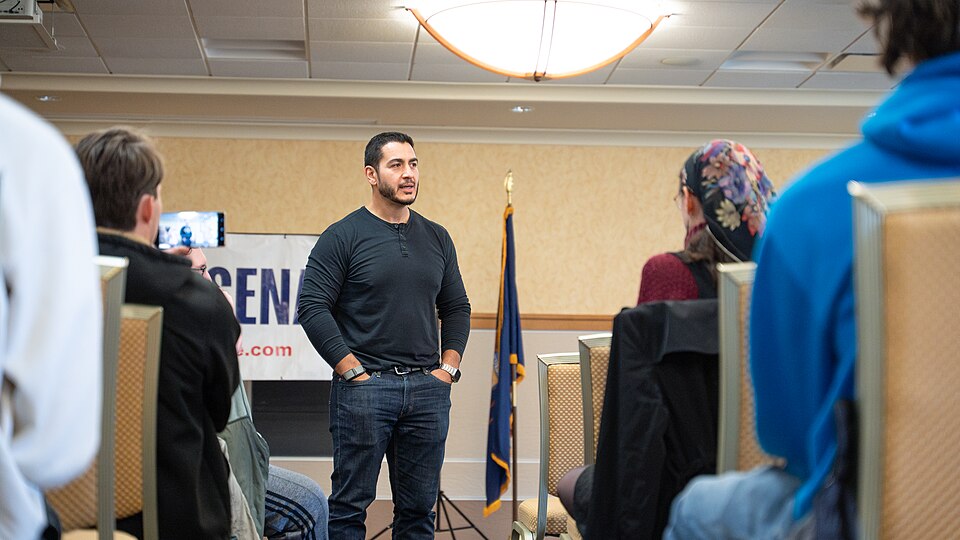
Former public health official and current progressive Democrat candidate in Michigan’s Senate Primary election, Abdul El-Sayed, is making waves in the U.S. political landscape. Michigan’s status as a swing state makes this race even more of a nail-biter, pushing Democrats to choose the best candidate to go up against Republican nominee Mike Rogers in November. Once there, the Democrats must fight to retake their majority in the upper chamber and potentially flip the Senate.
Though both are from the same party, the two Democratic candidates couldn’t be more different in their top issues and campaign backgrounds. They have differing opinions on energy, the economy, healthcare, etc, yet the status of Palestine and U.S. connections to Israel remain the most divisive among them. Their most prominent political divide is their stance on military aid to Israel, which makes sense given their markedly different proximity to the topic.
Haley Stevens, the other main candidate facing off against El-Sayed, staunchly supports unconditional aid in the form of arms to Israel, advocates for a two-state solution, and aligns herself with other Israel-backers.1 Most notably, her campaign has received over 30 million dollars from the American Israel Public Affairs Committee (AIPAC), specifically targeting El-Sayed’s platform while promoting Stevens’.2 AIPAC, notorious for its immense financial footprint in U.S. elections and lobbying efforts, has also raised several million dollars for Stevens’ own canvassing efforts through a donor platform. The organization is currently breaking records in campaign expenditure, and if met with defeat, will face one of the biggest financial blows in political spending history.3
El-Sayed directly opposes Stevens’ outlook on the topic of Israel and Palestine, publicly condemning AIPAC’s persistence in influencing American politics through massive donations to candidates like Stevens, often stomping out progressive opponents.
Leading With His Roots
This race is crucial for Arab-Americans, as it is one of the first times in American history that a Muslim American has a firm chance at serving in the Senate. El-Sayed is the child of immigrants from Egypt and a devout Muslim who has openly discussed his Islamic faith and how it has informed his dedication to public service.4 He leads with his identity and community in mind, evidently speaking out about issues that deeply affect Arab Americans, like disparities in medical visibility and political representation.
The issue of Palestine is not a controversial topic in the lives of Arab-Americans, as it remains one of the biggest political unifiers within the community. That’s why the rise of a candidate that not only shares an identity with Arab-Americans, but outwardly expresses the same stance that is deemed contentious by the rest of the world is so crucial in these coming months. The topic of Palestine has come to be at the very center of this election. It’s putting Arab-American identity at the forefront of U.S. politics and is putting American solidarity with Palestine to the test.
This race is more than a contest between Democratic candidates; it is a demonstration of Arab American voter power. Dearborn, Michigan, and the surrounding cities are among the most densely populated Arab areas in the country, making this election even nearer to the hearts of Arab Americans. They have a direct stake in the political inclusion of their community in the nation’s highest offices. These voters are presently affecting the outcome of the election, and the decision they make on their ballots allow them to choose a candidate that represents them.
El-Sayed for Everyone
While El-Sayed is a trailblazer for his fellow Arab Americans, his coalition extends to countless other groups. He garners support from progressives, younger Democrats, labor allies, and voters who are skeptical, or even disillusioned, of corporate influence in politics. Many don’t align ethnically or racially with El-Sayed but still find themselves represented in one or more of the numerous issues he speaks on.
This race is one of the most historic of its time, with rival candidates from the same party possessing vastly different views, record-breaking amounts of dark money being spent on ongoing U.S. elections, and a deeply polarized set of voters in a battleground state. Abdul El-Sayed tackles problems close to his community and appeals to a wider audience by operating at the intersection of crucial issues like foreign policy and changing demographics in our nation. The truth remains that no matter what happens this November, he has left his mark on the national stage, bringing the concerns of Arab Americans to the forefront of this country’s discourse on international affairs and government matters.
Want more articles like this? Sign up for our e-newsletter!
Check out our blog here!