
Subscribe
to receive news by email
Poll
Will the Trump Administration Shift U.S. Policy in Favor of Palestine?
- No (86%)
- Yes (14%)
 Loading ...
Copyright © 2026 Arab America
Go topPathbreakers of Arab America—Sadam Ali
By: John Mason / Arab America Contributing Writer
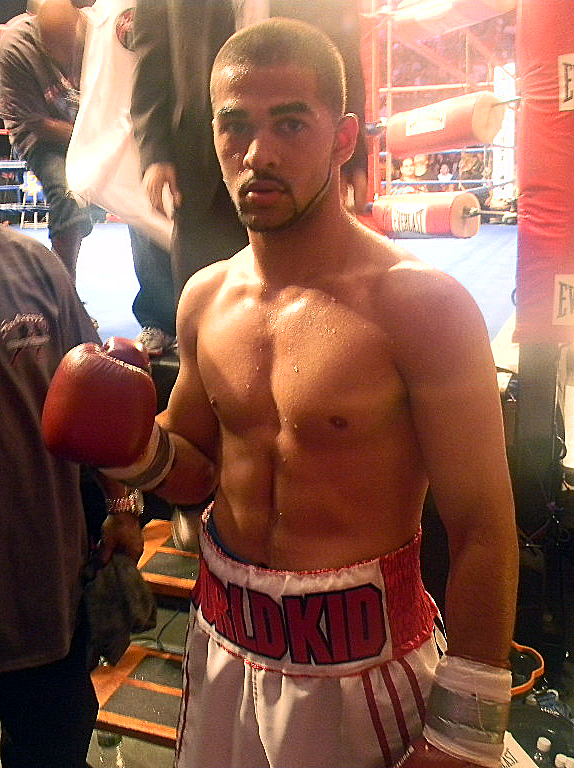
This is the 136th article in Arab America’s series on American pathbreakers of Arab descent. The series features figures from entertainment, business, sports, science, the arts, academia, journalism, and politics. Our 136th pathbreaker, Sadam Ali, was inspired to box by Yemeni British boxer Prince Naseem Hamed and influenced by his Yemeni immigrant family in his unshakable self-belief. His professional boxing record based on 30 major fights is an outstanding 27 wins against 3 losses, 14 versus 3 by knockout and 13 versus 0 by decision. Ali’s Yemeni heritage and his dual identity as a Yemeni American fostered pride in his origins while imbuing him with a sense of resilience that fueled his commitment to boxing.
Inspired by a Yemeni British boxer, Yemeni American Sadam Ali was the first Arab American to represent the U.S. in Olympics boxing
Sadam Ali was born September 26, 1988, in Brooklyn, New York to Yemeni immigrant parents of Muslim faith. His father, Mahmoud Ali, immigrated from Yemen as a young boy and worked as a real estate broker in Brooklyn, where the family settled in the Bedford-Stuyvesant neighborhood. It was there that Ali grew up as the youngest of six siblings, including four sisters and one brother. And it was also where he began boxing, at the Bed-Stuy Boxing Club at the age of eight.
Also known professionally as ‘World Kid,’ Ali was a Junior Olympic National Champion, a Police Athletic League National Champion, a U-19 National Champion, and a two-time New York City Golden Gloves champion. In 2006, Ali won the National Golden Glove Championship in the featherweight division at the age of 17. He then represented the U.S. at the 2006 World Junior Championships, where he won a bronze medal after losing in the semifinal round, Ali is only the second boxer to win the National Golden Glove Championship in two different weight classes, featherweight and lightweight, in consecutive years, 2006 and 2007, in New York. For the 2008 Summer Olympics in Beijing, he became the sole American lightweight permitted to compete in three Olympic qualification tournaments to be held over the ensuing eight months, for one of the six berths allocated to lightweights from the Americas. This is when he became the first Arab American to represent the U.S. in the Olympics. While he was very competitive leading up to the 2008 Olympics, Ali was outboxed in his opening match at the Olympic Games.
Ali’s overall amateur record was 89 wins–19 losses. He then began his professional boxing career. On January 17, 2009, “Ali made his pro debut and needed just 1:42 to defeat his competitor, one Ricky Thompson.” On November 8, 2014, Sadam Ali took on boxing star Juan Carlos Abregu. Ali “was heading into the fight as a big underdog. Ali had upset the odds and defeated Abregu, the fight was stopped in the 9th round and ruled as a TKO victory which meant Ali had won the welterweight title. Ali had knocked down his opponent in the 6th and 9th round before the fight had been stopped.” All was not victorious for him, however, evidenced by his subsequent match as a welterweight in 2016 against “Californian volume puncher,” Jessie Vargas, who delivered a decisive victory.
Perhaps Ali’s most notable achievement came on December 2, 2017, when he upset four-division world champion Miguel Cotto by unanimous decision to capture the World Boxing Organization junior middleweight title in Cotto’s final professional bout at Madison Square Garden. “His reign lasted until May 2018, when he was stopped in the fourth round by Jaime Munguía in a title defense, marking his first professional knockout loss.” In the title defense, “Munguia overwhelmed Ali from the opening bell, dropping him four times before the referee stopped the contest at 1:02 of round four via technical knockout. Munguia’s aggressive pressure and power punching exposed vulnerabilities in Ali’s defense.” This resulted in the immediate vacancy of the WBO title and marked the end of Ali’s championship run without any successful defenses.
Following his last fight in 2019, which began a six-year hiatus in his professional boxing career, Sadam Ali began transitioning into boxing coaching during this period. In a 2023 interview, he described the shift “as a way to stay engaged with the sport while helping others avoid the pitfalls he faced, emphasizing the satisfaction derived from guiding fighters with the same intensity he would have wanted for himself.” This personal drive was influenced by his formative experiences, “particularly the foundational training provided by his father from age eight, which shaped his coaching philosophy around disciplined, hands-on development.”
Ali made a comeback in 2025, returning to the ring following a six-year hiatus to continue his career at age 36. In August 2025, expressing “a renewed passion for the sport that had been absent during his time away, the former WBO junior middleweight champion decided to test his post-hiatus form before it was too late in his career.” On August 31, 2025, at Wayne State Fieldhouse in Detroit, Michigan, despite early signs of ring rust from the extended layoff, Ali faced unranked junior middleweight Cody Wilson in a 10-round bout. “Ali dominated the fight with precise counterpunching and superior footwork, securing a unanimous decision victory with scores of 99-91, 98-92, and 100-90.” This win improved his professional record to 28-3, with 14 knockouts.
Ali’s Yemeni heritage and his dual identity as a Yemeni American fostered pride in his origins while imbuing him with a sense of resilience that fueled his commitment to boxing
During his hiatus from professional boxing in 2019, Ali had a chance to coach Brooklyn-based boxer Sulieman ‘Slim’ Albaher, a Yemeni American YouTuber transitioning to boxing, from that year through early 2023. One source describes this mentorship as highlighting “a cultural representation in Brooklyn’s diverse boxing scene, bridging Somali and Yemeni immigrant communities through shared emphasis on resilience and discipline in the sport.”
We’ve already alluded to Ali’s fascination with Yemeni British boxer Prince Naseem Hamed, whom Ali as an eight-year-old witnessed in Hamed’s HBO debut, 17 years ago in Madison Square Garden. Ali said that that event made him feel “like he had been struck by lightning.” “The brash young champion was an epiphany Ali believed was showing him everything the future could hold.” Here was a role model extraordinaire, athletic, charismatic, and a fellow Yemeni on top of it all, offering him a pathway forward as a very young boxer. This led the teenager Ali to the place of a matured, highly decorated amateur boxer, becoming—as already noted—the first Arab American to represent the U.S. at the Olympic Games.
Not to be overlooked in his role in the modeling department is Ali’s father, Mahmoud, who, as we saw, had immigrated from Yemen as a young boy to Brooklyn. There, the family settled in the Bedford-Stuyvesant neighborhood. The family seemed to adapt to American life easily, while “the family dynamics revolved around support and cultural preservation, with Ali’s father actively encouraging involvement in physical activities from a young age.” This emphasis on discipline and sports helped instill resilience in Ali amid the demands of immigrant family life. Growing up in the diverse, urban landscape of Bedford-Stuyvesant, “a neighborhood known for its multicultural fabric and socioeconomic challenges,” worked in Ali’s favor. For there he learned “to navigate the typical experiences of a young person in a bustling city environment that blended opportunity with potential pitfalls.”
As with all cultural and social blending, it is difficult to sort out where the strands of Ali’s Yemeni and American cultures intertwine in the finished fabric of Ali’s life. A significant piece of the fabric consists of a trait he shares with the Yemeni British boxer Naseem Hamad and with his father, namely that of unshakable self-belief. Another key piece is the resilience needed for any immigrant family to adapt to the tough and diverse urban landscape of a place like Bedford-Stuyvesant.
Maybe that’s one good reason why we at Arab America leave the hyphen out of Arab American, since being both at the same time is essential to the integrity of each separately.
Sources:
“Sadam Ali,” Wikipedia, 2026
“Sadam Ali,” Grokipedia, Vo.2, 2026
“Sadam Ali, U.S. Muslim Olympic Athlete,” The Islamic Workplace, 8/23/2008
“A New Ali Forges His Own Path,” GetBack Magazine, 11/08/2014
“Sadam Ali—Alias ‘World Kid’,” BoxRec, 3/28/2019
“Sadam Ali—Arab Americans,” arabamerica.com, 2026
“Sadam Ali, Boxer–Yemeni American Community Success Stories,” Embassy of the Republic of Yemen, 2026
John Mason, Ph.D., focuses on Arab culture, society, and history and is the author of LEFT-HANDED IN AN ISLAMIC WORLD: An Anthropologist’s Journey into the Middle East, New Academia Publishing, 2017 and of his new novel, WHISPERS FROM THE DESERT: Zaki, a Little Genie’s Tales of Good and Evil (2025), under his pen name, Yahia Al-Banna. He has taught at the University of Libya in Benghazi, Rensselaer Polytechnic Institute in New York, and the American University in Cairo. John served with the United Nations in Tripoli, Libya, and consulted extensively on socioeconomic and political development for USAID and the World Bank in 65 countries.
The views and opinions expressed in this article are those of the author and do not necessarily reflect the position of Arab America. The reproduction of this article is permissible with proper credit to Arab America and the author.
Want more articles like this? Sign up for our e-newsletter!
Check out our blog here!