Subscribe
to receive news by email

Poll
Will the Trump Administration Shift U.S. Policy in Favor of Palestine?
- No (86%)
- Yes (14%)
 Loading ...
Copyright © 2026 Arab America
Go topWhy Israel is Resisting Course Correction and Hurting its Future
By: Ghassan Rubeiz / Arab America Contributing Writer
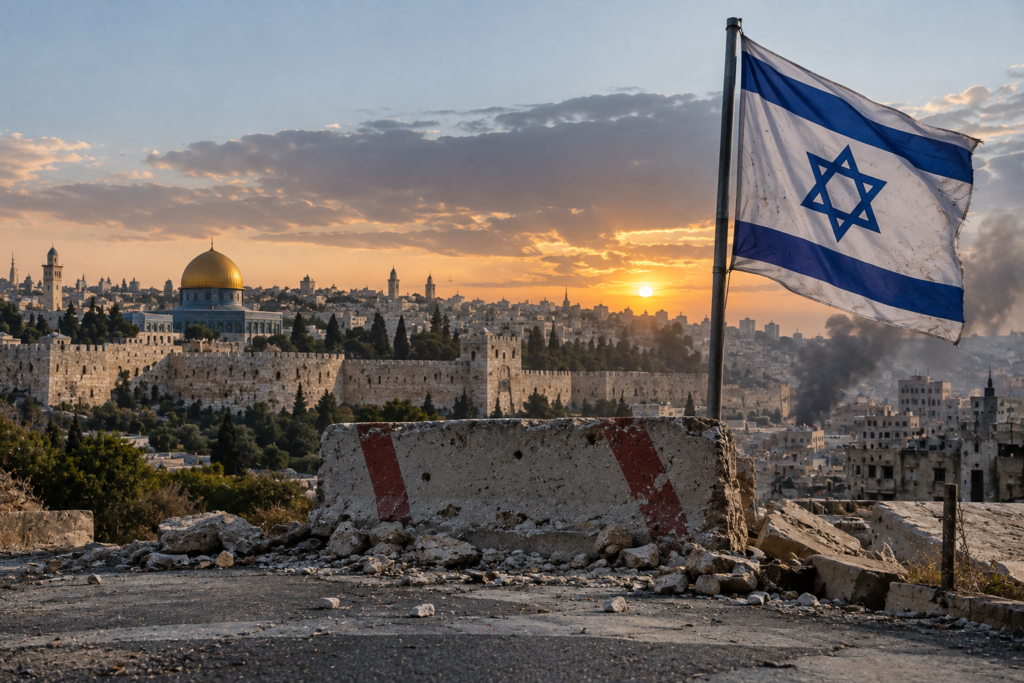
On September 23, Israel’s Central Elections Committee barred the country’s two main Arab lists, Ra’am and the Joint List, from the October 27 elections. A day later, it cleared the far-right parties of Itamar Ben-Gvir and Bezalel Smotrich. The Supreme Court will likely reverse the ban. But the message stands: Israel is normalizing inequality under the law and shrinking the political space of its two million Palestinian citizens.
The ban is a symptom of a larger failure. The trauma of October 7 was real, and Israelis’ fear is genuine. But in three years, Israel has made Gaza unlivable, destabilized the West Bank and tightened its grip on its Arab citizens. Its enemies are weaker than ever. What keeps Israel from correcting course seems to be largely an internal matter, and US politics reinforces it. Five forces, three Israeli and two American, impact a political system that resists change.
The first is Religious Zionism, which is no longer a fringe within Israel’s population. As finance minister, Smotrich holds sweeping civil authority in the West Bank. As national security minister, Ben-Gvir commands the police. Their ideology treats the land as a divine bestowal and annexation as a religious duty. The settler population is its army on the ground. More than 700,000 settlers live in the occupied West Bank and East Jerusalem, with their own armed networks. Their violence erodes the rule of law and speeds annexation. At the UN on September 24, Netanyahu blamed the violence on a few “juvenile delinquents.” No Israeli government has confronted this movement. Now it is part of the government.
The second is the ultra-Orthodox parties (Haredim). They care little about territory. Their price is exemption from military service, state subsidies and a veto over civil marriage and pluralism. Once that price is paid, they become reliable partners of the far right. Their votes keep the annexationists in power.
The third is leadership, including the opposition. Netanyahu has survived by allying with extremists and weakening institutional checks. He treats political problems as military ones. Opposition leader Gadi Eisenkot denies promising to include Ra’am in a future coalition. A political opposition that cannot govern without Arab votes, and will not govern with them, cannot replace Netanyahu.
Two American forces bolster the three internal ones. The powerful and highly politicized Evangelical movement, American-led and known as Christian Zionists, views Israel through end-times prophecy and opposes Palestinian statehood on religious grounds. Mike Huckabee, the U.S. ambassador to Israel, who was an ex-governor of Arkansas and who started as an Evangelical preacher, often acts as Israel’s envoy to Washington. He defends Israel’s claim to all the land between the Jordan River and the Mediterranean Sea.
The other US factor is AIPAC, the American Israel Public Affairs Committee. It lobbies for unconditional support for Israel and punishes US legislators who criticize Israel or its government. For decades this has shielded Israel from accountability and removed any incentive for reform.
Yet counter pressures are building, and they are generational, not merely partisan. In a New York Times/Siena poll this spring, nearly three-quarters of Democrats opposed further aid to Israel. In July, 103 House Democrats voted to end military aid to Israel altogether. More striking, a Pew survey found that 57 percent of Republicans under 50 now view Israel unfavorably. Evangelical loyalty to Israel is “aging out”.
The heaviest pressure may be the cost of war. In its first two years, the Gaza war and its regional spillover cost Washington over $30 billion. That covered aid to Israel and America’s own operations in Yemen and Iran. This year, America went to war alongside Israel against Iran. As the national debt rapidly climbs, Americans will ask why they keep paying for wars they did not choose. Economics may force a recalibration that moral arguments could not.
What does this mean for Palestinians? They must assume Israeli reform is not coming soon. They must also tidy up their own house.
The Palestinian National Authority is virtually ineffective. Its president, Mahmoud Abbas, is 90 years old, and his term expired in 2009. His designated successor, Hussein al-Sheikh, drew 3 percent of the vote in a 2022 poll. A leadership without legitimacy can neither mobilize a people nor negotiate for it. Palestinians badly need national elections (Elections are unlikely to take place under a government threatened by effective representation.) and a single leadership for the West Bank and Gaza. They need a leader who may inspire nonviolent, civil resistance as a moral alternative to armed struggle.
Arab citizens of Israel hold another lever. They are a fifth of the population within the country. With high turnout, their parties could win around 15 of 120 seats of the Israeli parliament (Knesset). That will not win governing power, but it can decide who governs. Ra’am and the Joint List differ on ideology. Still, a shared electoral pact and alliances with Jewish non extreme parties, would make them impossible to bypass.
Above all, Palestinians must stay on the land. Nonviolent endurance denies Israel the demographic victory it seeks. Israel tried to remove Arab voters from the ballot because it fears them. That fear is the measure of Palestinian power. Used wisely, it can outlast the forces that now hold Israel captive.
Ghassan Rubeiz is the former Middle East Secretary of the World Council of Churches. Earlier, he taught psychology and social work in his country of birth, Lebanon, and later in the United States, where he currently lives. He has contributed to political commentary for the past twenty years and delivered occasional public talks on peace, justice, and interfaith subjects. You can reach him at rubeizg@gmail.com
The views and opinions expressed in this article are those of the author and do not necessarily reflect the position of Arab America. The reproduction of this article is permissible with proper credit to Arab America and the author.
Want more articles like this? Sign up for our e-newsletter!
Check our blog here!