

Subscribe
to receive news by email

Poll
Will the Trump Administration Shift U.S. Policy in Favor of Palestine?
- No (86%)
- Yes (14%)
 Loading ...
Copyright © 2026 Arab America
Go topPalestine Dominated UNGA 81 — But What Changed on the Ground?
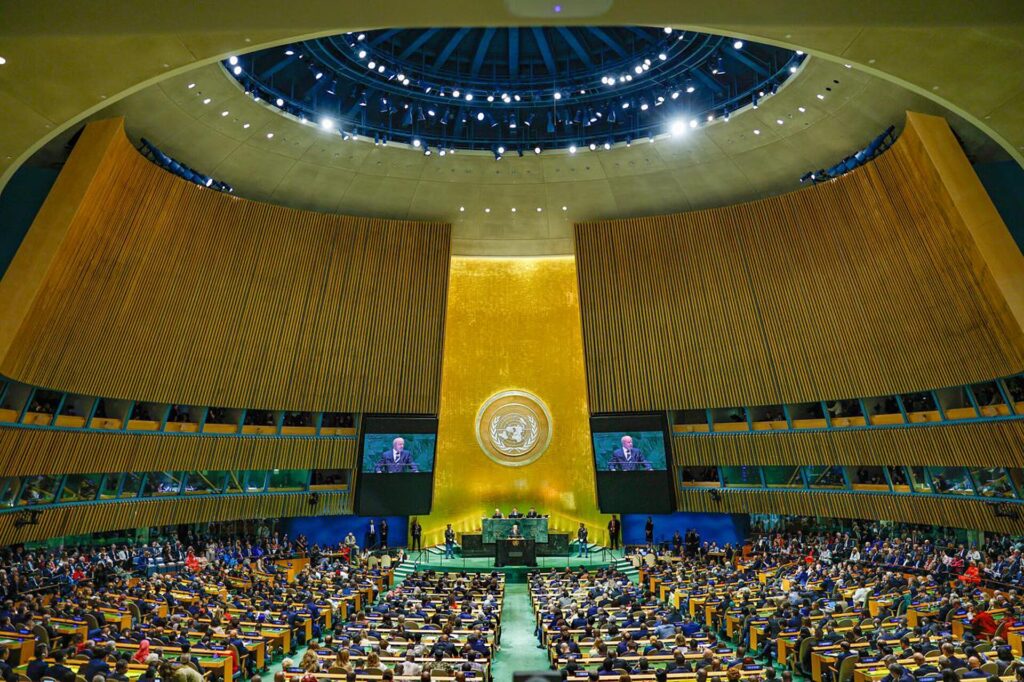
The 81st United Nations General Assembly in New York. Via Wikimedia Commons.
By Aziz Hellal / Arab America Contributing Writer
The 81st session of the UN General Assembly’s general debate, held September 22–28 in New York, covered wars and crises from Ukraine to Iran. But Palestine was impossible to ignore.
For a full week, Gaza, the West Bank, and Palestinian statehood returned again and again to the podium. The language was sharper, Israel faced growing diplomatic pressure, and some Western governments moved beyond recognition toward economic measures. Yet when the speeches ended, nothing on the ground had changed.
The loudest week for Palestine in years
The week opened with outgoing Secretary-General António Guterres calling Gaza’s destruction “a scale of killing and destruction the likes of which I have never witnessed” and warning about the expansion of Israeli settlements in the West Bank.
Arab leaders were even more direct. Jordan’s King Abdullah II argued that the world already has tools to respond — sanctions, asset freezes, embargoes, and diplomatic isolation — but has chosen not to use them against Israel.
Türkiye’s Erdoğan described Gaza as “our time’s most inhumane, most embarrassing concentration camp,” while Qatar’s Emir called what happened there “a genocide in every sense of the word.”
France’s Emmanuel Macron, in his final UN address before leaving office, dismissed Donald Trump’s Gaza diplomacy as “a spectacle that should shame us all,” arguing that it had not reopened humanitarian access “for a single second.”
Trump offered a very different picture. He told the Assembly that “we ended the war in Gaza,” presenting his peace plan as a major diplomatic success and attacked the International Criminal Court as “evil” over its arrest warrant for Netanyahu.
A walkout inside, protests outside
Netanyahu’s appearance provided one of the clearest signs of how much the diplomatic atmosphere has changed. As he approached the podium, dozens of delegations left the General Assembly hall in protest, marking the second year in a row that his UN address was met with a mass walkout. Netanyahu responded by calling those who left “moral cowards.” He also rejected the accusations against Israel, calling genocide allegations “the biggest lie of the century.”
The confrontation did not stop inside the UN. Netanyahu arrived in a New York led by Mayor Zohran Mamdani, one of his most vocal American critics. Mamdani had previously called Netanyahu a war criminal and pointed to the International Criminal Court’s arrest warrant against him.
Netanyahu responded directly from the UN podium, accusing the mayor of spreading lies about Israel and trying to silence him. Mamdani fired back after the speech, again pointing to the ICC warrant and rejecting Netanyahu’s accusations.
Outside the UN, protesters also gathered against Netanyahu’s visit, with more than 100 people arrested during demonstrations in New York. The contrast was difficult to miss: the Israeli prime minister was addressing the world’s largest diplomatic gathering while facing protests both inside the hall and in the city hosting it.
From symbolism to sanctions
The most significant shift around UNGA 81 was not a speech but a policy turn. There were no new recognitions of Palestinian statehood — the big wave came a year earlier, bringing the total to 160 states, which Mahmoud Abbas thanked from the podium. What was new was economic.
In the weeks leading up to UNGA, the UK, France, and Canada moved beyond recognition, announcing coordinated steps to ban imports from Israeli settlements and target those involved in their expansion. Britain moved ahead with sanctions against people involved in building or financing settlements. Israel responded by ordering the closure of Britain’s consulate in East Jerusalem.
This matters because it breaks a decades-old pattern. For years, Western support for Palestinian statehood largely remained in the realm of declarations. Trade restrictions on settlement goods are different because they attach an economic consequence to that position.
Burnham presented the move as a shift from words to action, while still condemning the October 7 attack and reaffirming Britain’s support for Israel’s security. His government also singled out the E1 settlement project as a direct threat to the possibility of a Palestinian state.
Abbas himself addressed the Assembly by pre-recorded video after the US denied visas to the Palestinian delegation for a second consecutive year. He laid out a vision of a non-militarized Palestinian state living alongside Israel and called for Gaza and the West Bank, including East Jerusalem, to eventually come under “one State, one government, one law.”
He also announced Palestinian legislative elections for November 28. Before he could speak, however, the General Assembly had to vote to allow his remote participation. The measure passed 152–3–4, with only the US, Israel, and Paraguay voting against it
The pattern that won’t break
So was UNGA 81 a turning point? The diplomatic mood was clearly different. Palestinian statehood now has broader recognition, Western governments are beginning to attach economic measures to their opposition to Israeli settlements, and Netanyahu faced another mass walkout inside the General Assembly.
But the week produced no new binding action from the Security Council, while Gaza and the West Bank remain largely unchanged by what was said in New York.
That is the contradiction at the heart of UNGA 81. The language around Palestine is getting stronger, and some governments are beginning to move beyond words. But Palestinians have heard strong speeches before.
The real test will be what happens after world leaders leave New York: whether the new measures against settlements are actually enforced, whether pressure on Israel continues, and whether any of it produces a visible change on the ground.
Want more articles like this? Sign up for our e-newsletter!
Check out our blog here!





.jpg)