Subscribe
to receive news by email

Poll
Will the Trump Administration Shift U.S. Policy in Favor of Palestine?
- No (86%)
- Yes (14%)
 Loading ...
Copyright © 2026 Arab America
Go topThe Colonial Present and Its Effects on the Arab World
By Ben Samuels/Arab America Contributing Writer
Even though many Arab World nations were granted independence during the twentieth century, the effects of colonialism are still highly apparent in social, political, and economic spheres. Colonialism, by definition, is “a practice of domination, which involves the subjugation of one people to another.” According to the Stanford encyclopedia of philosophy. Direct colonialism which is more physical and uses control over government to execute its subjugation has transitioned to what we call the colonial present which depicts the new stage of colonialism that is just as exploitative but framed a bit differently as much of the physical aspect has disappeared; however, the long-lasting effects have ingrained colonialism into these societies, and the colonial present has been shaped by deeply ingrained influence and dependency that keep parts of the Arab World in check. Overall, the colonial present has harsh effects on the Arab World through its systemic ingraining and development on the back of direct colonialism.
Colonial Roots
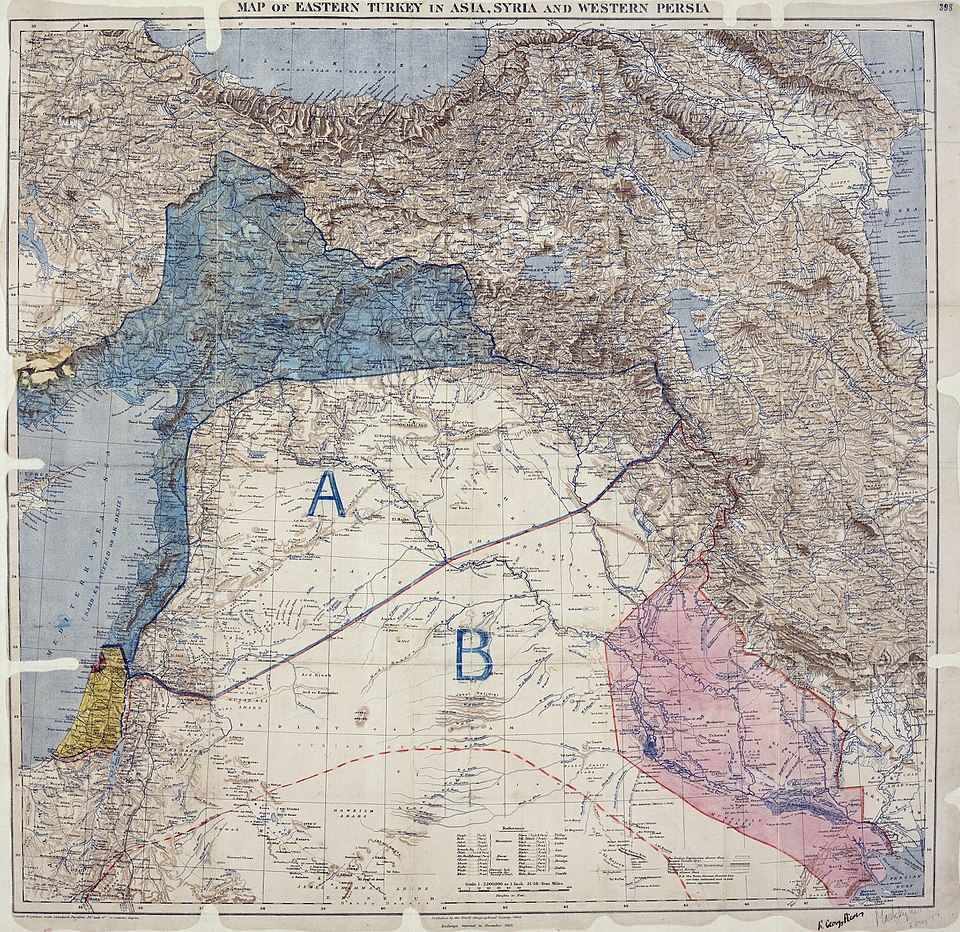
Many of the more contemporary issues in parts of the Arab World, such as political instability, international dependency, and ethnic conflict, have roots that stem from European direct colonialism. The fall of the Ottoman Empire in 1922 was the start of the long-lasting European colonialism that has plagued the Arab World into the 21st century. When the empire fell, it was divided between the British and French in terms of a secret pact called Sykes-Picot, which used the Arab World as spheres of influence for the European superpowers, and borders were drawn up based on what was good for the colonizers, not for the people. As a result, ethnic conflict became a large issue as territorial disputes were set up for years to come. For example, Iraq mixed Sunni, Shia, and Kurdish people among the nation, which was the source of fire for years of disputes. So, overall, much of the geopolitical conflict was set up by these borders that were drawn without consideration. In addition, the European powers controlled the export economies of Arab World nations, as the Suez was run by the British, which took profit out of the hands of the Egyptians, as well as oil that was drilled went to the colonizers, and that market stayed away from the native people. This direct colonialism was put in place to help the colonizers profit while keeping the colonized weak, as they weren’t able to grow anything on their own. Many Arab World nations started to gain independence in the 1950s; however, the 20-plus years of direct colonial rule were detrimental to the growth of these nations and led to modern day as the remnants of the colonial system are still highly apparent.
The Colonial Present
Even though this direct rule is inherently over, by no means does this signal that the effects of colonialism have passed the region by. This new form of indirect colonialism, the colonial present, has been deeply ingrained in society through years of harsh exploitation that set up high levels of both political and economic control for global powers, even though they aren’t necessarily physically present in the region as they once were. Foreign military intervention is a large part of this concept, as this has led to influence over regional dynamics that can play into the interests of larger powers. For example, the U.S has more military bases in the region than anywhere else, and this is a direct example of how superpowers are still heavily involved in the region, as these bases signify control and a level of authority in the region, as many nations feel as if they don’t have a choice in whether or not they want direct intervention through bases. Also, the Iraq war and Syrian civil war were both plagued by foreign intervention, as choices made on who to back deeply affected the war and played into the interests of these larger nations. Finally, economically, many Western powers have deep ties to the oil markets, as there is significant reliance on foreign investments to keep them running. As oil is one of the major exports, it is crucial that it stays available for the nations that can sell it, and the West has dipped into that market over time to a point where there is significant foreign influence over the Middle Eastern oil market. Overall, many sectors of the Arab World are still controlled by Western choices, which exemplifies the pressures of the colonial present.
Conclusion
Direct colonialism may have come to an end in the Arab World; however, through political and economic influence, it becomes very apparent how the colonial present has a strong chokehold over the region. The systemic ingraining has made the region’s resources highly accessible to global superpowers, and foreign military intervention, political influence, and economic control through oil markets continue to shape the Arab world 100 years after the fall of the Ottoman Empire.
Want more articles like this? Sign up for our e-newsletter!
Check out our blog here!