Subscribe
to receive news by email

Poll
Will the Trump Administration Shift U.S. Policy in Favor of Palestine?
- No (86%)
- Yes (14%)
 Loading ...
Copyright © 2026 Arab America
Go topThe UAE Built a Tourism Boom on Stability. Then Came the Iran War.
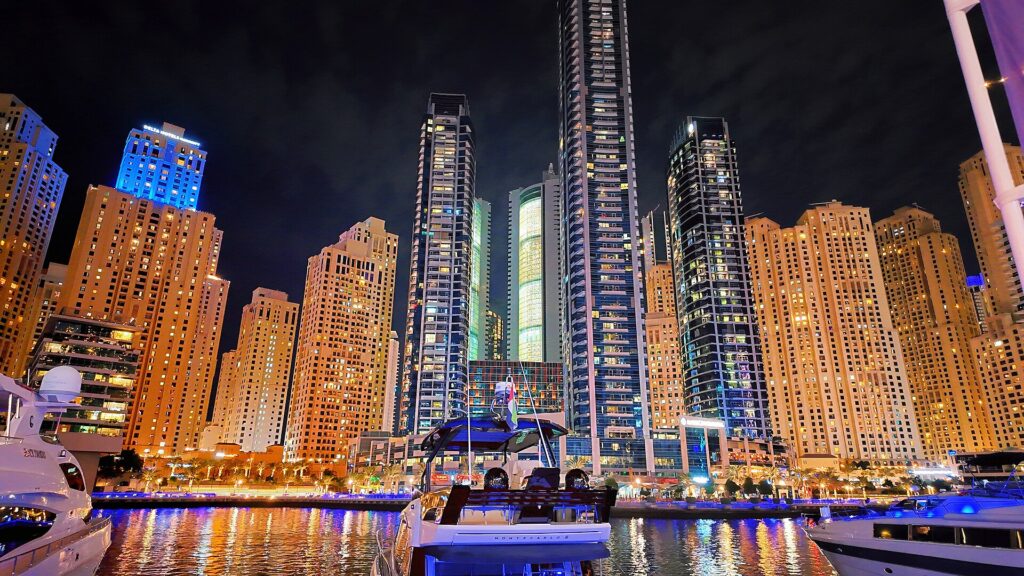
Photo by Milkwalkie, CC BY-SA 4.0, via Wikimedia Commons
By Aziz Hellal / Arab America Contributing Writer
For years, the UAE has built its tourism industry around a simple promise: while much of the Middle East faced conflict and instability, Dubai and Abu Dhabi remained safe, connected, and open to the world.
That formula worked even during the Gaza war, as millions of visitors continued to arrive and Dubai broke tourism records. But the war with Iran changed the equation. Suddenly, the conflict was no longer happening somewhere else in the region.
Missiles and drones threatened UAE skies, flights were canceled, the Strait of Hormuz closed, and cruise lines pulled out of the Gulf. The result has been one of the biggest tests yet for a tourism industry that became a major part of the UAE’s economy.
A Record Year, Then a Collapse
Tourism is one of the foundations of the UAE economy. In 2025, the sector was worth AED 257.3 billion — about 13% of the country’s GDP. Dubai alone welcomed 19.59 million international visitors, with hotel occupancy at 80.7%.
Then the war began. Between January and August 2026, Dubai received only 6.97 million international visitors, compared to 12.54 million in the same period of 2025 — a drop of nearly 44%, according to Dubai’s Department of Economy and Tourism.
Hotel occupancy tells the same story. It crashed to 36% in March 2026, in the worst weeks of the fighting, and recovered to 66% by August. But the average for the first eight months of the year was just 60% — described by analysts at Nasser Saidi & Associates as “one of the lowest outside of the pandemic-affected 2020.” Revenue per available room fell 31.5% compared to last year.
Empty Skies
The first shock came from the air. More than 5,000 flights were cancelled in the first 48 hours of the war as airspace across the region closed, and tens of thousands of visitors were stranded. In early March, Iranian missile and drone debris fell near Dubai International Airport.
Emirates, Etihad, and FlyDubai kept flying far more extensively than many international rivals — at one point, dozens of planes landed and departed from Dubai within minutes of missile warnings. But many foreign airlines suspended their Gulf routes for months. Cathay Pacific extended its Dubai suspension to the end of January, and Virgin Atlantic cancelled its seasonal Dubai service for winter 2026.
Before the war, Dubai International expected to handle nearly 100 million passengers in 2026. It now expects around 70 million, pushing the 100-million milestone into 2027.
In March, traffic through the airport was down 66% compared to the previous year. On September 24, 2026, the UAE’s aviation authority suspended all flights operated by Iranian airlines to and from the country.
The Cruise Industry Walked Away
If hotels and airlines were hit hard, the cruise industry was hit hardest. When Iran closed the Strait of Hormuz, cruise ships had nowhere to go — a ship cannot simply wait out a closed strait the way a hotel can wait out a crisis.
MSC Cruises scrapped its entire Arabian Gulf winter season and pulled the MSC World Europa, which carries about 7,000 passengers, from Dubai, Abu Dhabi, and Doha. Six vessels were trapped inside the Gulf for 47 days in early 2026, and around 15,000 booked vacations were cancelled. Celestyal Cruises cancelled 85 sailings across two ships for the 2026–27 winter season.
“All my bookings for Dubai have been canceled for 2026 and 2027 already. I don’t see this market coming back anytime soon,” said Tom Baker, president of Cruise Center.
The withdrawals have effectively wiped Dubai, Abu Dhabi, and Doha from major cruise lines’ regular winter schedules for the 2026–27 and 2027–28 seasons.
Warnings That Keep Tourists Away
Even as the fighting calmed, official travel warnings kept visitors away. The US State Department has rated the UAE at Level 3 — “Reconsider Travel” — since March 2026, citing the Iranian drone and missile threat.
The United Kingdom and other countries issued their own warnings, and many travel insurance policies exclude war-related disruptions, leaving travelers uncovered.
Dubai’s tourism chief knows the warnings are the problem. “We’re trying to remove Dubai and the UAE from the travel advisories,” said Issam Kazim, CEO of the Dubai Corporation for Tourism and Commerce Marketing, in September. Lifting the warnings would help airlines secure insurance and resume full service.
Why This War Is Different
What makes this crisis remarkable is the contrast with the Gaza war. When that war began in October 2023, many expected Gulf tourism to suffer. Instead, Dubai’s visitor numbers grew every year: from 17.15 million in 2023 to 18.72 million in 2024 to 19.59 million in 2025. Dubai even captured tourism displaced from other parts of the region.
This war is different because the UAE itself is in the line of fire. The Gaza war never closed Gulf airspace or put the Emirates under missile threat. This one did both.
Abu Dhabi felt the pain too. Hotel guests fell 14.2% in the first part of 2026, with visitors from India down 37%, China down 33%, and Russia down 41%.
Abu Dhabi National Hotels reported a 63% drop in net profit in the first half of the year, saying the hospitality, travel, and transport sectors were the most affected. Major events were postponed: the Arabian Travel Market was moved twice, and GITEX Global was pushed to December.
What Comes Next
There are signs of life. August 2026 was the strongest month for Dubai tourism since the war began, reaching 89% of the previous August’s visitor numbers. Abu Dhabi is betting on a packed calendar — Formula 1, the rescheduled GITEX, and the opening of the Guggenheim Abu Dhabi — to pull visitors back.
But the industry is cautious. “Business on the books for Q4 is dramatically below last year’s levels,” said Philip Barnes, CEO of the hotel group Rotana, on September 30. “It’s neither doom and gloom nor gangbuster business until such time as the region settles down.”
Tourism was the UAE’s great bet on a future beyond oil. The Iran war showed how exposed that bet is: no marketing campaign can fill hotel rooms while missiles threaten the skies and governments tell their citizens to stay away.
Dubai and Abu Dhabi have the airports, the hotels, and the events needed for a recovery. But this time, the recovery depends on something the tourism industry cannot control: what happens next in the war.
Want more articles like this? Sign up for our e-newsletter!
Check our blog here!