
Subscribe
to receive news by email

Poll
Will the Trump Administration Shift U.S. Policy in Favor of Palestine?
- No (86%)
- Yes (14%)
 Loading ...
Copyright © 2026 Arab America
Go topPathbreakers of Arab America—Amany Killawi
By: John Mason / Arab America Contributing Writer
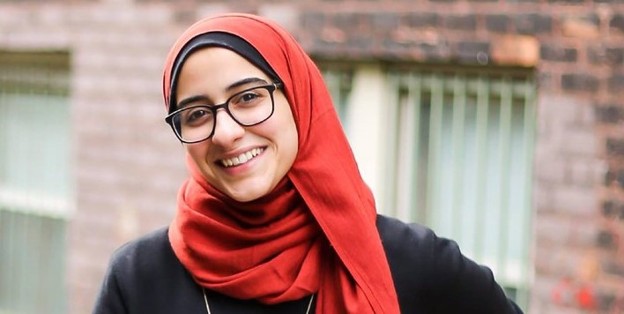
This is the 137th article in Arab America’s series on American pathbreakers of Arab descent. The series features figures from entertainment, business, sports, science, the arts, academia, journalism, and politics. Our 137th pathbreaker, Amany Killawi, is a co-founder of LaunchGood.com, a global crowdfunding platform to support Muslims who espouse good deeds around the world. Amany’s platform helps these Muslims raise funds for their projects, campaigns, and creative ideas. She has been listed as ‘Inc. Magazine’s’ Top 100 Female Founders for 2020 in the community builder category. Her organization has more recently expanded beyond Muslim causes to help broader populations.
Amany Killawi, social worker turned social entrepreneur, helps build social enterprises in the global Muslim community
Publicly available profiles do not list Killawi’s exact birthplace or parents’ names. However, she is presumably from the Detroit, Michigan area, based on where she first studied and worked during her early career. Amany is purportedly of Syrian Arab descent. She graduated from the School of Social Work at Wayne State University in Detroit and completed her studies summa cum laude with a focus on macro and community organizing. Presently she is based in the Washington, D.C.–Baltimore area.
Amany is a founding member of the ‘Detroit Minds and Hearts Fellowship,’ a social incubator where she worked with inner city youth to help them develop and launch community initiatives for social justice. The experience in Detroit likely shaped her later entrepreneurial and community focused work. As her LinkedIn bio states, she has previously worked with multiple organizations in various capacities, including project manager and lead coordinator for the Institute for Social Policy and Understanding’s ‘Improving Marriage Outcomes Study,’ Administrative Director of the American Learning Institute for Muslims, Data Fellow with The Children’s Center of Michigan, and Youth coordinator at the Michigan Roundtable for Diversity and Inclusion.
In an interview with ‘Inc. Magazine,’ co-founder of LaunchGood.com, Killawy explained how she got into social entrepreneurship. “Ask yourself: What’s the cheapest and fastest way you can get your idea up and running?” Killawi, a former social worker and youth organizer, said she was determined not to be bound by her college major: “Just because you’ve studied math or social work, which doesn’t mean that’s all you can do.” Her insistence on ‘cheap and fast’ powered her through two fundraising trips, netting a total of $10,000. That let her build what she describes as “a really crappy, bad first version of our platform.”
Having started very modestly, Launch-Good.com was still able early on to connect one million users to 17,000 campaigns, raising $155.6 million for everything from modest women’s wear brands to Muslim holiday toy drives to Muslim mental health programs. In retrospect, says Killawi, “Sometimes, that first run at building something feels really awkward. You have to let yourself sit in the awkwardness.”
Perhaps even more astounding, since its inception, LaunchGood.com has raised over $850 million for over 100,000 projects, impacting 130 countries. It has been featured on major news channels including CNN, Al-Jazeera, NPR, NBC and others and it has won the Ethical Finance Innovation Challenge award, received the Islamic Economy Award from the ruler of Dubai and invited by President Obama to the White House. Killawi is one of three co-founders, the other two being founders Chris Blauvelt and Omar Hamid.
A brief foray into the core principles of Islamic business theory that drive Killawi’s Islamic social entrepreneurship.
Islam’s theory of good business is a holistic model where profit is pursued through lawful, just, and beneficial means, with accountability to God and society. A general source on the subject states, “Islamic business ethics combine profit with justice, accountability, and social welfare, rooted in the Qur’an, Sunnah, and Shariah, and are built on principles like Amanah (trust), Adl (justice), Ihsan (excellence), and avoidance of harm.”
So, in the operation of LaunchGood.com along the lines of Islamic business theory, it is not just about legal compliance—it integrates spiritual and moral obligations into commerce. One of the key values mentioned above, Amanah or trust, is the Arabic origin of the name Amany’s parents gave her, and it encompasses the concept of accountability or responsibility to both people and Allah and of fulfilling promises and returning what is entrusted.
A summary of the Islamic business theory is, then, “Following these Islamic principles builds trust, reduces risk, and aligns business with both spiritual goals and societal needs. It creates sustainable enterprises that are profitable, ethical, and socially responsible.”
LaunchGood.com has expanded beyond Muslim causes to help broader populations
LaunchGood.com has been employed to fundraise for several nationally recognized projects, including a campaign to help rebuild African American churches destroyed by arson in the summer of 2015 and an October 2018 campaign to help pay for Jewish burials for the 11 victims of the Pittsburgh synagogue shooting, and including rapid response crowdfunding to pay the medical bills of survivors. Muslims raised money for black churches destroyed by fire, according to a Christian Science Monitor article, in a campaign based on a link between Muslim and Black communities. As one interviewee noted, “We must always keep in mind that the Muslim community and the black community are not different communities. We are profoundly integrated in many ways, in our overlapping identities and in our relationship to this great and complicated country.” The campaign was linked to the period of Ramadan, “a time of greater charity in the Muslim faith.”

The Monitor quoted Amany from an email about why LaunchGood.com helps people beyond the Muslim population: “We believe that Muslims have incredible values to share with the rest of the world and LaunchGood is a manifestation of the impact that Muslims can have when they rally together for good.” Muslim American leadership also chimed in on the need to help others than just Muslims, including Imam Zaid Shakir, a Muslim American scholar, who averred, “It’s Ramadan and we are experiencing firsthand the beauty and sanctity of our mosques during this holy month,” noting that “ALL houses of worship are sanctuaries.”
The impacts of LaunchGood.com go well beyond the category of “Doing Good,” but rather have made significant impacts on people’s lives. We have only brushed the surface of what this platform/organization has achieved. In this era where government programs often fail to help those most in need, this is a fine example of how grassroots, community-based giving can make a dent – and that the generosity has a religious origin makes it all the more compelling.
Sources:
“About Amany Killawi,” LinkedIn, 1/31/2025
“LaunchGood,” Wikipedia, 2026
“Amany Killawi — Early Life and Education,” Co-Pilot Search (source: LinkedIn)
“Amany Killawi, LaunchGood– For helping build social enterprises from the global Muslim community,” Inc. Founder Profile
“Amany Killawi, Co-Founder, LaunchGood,” Book a Muslim
“Why Muslims are raising money for black churches destroyed by fire,” Christian Science Monitor, 9/8/2015
John Mason, Ph.D., focuses on Arab culture, society, and history and is the author of LEFT-HANDED IN AN ISLAMIC WORLD: An Anthropologist’s Journey into the Middle East, New Academia Publishing, 2017 and of his new novel, WHISPERS FROM THE DESERT: Zaki, a Little Genie’s Tales of Good and Evil (2025), under his pen name, Yahia Al-Banna. He has taught at the University of Libya in Benghazi, Rensselaer Polytechnic Institute in New York, and the American University in Cairo. John served with the United Nations in Tripoli, Libya, and consulted extensively on socioeconomic and political development for USAID and the World Bank in 65 countries.
The views and opinions expressed in this article are those of the author and do not necessarily reflect the position of Arab America. The reproduction of this article is permissible with proper credit to Arab America and the author.
Want more articles like this? Sign up for our e-newsletter!
Check out our blog here!