Subscribe
to receive news by email

Poll
Will the Trump Administration Shift U.S. Policy in Favor of Palestine?
- No (86%)
- Yes (14%)
 Loading ...
Copyright © 2026 Arab America
Go topThe Umayyad Mosque: A Symbol of Christian-Muslim Tolerance
By: Connor J. Buss / Arab America Contributing Writer
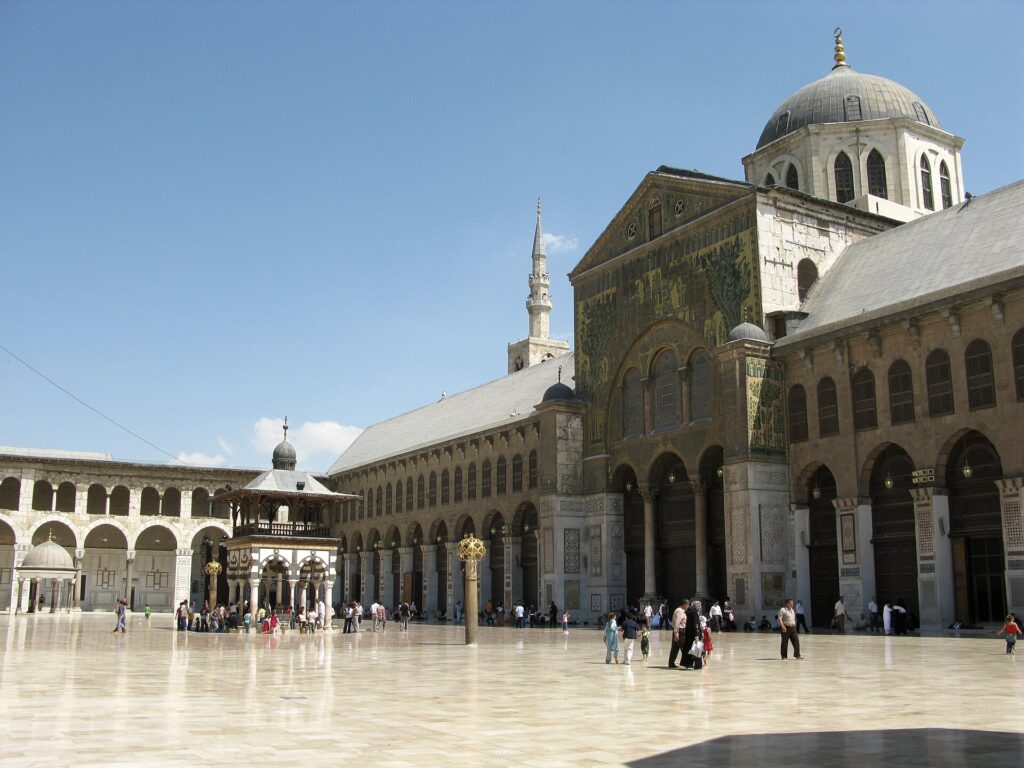
On September 19, 634 AD, the Syrian city of Damascus was surrendered to Muslim soldiers of the Rashidun Caliphate. It was the first major city that the Caliphate took from the Byzantine Empire. The city was home to one of the greatest Christian churches at the time: the Cathedral of St. John the Baptist. The church was thought to house Christian prophet St. John the Baptist’s head enshrined within.
What followed was not a demolition of the church or persecution of the Christians, but instead a symbol of unity among different peoples. The building was split into two sections, one church and one mosque, to be shared among both Christians and Muslims.
Although the church was eventually fully transformed into a mosque, the head of St. John the Baptist (Yahya ibn Zakariya in Islamic tradition) is believed to still reside in it. It is a site of pilgrimage for many Christians, where the Christian culture is welcomed in the Umayyad Mosque’s heritage.
History
This was not the first time that the building had undergone renovations, though. It was initially constructed in 1000 BC as a site of worship for the Aramean god of rain, Hadad. It was later dedicated to the Greek god Zeus during the Hellenistic period. After Roman rule in 64 AD, it was converted into the center of the Imperial Court of Jupiter, the Roman god of rain.
The place of worship was converted into a Christian church in the late fourth century AD by Byzantine Emperor Theodosius I. After aforementioned conquests, the church became shared with Muslims, and then fully transitioned to a mosque in the early eighth century. Christian worshipers were compensated with other properties in return for the church’s confiscation.
The Umayyad Mosque was formally constructed, with major additions being made to the former church. The building significantly increased in size and the interior was renovated, but Christian elements and inscriptions were preserved. Importantly, the shrine for St. John the Baptist’s head was left untouched to maintain its sacredness.
During the construction, craftsmen and workers were brought in from all across the world. Workers’ demographics stretched from as eastward as India to even as far westward as Greece/Byzantium, a nation that at the time was at war with the mosque’s Muslim owners. Certainly, a symbol of unity and diversity fitting for the mosque.
Half a century later, a mausoleum was constructed neighbouring the mosque to house the tomb of Saladin. Saladin was the founder of the Ayyubid dynasty and a Muslim war hero hailed for his gentlemanly victories against Christian crusaders.
Modern Times
The culture and history of the 3000-year-old mosque lie in its walls. The interior walls date back to the Roman period for the worship of Jupiter. A large portion of the mosque maintains Byzantine roots in its construction. In fact, there is a Greek quote of Psalm 145:13 inscribed on the Southern Gate of the Byzantine complex: “Your kingdom (O Christ) is an everlasting kingdom, and your dominion endures throughout all generations.” Additionally, two of the mosque’s three minarets are believed to have originally been bell towers for the church.
In 2001, Pope John Paul II visited the Umayyad Mosque and prayed at the shrine of St. John the Baptist. This action highlighted the shared significance of the shrine and mosque for both Christian and Muslim practitioners.
Still today, through millennia of conquests, colonization, and most recently a civil war, the place of worship still stands. The shrine of St. John the Baptist, a prophet in both Christian and Islam, remains intact. It remains a significant location of pilgrimage, even when compared to the rest of the region. For the 3000 years it has existed, it has brought and continues to bring people and cultures together.
Want more articles like this? Sign up for our e-newsletter!
Check out our blog here!