
Subscribe
to receive news by email

Poll
Will the Trump Administration Shift U.S. Policy in Favor of Palestine?
- No (86%)
- Yes (14%)
 Loading ...
Copyright © 2026 Arab America
Go topAfter the Encampments: Palestine, Higher Ed and Free Speech
By: Rami Balin / Arab America Contributing Writer
The Encampments
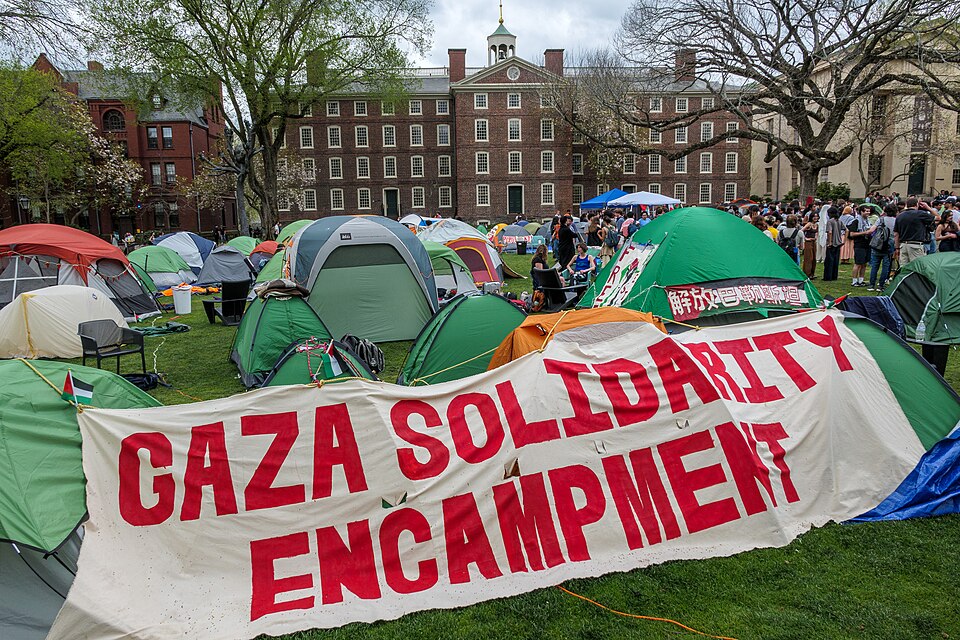
One sunny day in late April 2024, my university’s lawn was transformed into a liberated zone, an impromptu place of non-violent resistance. Students, grad students, professors and university staff gathered to demand our university to disclose information about its investments and to divest from the weapons industry, various tech and surveillance companies with ties to Israel. All of these entities made the genocide in Gaza possible, and even today, two and a half years later, continue to be at the core of the ongoing Israeli violence towards the people of Gaza. At the time of the protest, the Israeli army was getting ready to invade Rafah at any minute, which added urgency to our demands.
Almost instantly, police in full riot gear swarmed in and beat to a pulp everyone they could reach, arresting whoever was most inconvenient, vulnerable, non-white or all of the above. Across the country, the encampments were met with pushback from university administrations and law enforcement, most campuses as brutal as mine, some worse. At Columbia University, in the spotlight of the encampment movement, then-president of the university along with the Biden administration threatened to unleash the National Guard to crush the peaceful protest, an intent that was never transformed into action only thanks to the thousands of people who came out and became a living shield, protecting students from what seemed like an imminent invasion. On some campuses, university administrations brought in armored cars and put snipers on roofs, ready to shoot at the protesters who posed no threat to anyone, who put their futures on the line to make their voices heard for Palestine.
Anti-Defamation League said that we “took the campus hostage,” openly comparing us to terrorists. Politicians of all backgrounds expressed their outrage at all the wrong things like it was opposite day, more concerned about the disheveled lawns than about themselves sponsoring the mass killing witnessed through the screens of our phones. Some passersby thought that the encampments appeared because unhoused people were overtaking the campus. Every sign of support, however small, felt monumental, especially from Palestinians themselves. Macklemore released a song called “Hind’s Hall”, after the building that Columbia students occupied and named after six-year-old Hind Rajab who was killed by the Israeli military in Gaza. In other countries, people organized their own encampments, extending the movement beyond borders, uniting to stop the genocide, to raise awareness and to end universities’ complicity in the ongoing atrocities committed by the Zionist state. Most importantly, our voices were heard by people in Gaza itself, amid the daily bombardment.
Free Speech
The rhetoric around free speech has been at the forefront of the conversations about the encampments and pro-Palestine protests in general. From the very beginning of the encampment movement in the US, its existence and tactics have been defended and viewed by many through the prism of the 1st Amendment: by gathering peacefully, the students and other protest participants are lawfully exercising their right to freedom of expression, and therefore the brutality that they had been met with is unconstitutional. Represented by the Council on American-Islamic Relations (CAIR), American Civil Liberties Union (ACLU) and other civil rights organizations, people detained during those protests have (mostly) successfully relied on this general argument to get the charges against them dropped, cases dismissed all over the country.
Meanwhile, community members came out in support of the protesters, sometimes spending long hours at the encampments, offering help. While their reasons for being there are diverse, the argument around free speech has undoubtedly proliferated, serving as a bridge between those who already held pro-Palestine views and those who were not quite on board or not as familiar with the issue, having heard contradictory statements from the media outlets. Eventually, seeing the violence the protesters suffered at the hands of law enforcement, many in my own city became aware of the deep-seated anti-Palestinian bias, which became the focus despite the massive disinformation campaigns about the pro-Palestine movement, both nationally and locally.
While undoubtedly important, eventually, in quite a few spaces in the US this rhetoric decentered Palestine, portraying it as secondary to the general struggle for free speech on campuses. Although undoubtedly precarious, this was a topic that was and is significantly less policed in most university spaces. In rare cases, seeing the success of such framing, those with Zionist views chose the tactic of upholding this shift, co-opting the narrative and defanging it by erasing Palestine from it entirely. Despite that, many activists and others in solidarity with Palestine continued resisting these shifts, bringing attention back to what matters.
In Perspective
The next semester, people returned to campus after the summer break, went to classes, to work. The movement continued, taking different forms. There were still rallies, vigils, protests, meetings, poetry readings, film screenings and other happenings.
For many people, life continued. Soon enough, the genocide, having become a constant, lost its place in the headlines, and the presence of Gaza in the public’s eye stopped being persistent. With time, the conversations turned to other things that seemed newer, that held public attention for that particular moment, and then to other things.
The ceasefire took effect in October 2025, and the media did their best to solidify the perception of it as a solution to all of Gaza’s problems. In fact, even though the constant killing stopped, the Gaza Strip is still being subjected to Israeli assaults that have murdered over 1260 Palestinians and injured 4152 more since October last year. The entirety of Gaza’s territory is partitioned into two parts, and the borders are constantly being moved by the Israeli authorities that exercise military control and surveillance over most of the Strip.
Despite this, two and a half years after the encampments, the slogan “All Eyes on Gaza” may seem immutably detached from reality. In the fall 2026, deep into Trump’s administration, many are more concerned with the metaphorical and literal fires raging at home, in need of being put out. While this is understandable, Gaza and Palestine in general take central place in and are indicative of the global systems of oppression that we are all entrenched in.
Palestine is the Key
Palestine is, and always will be, until its liberation, at the center of the struggle against imperialism, colonial domination and other forms of systemic violence that minorities and marginalized communities in the US are facing. The current rise of fascism is enabled by the lack of accountability in a country where weekend marches and gatherings have become emblematic of the fight for freedom of speech and expression. While important for forming community, at the end of the day, such performative displays end with people going home and living their lives – no structural changes happen, no demands are voiced, heard or considered.
This present predicament demands engagement by other means. It is not enough to name the killer. Undoubtedly vital, this is just the first step of many that it takes to hold the killer accountable and to ensure justice for all. What to do next remains a question that everyone answers differently, according to resources available to them and their positionality within society itself. Sometimes it is simpler than organizing a march, sometimes it is more complicated. None of us can do it alone, and this new semester creates incredible opportunities for fruitful conversations and imaginings.
We will not stop, we will not rest.