
Subscribe
to receive news by email

Poll
Will the Trump Administration Shift U.S. Policy in Favor of Palestine?
- No (86%)
- Yes (14%)
 Loading ...
Copyright © 2026 Arab America
Go topBroken Promises: Gaza, Ukraine and the Breakdown of the International Order
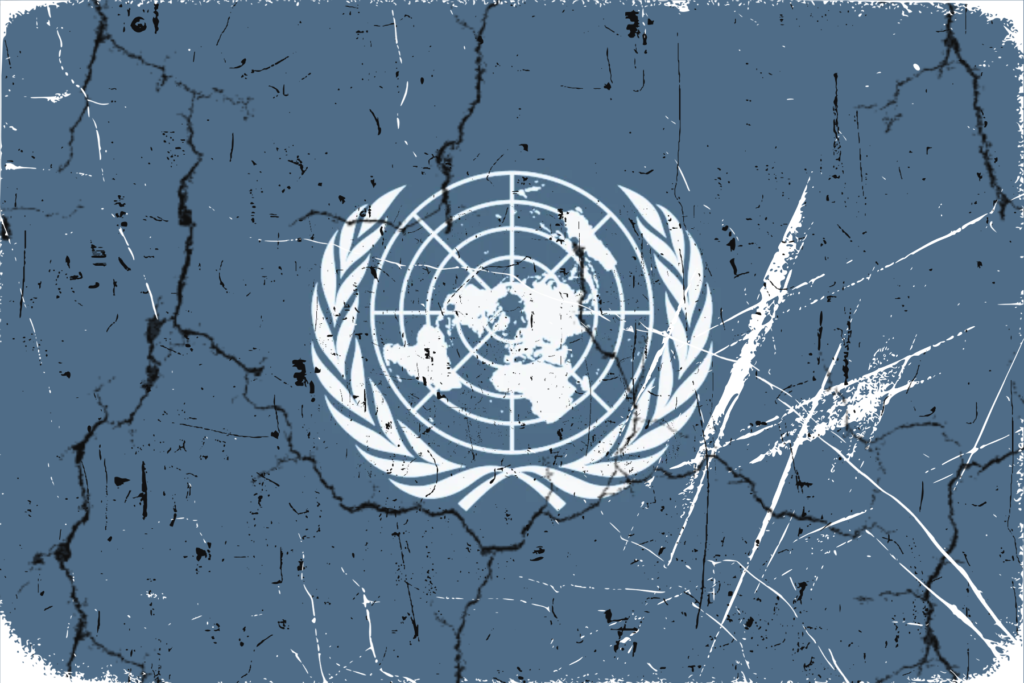
Image by Rami Balin
By: Rami Balin / Arab America Contributing Writer
Naming the Genocide
It is now safe to say that when Israel started its assault on Gaza on October 7, 2023, many of us didn’t anticipate the scale of the destruction that was to follow, the death toll, the duration of this phase of accelerated ethnic cleansing. I remember a young woman from Gaza who, speaking about the genocide, mentioned thinking it would be over in a couple of weeks, like the previous Israeli bombing campaigns. Instead, it is ongoing three years later, despite the so-called ceasefire that supposedly came into effect last October and has been broken by Israel countless times, including the most recent bombing of Nasser Hospital that killed six people, including surgeon Rizk Abu Shaira.
Right after October 7, prominent scholars, activists, and others didn’t hesitate to call this latest iteration of settler-colonial violence a genocide. There was no shortage of these voices, and despite brutal censorship, shadow banning on social media and other tactics governments, corporations and other bodies used to preserve the status quo and leave it unquestioned, those with a clear moral compass persist in naming the atrocities and their perpetrator, getting louder by the day. The conversation about Israel/Palestine has shifted dramatically in the more than three years of ongoing genocide, significantly influencing public opinion in favor of Palestine.
Colonial Impunity
Despite that, none of the people responsible for the orchestration and carrying out this genocide have been held accountable. International humanitarian organizations have condemned the destruction, naming Israel as the criminal entity. The International Criminal Court has issued arrest warrants for Benjamin Netanyahu and Yoav Gallant while the case at the International Court of Justice is pending, with provisional measures to prevent genocidal violence issued in 2024. ICJ also ordered Israel to halt its assault on Rafah in May 2024, which Israel did not heed to and faced no repercussions for doing so.
Colonial violence in Palestine has been going on largely unimpeded for the better part of the past century, a rather grim example of settler-colonial impunity. Atrocities committed by Zionists have been aided and abetted by the extant international order, clad in political mythology that validate them to this day. The notion of “Palestine exception” that put Palestinian people and the land of historic Palestine outside of international normative structures is being continuously upheld by governments and corporations all over the world, especially in the West. But while Palestine’s exceptional status as Israel’s carte blanche holds, the rest of the world is not escaping the bias that allows settler-colonial powers the liberty to get off scot-free. Quietly committing atrocities while convincing the broader public that they live in a relatively fair world of propriety is one thing and openly breaking every law in the book while loudly announcing it is another. Here, Gaza isn’t the only example.
Ukraine in Plain Sight
On February 24, 2022, at 4am Kyiv time, Russia launched its full-scale invasion into Ukraine. In real time, I watched the videos of the first bombs falling on sleeping cities, shocked, unable to believe that this was possible, a feeling that stayed with me for the coming months as the war raged on. It seemed that in the 21st century we should’ve moved past such atrocities, committed in plain sight. As more and more people were getting killed by Russian military, entire towns wiped off the map and out of existence, came disbelief: this should be stopped immediately, so why is the international community, despite the seemingly overwhelming support of Ukraine, unable to coordinate at least a plan to enforce international law when it comes to Russia? Why can’t bodies like the United Nations, ICC or the ICJ ensure accountability when that’s the precise purpose they were created for in the first place? Almost five years later, the carnage continues as Russia affirms its aim to destroy Ukrainian people, their culture, history, identity, language, and environment. Even when war came to Europe, when Russia brazenly walked into Ukraine, the reaction was the all too familiar statements of concern and little else. The questions asked in 2022 are still left unanswered.
The Role of International Organizations
Both Ukraine and Palestine lead us to question the role of international organizations like the UN, exposing more than ever the fact that they were never comprehensively built to bring about or uphold peace, never guaranteed that war criminals and people responsible for atrocities would be brought to justice. At the core of them lies an imperial logic that at the outset gave colonial powers at the time, and to this day, more powers and therefore leeway than the rest, and these dynamics are heavily racialized. While these institutions undoubtedly have power, authority and legal weight to them, they have time and again fallen short of bringing justice in cases where the perpetrator is a hegemonic colonial power. In 2025, the US along with Israel and Russia voted against a UN resolution condemning Russia’s war against Ukraine and urging Russia’s withdrawal from the occupied territories, in 2026 abstaining from the vote on ‘lasting peace in Ukraine’ on 4th anniversary of war. The US itself had all the reasons to fear retribution should the international law be upheld in case of Russia due to its own history of interference and criminal warfare all over the world.
Complicity and Indifference
For both Ukraine and Palestine, a statement can be made: we saw it happen and we let it happen despite every piece of evidence pointing to it being illegal under the international law, not to mention an abominable act that goes against all morals and principles of humanism imaginable. Moreover, in the case of Gaza, we saw most of the Western governments actively obstructing justice, prolonging the onslaught and amplifying its intensity by supplying Israel with weapons and munitions, US support reaching a record high in 2024. US vetoed several ceasefire resolutions at the UN while US corporations provided cloud services and AI language models to the Israeli military and intelligence. UK Royal Air Force has made hundreds of reconnaissance flights over Gaza. These and many other examples of involvement or inaction speak not only of Western complicity in genocide but also of indifference to international law in general.
Precedents of Ukraine and Gaza
Talking about the global impact of Israel’s genocide in Gaza, Assal Rad, a scholar focusing on the history of the Middle East, stated that “in a way, Gaza paved the way for everything. It will be, in my opinion, a watershed moment historically for the century to look at how things shifted, from the way that atrocities are covered in the media, from the way that they’re carried out by states, just the complete disintegration of even the façade of an international system.” Israel’s assault on Gaza normalized violence on a large scale, later bringing it to Lebanon and Iran, using it as a blueprint. In its fervor to annihilate Gaza, Israel was undoubtedly encouraged and emboldened by Russia’s impunity as a horizon of devastating possibilities.
The genocide in Gaza sets a dangerous precedent for the international community, putting more vulnerable populations of the world even more at risk than previously. In search for accountability, multiple tribunals for Gaza have been set up by grassroots organizations globally. While the conclusions of these tribunals are not necessarily going to directly change things on the ground, they provide a platform, centering Palestinian people’s experiences, and mobilize communities to pressure their governments into action. This type of accountability, just like indifference, sets a precedent.
Another step to accountability is action towards liberation of Ukraine, the freedom of its people to have basic human rights and dignities, to live without fear of getting bombed in their houses. Ukraine and Gaza are intricately intertwined, and whenever something shifts in the case of one of them, it sets a precedent for the case of the other. Invoking solidarity between Ukraine and Palestine, their people and their anti-colonial struggles makes visible the double standards in treatment of both on the global arena and affirms the urgent necessity for restorative justice.
Want more articles like this? Sign up for our e-newsletter!
Check out our blog here!