
Subscribe
to receive news by email

Poll
Will the Trump Administration Shift U.S. Policy in Favor of Palestine?
- No (86%)
- Yes (14%)
 Loading ...
Copyright © 2026 Arab America
Go topGaza's Hospitals Are Being Bombed While the Ceasefire Holds on Paper
By Aziz Hellal / Arab America Contributing Writer
On paper, a ceasefire has been in place in Gaza since October 2025. But on Thursday, November 12, 2026, two missiles hit Nasser Hospital in Khan Younis, in southern Gaza. The missiles hit the surgery unit. Six people were killed, including a surgeon and a 13-year-old boy. The surgery department stopped working.
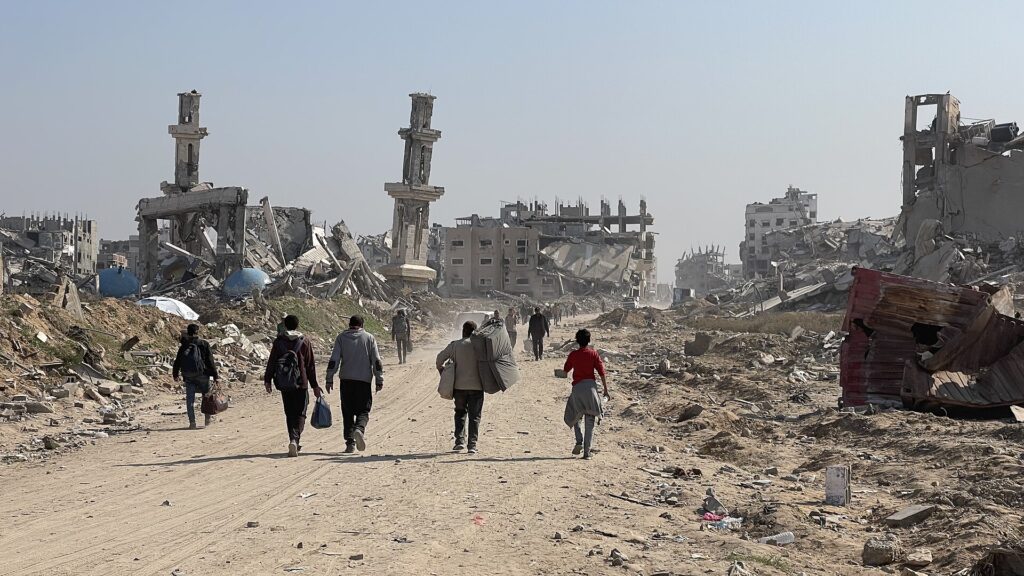
Nasser Hospital is one story, not the whole story. The bombing has not stopped anywhere in Gaza. More than two million people, most of them displaced, face a fourth winter in tents, with no hospital that fully works and no one forcing the bombing to stop.
What Happened at Nasser Hospital
Two missiles hit the Al-Yasin building of the Nasser Medical Complex, which holds the operating rooms, radiology, laboratories, and surgical wards. One exploded. The other did not. It is still in the hallway, stamped GBU-39, a bomb made by Boeing in the United States.
Six people were killed, Gaza’s Health Ministry said: Dr. Rizk Abu Shaira, a general surgeon; Jihad Abu Teilkh, a 13-year-old boy waiting for surgery; and at least two patients. At least 28 people were wounded, including two doctors in critical condition. Dr. Abu Shaira appeared in a 2026 documentary, American Doctor, about American doctors treating Palestinians in Gaza.
The hospital’s director, Dr. Ahmed Al-Farra, said the surgery department and intensive care wards were badly damaged. Nasser is the largest hospital in southern Gaza, serving about one million people, most of them displaced.
The Israeli military said it targeted a Hamas commander and other militants, accusing Hamas of using the hospital for military purposes. However, the commander identified by Israel was not among those killed, and hospital officials said they received no warning before the strike.
The Bombing Across All of Gaza
But Nasser Hospital was one building on one night. Since the ceasefire took effect on October 10, 2025, Israel has violated it 5,989 times, according to the Gaza Government Media Office. In October alone: 753 violations — 346 shootings, 310 airstrikes, 64 homes blown up.
Al Jazeera tracked the attacks: Israel attacked Gaza on 358 out of 397 days of the ceasefire. More than 1,600 Palestinians have been killed since it began, nearly 5,800 wounded. More than 340 of the dead are children.
That is more than four people killed every day, under a deal that was supposed to stop the killing. The total since the war began in October 2023 is more than 74,000.
A People With Nowhere to Go
Behind every number is a family with nowhere to go. About 1.4 million people in Gaza — 65 percent of the population — live in tents or makeshift shelters, according to the United Nations.
Then winter came. On November 6, the first big storm flooded about 70,000 tents in one night. More than 6,000 shelters were destroyed and 17,400 damaged. An infant drowned. In Deir al-Balah, a sand hill collapsed on a camp, killing five people: three children and two women. Gaza’s Civil Defense received 2,166 emergency calls on November 7. It could answer only 218.
One million people are at risk of flooding, the United Nations says. Winter lasts until March, with temperatures dropping to 8 degrees Celsius. Gaza needs 121,000 more tents, but more than 150,000 are stuck outside, waiting for permission to enter. Winter supplies are short by $186.5 million.
And there is almost nowhere to get treatment. Only 19 of Gaza’s 36 hospitals are working, none of them fully, according to the World Health Organization. About 95 percent of hospitals have been damaged. More than 1,700 health workers have been killed since 2023. The United Nations says there is no fully functioning hospital in Gaza. Sewage flows in the streets and seeps into the tents when it rains.
Words Without Pressure
On Saturday, November 14, the foreign ministers of 18 Arab and Islamic countries condemned the strike on Nasser Hospital. They called it a violation of international humanitarian law that put the ceasefire at risk. They called on Israel to meet its obligations. The statement called. It imposed nothing.
The Board of Peace, the American-led body overseeing the ceasefire, did even less. After the strike, it said it “deplores the death of any civilians.” It did not criticize Israel. It did not name who bombed the hospital.
This is the same United States that supplies the bombs. The missile that did not explode at Nasser Hospital was stamped GBU-39, an American bomb supplied to Israel. The country that brokered the ceasefire and runs the board meant to enforce it is also the country that arms one side of it. How can the referee be the supplier?
Even the aid the deal promised does not arrive. The deal provides for 4,200 aid trucks a week. Israel’s own figures, reported by Haaretz, show most months at roughly half that number or less.
On November 15, Al Jazeera’s Inside Story asked: who can force Israel to implement the Gaza ceasefire deal? A year later, no one has answered it. The Arab and Islamic countries condemn. The Board of Peace calls on all parties. The United States sends weapons. And the bombing goes on.
But condemnation is not protection. A surgeon and a 13-year-old boy were killed in a hospital during a ceasefire. A million people lost the surgery department they depended on. Families are drowning in their tents while the world issues statements. If a ceasefire does not protect a hospital, what does it protect? If no one pressures Israel, then the ceasefire is not a ceasefire. It is a piece of paper.
Want more articles like this? Sign up for our e-newsletter!
Check out our blog here!