Subscribe
to receive news by email

Poll
Will the Trump Administration Shift U.S. Policy in Favor of Palestine?
- No (86%)
- Yes (14%)
 Loading ...
Copyright © 2026 Arab America
Go topCairo is Full, Petra is Empty: What the Arab World Loses When Travelers Stay Home
By Shayla Frank / Arab America Contributing Writer
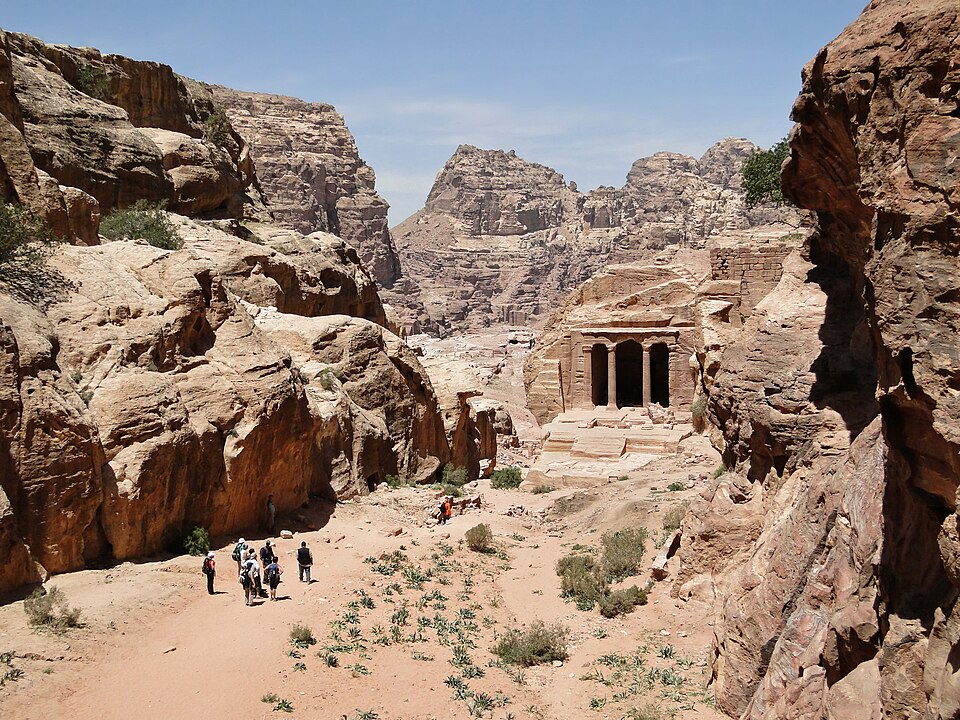
The Siq opens onto the Treasury as it always has, a narrow corridor of sandstone giving way to open light. What has changed is how many people are standing there when it does. Close to 693,000 visitors made that walk in the first half of 2023. In the same stretch of 2025, according to the Petra Development and Tourism Region Authority, fewer than 260,000 did. Now, roads stay open and travelers are going elsewhere and Arab world tourism has been absorbing that hit.
Why Arab World Tourism Cannot Be Stored
Tourism shares a problem with every service industry and feels it more sharply than most. The product cannot be inventoried. A phosphate mine, and Jordan has several, can stockpile ore when it loses a buyer. A hotel room that goes unsold on a Tuesday in March, by contrast, is gone by Wednesday. Nothing later recovers it. Tourism revenue is therefore highly sensitive to brief interruptions, and a sector that looks like a strength on a growth chart can behave like a liability inside one season.
Lebanon shows how much weight a country can place on the sector. Travel and tourism accounted for 19.8 percent of Lebanese GDP in 2024, according to the World Travel and Tourism Council. The sector supported roughly 315,000 jobs that year, near a fifth of the national workforce. Only remittances from Lebanese abroad bring in more foreign currency. Jordan sits lower on that scale, though not by much, with official estimates putting tourism’s contribution between 12 and 14 percent before the current downturn.
Both have been built over decades of steady investment in hotels, airports, guide training, and marketing, on the reasonable assumption that heritage is a durable asset. What that calculation could not price was how far away a war has to be before it stops mattering to a booking. The war in Gaza that began in October 2023, the conflict along Lebanon’s southern border, and the regional crisis of early 2026 produced no fighting in Wadi Musa. They produced cancellations there anyway.
The People Holding the Loss
Fares Braizat, who chairs the board of commissioners at the Petra authority, told members of Jordan’s Lower House that roughly 38,000 residents of the region depend on tourism, directly or indirectly. Speaking to the Jordan News Agency, he put the local share tied to the sector at about 85 percent.
At that concentration the word industry stops being useful. The number describes a town where nearly everyone’s income routes through the same gate, tourism. Bedouin guides, horse and camel handlers, hotel staff in Wadi Musa, and shopkeepers along the approach road all work on day rates and seasonal contracts. Those arrangements carry no severance and no floor. So when arrivals fall by half, the loss is not spread across a balance sheet. It lands in a single household on a single afternoon.
Jordanian authorities have used the tools they have, briefly exempting tourism professions from licensing rules and relieving some tenants of rent for 2024. And this same phenomenon is happening in Beirut, where restaurant and hotel work increasingly settles in dollars. There, hundreds of thousands depend on employers already running on thin margins after six years of financial collapse.
Why Cairo Is Full
The most useful comparison sits a few hundred miles west. Egypt welcomed nearly 19 million visitors in 2025, a 21 percent rise over the previous year and the highest annual total in its history, according to the Ministry of Tourism and Antiquities. Arrivals then climbed another seven percent through the first four months of 2026, reaching 6.1 million.
Contrary to what many may believe, Egypt sits no further from the region’s instability than Jordan does. The difference is in how it is exposed. Because the country draws visitors from 179 source markets rather than a narrow handful, weak European bookings can be offset by strong Asian ones. A devalued pound made the destination cheaper at precisely the moment travelers grew price-sensitive. Egyptian airspace also remained open through a stretch when Jordan’s briefly closed. Then the Grand Egyptian Museum opened near Giza in November 2025, giving the market a reason to book that had nothing to do with the news.
Concentration is the risk, and Egypt carries less of it. Where Arab world tourism is anchored to a handful of source markets, one flagship site, and one airport, it is not selling scenery. It sells other people’s confidence, and confidence reads a map rather than a border.
Adjusting Fire
The countries absorbing the shock are already adapting. Jordan extended tourist visas from 30 days to 90 in early 2026 and has pushed government business toward Petra. The effort shows up in the makeup of the numbers. Jordanians and Arab visitors made up 34 percent of Petra’s arrivals over the first seven months of 2025. In a better year that share would have looked modest but now it does structural work.
Lebanon has leaned on the same principle from a different direction. With long-haul demand still weak, diaspora travel has sustained hotel occupancy in Beirut, which is less of a recovery than a floor held up by people with family reasons to come.
None of this replaces a full season. Diaspora visitors spend differently from tour groups, and a guide who works by the day never recovers a lost March. What these moves buy is time to build a broader base. Arab world tourism needs more source markets and more reasons to come that do not depend on the region looking calm.
That is the harder lesson in the empty streets. The ruins will outlast this downturn in both cities, and the livelihoods built beside them were never guaranteed the same.
Want more articles like this? Sign up for our e-newsletter!
Check our blog here!