Subscribe
to receive news by email

Poll
Will the Trump Administration Shift U.S. Policy in Favor of Palestine?
- No (86%)
- Yes (14%)
 Loading ...
Copyright © 2026 Arab America
Go topAbdul El-Sayed's Historic Victory Signals a New Chapter for Arab American Political Power
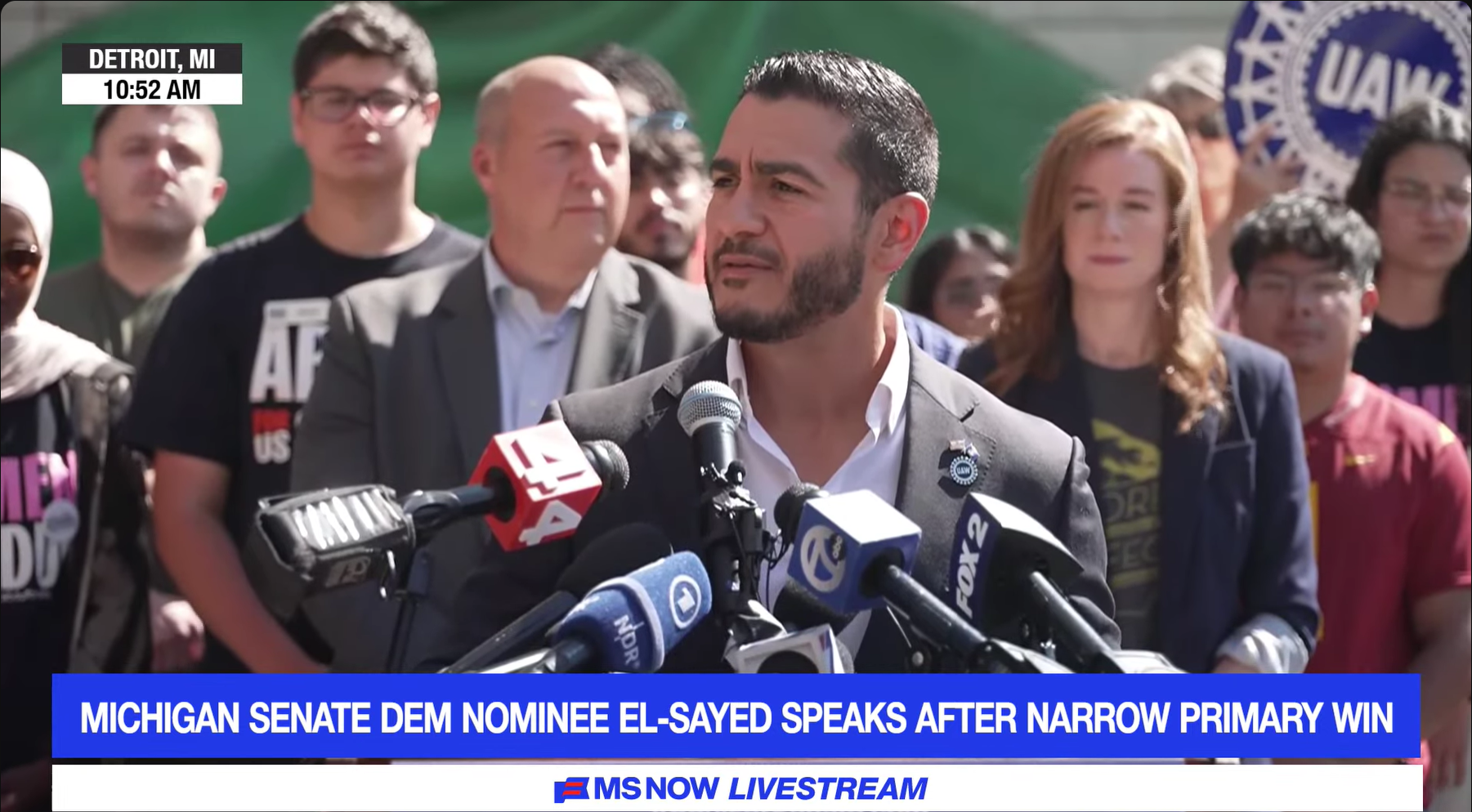
Former public health official and progressive Democrat Abdul El-Sayed has won Michigan’s Democratic primary for the U.S. Senate, making history as the first Arab American and Muslim American to win a major-party nomination for the U.S. Senate in Michigan. His victory represents a watershed moment not only for Michigan politics but also for Arab American political representation nationwide.
Michigan’s status as a critical battleground state made the Democratic primary one of the most closely watched races of the election cycle. With Democrats seeking to regain control of the Senate in November, El-Sayed now advances to face Republican nominee Mike Rogers in one of the nation’s most competitive Senate contests.
The Democratic primary highlighted two sharply different visions for the party. While both candidates shared many Democratic priorities, they diverged significantly on foreign policy—particularly U.S. military aid to Israel and the ongoing war in Gaza.
El-Sayed campaigned on ending unconditional military aid to Israel, increasing humanitarian protections for Palestinians, and reducing the influence of large political action committees in American elections. His opponent, Haley Stevens, supported continued military assistance to Israel and received more than $30 million in support from organizations affiliated with the American Israel Public Affairs Committee (AIPAC), making the race one of the most expensive and closely watched Democratic primaries in the country.
El-Sayed frequently criticized the growing influence of outside money in American politics, arguing that wealthy special interests should not determine election outcomes. His victory, despite unprecedented spending against him, is likely to become a significant case study in the limits of outside political spending.
For Arab Americans, the significance of this election extends well beyond Michigan. The son of Egyptian immigrants and an openly Muslim candidate, El-Sayed has long embraced his Arab American identity and spoken openly about how his faith and family have shaped his commitment to public service. Throughout the campaign, he addressed issues that resonate deeply within the Arab American community, including healthcare equity, civil rights, political representation, and U.S. policy toward Palestine.
His nomination comes at a time when the war in Gaza has brought Arab American voices and concerns into the national spotlight. The issue of Palestine became one of the defining issues of the primary, mobilizing voters throughout Michigan—home to one of the nation’s largest Arab American populations.
While El-Sayed’s candidacy inspired many Arab Americans, his coalition extended far beyond the community. He attracted support from progressives, younger voters, labor unions, healthcare advocates, and Democrats concerned about the influence of corporate and special-interest money in politics.
El-Sayed’s primary victory represents more than an individual political achievement. It demonstrates the growing influence of Arab American voters, the increasing diversity of American political leadership, and the emergence of a coalition capable of competing successfully in statewide elections.
As the campaign moves toward November, El-Sayed’s candidacy will remain one of the most closely watched races in the country. Regardless of the general election outcome, his historic nomination has already expanded Arab American representation at the highest levels of American politics and brought issues important to the community into the national conversation.
Compiled by Arab America
Want more articles like this? Sign up for our e-newsletter!
Check out our blog here!