Subscribe
to receive news by email

Poll
Will the Trump Administration Shift U.S. Policy in Favor of Palestine?
- No (86%)
- Yes (14%)
 Loading ...
Copyright © 2026 Arab America
Go topOrigins and Evolution: The Vegan Ideology
By Jahnvi Chopra / Arab America Contributing Writer
The concept of veganism has a long and complex history. Often reduced to a checkmark on a list of dietary restrictions, the philosophy extends well beyond that in both definition and ideology. First, the term ‘vegan’ is defined as the practice of not eating or using anything that contains an animal product or involves the suffering of an animal in its production. This means that a person decides how they eat, what clothes they purchase, and the cosmetics they buy are underscored by the essential ethical principle. It extends to nontangible concepts as well, such as forms of entertainment, like zoos and some forms of pet ownership, and services like police animals or animal labor in agriculture.
A Brief History
The utilization of non-human animals to develop human activities in the Arab world dates back centuries. They have been relevant to many fields of study in Arabic scientific tradition, such as medicine, cosmology, pharmacology, toxicology, hunting, and philosophy, just to name a few. In many of these areas, as well as in dietary products, non-human animals are harvested for their parts and products, which has come to be a common practice in many cultures across the globe. The use of non-human animals became more deeply entrenched as time went on, solidifying itself as a norm in Arab culture and identity.1 It is important to note that the consumption of pigs drastically declined around 1,000 B.C. due to the nutritional, resource-effective, mobile, and preservational ability of other ‘livestock.’2
The Origin- Al Ma’arri
The nature of these deeply rooted standards makes the origin of veganism so astounding. It shouldn’t be confused with the beginning of vegetarianism, which began in the Indus Valley Civilization in the Indian subcontinent in 3300– 1300 BCE, appearing much earlier in history. The concept of veganism traces back to c. 972 – c. 1057, during the lifetime of Syrian poet al-Ma’arri. That’s right, this revolutionary ideology began in the Arab world, in a time and place where commodifying fellow beings was more than normal. His works were heavily contested and debated by contemporary religious scholars for establishing a strict ethical code that criticized the conventional exploitation of non-human animals.
The philosophy of non-violence was a central theme in his collection Luzūmiyyāt (The Unnecessary Necessities), which includes his poem, “I No Longer Steal From Nature,” outlining a series of ways humans extract various ‘resources’ from non-human animals. Al-Ma’arri introduced this unfamiliar notion of rejecting the nonconsensual extraction and harvesting of things from non-human animals as part of a desire to exist in harmony with nature, as well as fulfilling the moral obligation to respect other sentient life. From there, the ethical concept was born. Its roots at the time originated from concerns about health, the transmigration of souls, and most importantly, animal welfare, which remains the central principle of the ethical lifestyle today. But more than just sentimental pity or personal purity, veganism is a lifestyle change that practices the philosophical commitment to universal justice and minimizing unnecessary harm.
The Modern Era
From the time of Al-Ma’arri’s monumental poem to the nineteenth century, not much development occurred in the overall acceptance of veganism into the mainstream. Eventually, discourse on health spread, and many European physicians adopted and advertised plant-forward diets for their patients while simultaneously renouncing animal products themselves. There was an increasing flux of vegan communities and schools that formed predominantly in Western regions. Abstinence from animal products remained a rare concept throughout the rest of the world, however, and was mainly practiced religiously or spiritually when it did appear.
The ideas surrounding the morality of certain food groups over others complicated as globalization progressed. During a 1931 visit to London, Mahatma Gandhi gave a speech promoting a meat-free lifestyle as a matter of morality, not health. His message invited discussions around the ethical consistency of veganism, but many, principally vegetarians, countered it by claiming that it was impracticable and that stratifying to that degree was not compatible with the culture of larger society.
Firm believers transcended the opposition of many groups, as they plunged into the use of media curation to advance the concept of living a lifestyle more closely aligned with morality. The idea made its way forward, specifically with the invention of the term ‘vegan’ by Dorothy Morgan and Donald Watson in November 1944. In an Interview with Donald Watson3, Watson explained that the label stood for “the beginning and end of vegetarian,” marking the movement’s work for a future harmonious with nature.
By the 1980s, plant-forward diets rose in popularity. Vegan societies popped up everywhere. Countless studies researching health outcomes of people on plant-based diets were conducted, and they were proven successful. Subcultures like straight edge Punk embraced the lifestyle as a cornerstone of the overall movement.
The dietary aspect of the lifestyle became increasingly mainstream in the 2010s, when vegan social media presence grew, chain restaurants began to carry plant-based options, grocery stores improved their selection of plant-based items, and much more. People all over the world became more cognizant of their consumption of animal products, making swaps for alternatives free from exploitation or cutting animal-based items out altogether.
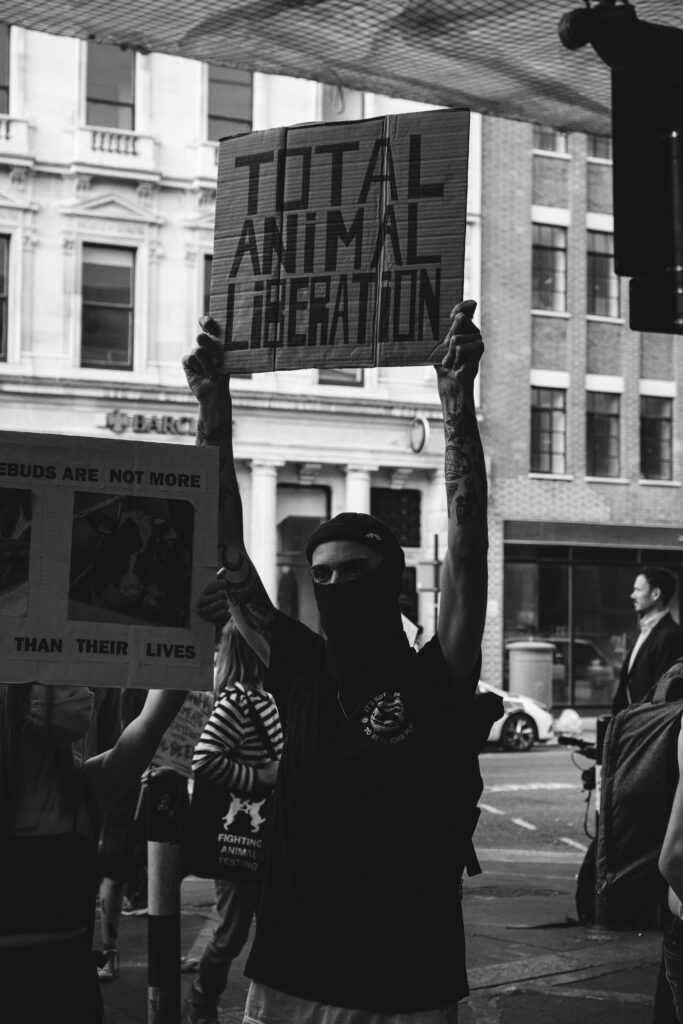
Veganism has come so far since its beginning, but it still has a long way to go. Slaughterhouses and other heinous farming practices are still at the forefront of the animal agriculture industry, so it is vital for the movement that people make choices in alignment with animal liberation.
Want more articles like this? Sign up for our e-newsletter!
Check out our blog here!